Chest Tube Drainage Systems: Tidaling vs. Bubbling Explained
Why the Chest Tube Drainage System Shows Up So Often on Nursing Exams
Few pieces of equipment make nursing students as nervous as a chest tube drainage system. It has chambers, water levels, suction settings, and tubing running from the patient's chest to the floor, and every part tells you something about how the patient is doing. The two findings that confuse students most are tidaling and bubbling. Once you understand tidaling vs bubbling, most chest tube NCLEX questions become far more predictable, because the exam keeps testing the same core idea: is this finding expected, or does it signal a problem that needs action?
A chest tube removes air, fluid, or blood from the pleural space so the lung can re-expand. Normally, the pleural space holds negative pressure that keeps the lung inflated against the chest wall. When air enters (pneumothorax), blood collects (hemothorax), or fluid builds up (pleural effusion or empyema), that negative pressure is lost and the lung collapses partially or fully. Chest tubes are also placed after thoracic and cardiac surgery, which is why you will see them on the med-surg floor and in postoperative units. If you are heading into that rotation, our guide on what to know before taking med-surg nursing covers the other equipment you will meet there, and our review of perioperative nursing concepts explains how chest tubes fit into postoperative care.
On the exam, chest tube items are almost always framed as safety or prioritization questions. You are rarely asked to name a chamber for its own sake. Instead, you are given a finding and asked what the nurse should do first.
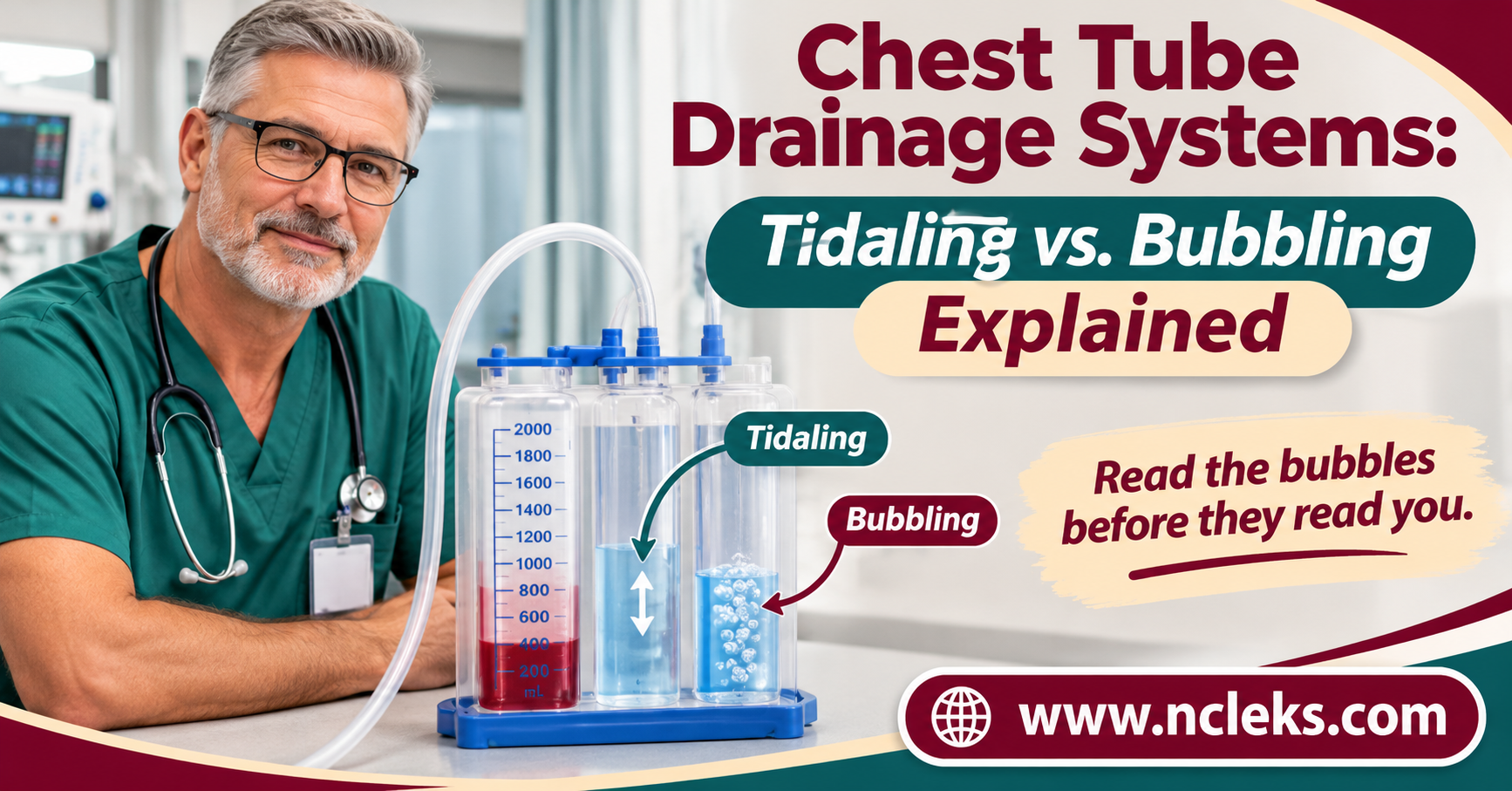
The Three Chambers of a Chest Tube Drainage System
Most modern units are disposable three-chamber systems, and each chamber has a single job. Knowing those jobs is the foundation for everything else in this article.
The collection chamber sits closest to the patient and receives drainage from the pleural space. You mark the drainage level on the outside of the chamber at set intervals, usually every shift or hourly in the early postoperative period, and note the color and consistency. Drainage that changes from serosanguineous to bright red, or that exceeds roughly 100 mL per hour, should be reported to the provider promptly because it may signal active bleeding.
The water seal chamber is the heart of the chest tube drainage system. It contains about 2 cm of sterile water that acts as a one-way valve: air can bubble out of the pleural space through the water, but atmospheric air cannot travel back into the chest. This is the chamber where both tidaling and bubbling are evaluated, so it deserves most of your attention during assessment.
The suction control chamber regulates how much negative pressure is applied. In a wet suction system, the height of the water column (commonly 20 cm) sets the suction level, not the dial on the wall. In a dry suction system, a regulator dial sets the pressure and a float or bellows indicator confirms suction is working. Either way, the whole unit must stay upright and below the level of the chest so drainage flows by gravity and nothing siphons back into the pleural space. Checking these chambers should be a routine part of your head-to-toe nursing assessment whenever your patient has a chest tube.

Tidaling: The Normal Rise and Fall in the Water Seal
Tidaling is the gentle up-and-down movement of the water level in the water seal chamber that follows the patient's breathing. It happens because pressure in the pleural space changes with each breath, and the water seal reflects those changes. In a patient breathing on their own, the water level rises during inspiration, when intrathoracic pressure becomes more negative, and falls during expiration. In a patient on positive pressure mechanical ventilation, the pattern reverses, so the level falls on inspiration and rises on expiration. That reversal is a favorite detail on chest tube NCLEX items, so commit it to memory.
Tidaling is an expected finding. It tells you the tube is patent and communicating with the pleural space. The more interesting question is what it means when tidaling stops. There are two very different explanations, and the exam wants you to tell them apart. The first is good news: the lung has fully re-expanded, the pleural space has closed around the tube, and there is no longer pressure change for the water seal to reflect. This usually happens after several days and is confirmed by chest x-ray. The second is a problem: the tubing is obstructed by a kink, a clot, the patient lying on it, or a dependent loop of tubing filled with fluid.
Because you cannot assume the good explanation, your first move when tidaling disappears is to assess the tubing from the insertion site to the drainage unit. Straighten kinks, reposition the patient, and coil excess tubing flat on the bed. This airway-first, obstruction-first reasoning mirrors the approach in our article on ABCs vs Maslow in NCLEX priority questions.
Bubbling: When It Is Expected and When It Means a Leak
Bubbling is where most students get tangled up, because whether it is normal depends entirely on which chamber you are looking at and what kind of bubbling you see. Keep the chambers separate in your mind and the tidaling vs bubbling distinction becomes much clearer.
In the water seal chamber, intermittent bubbling is expected for a patient with a pneumothorax. As air leaves the pleural space, it escapes through the water seal, especially during exhalation, coughing, or sneezing, when intrathoracic pressure rises. This bubbling should decrease over time as the lung heals and re-expands. What is not expected is continuous bubbling in the water seal chamber. Constant bubbling, even between breaths, signals an air leak, either somewhere in the system (a loose connection, a crack in the tubing, a dislodged tube) or at the patient level from a large bronchopleural fistula. A continuous leak needs to be found and reported.
In a wet suction control chamber, the rules flip. Gentle, continuous bubbling is exactly what you want to see, because it shows suction is being applied. If there is no bubbling in the wet suction chamber, check that the wall suction is on and connected. Vigorous bubbling is not more effective; it only evaporates the water faster and adds noise, so the suction source should be turned down until the bubbling is gentle. Dry suction systems have no bubbling in this chamber, so you confirm function with the visual indicator instead.
Deciding which finding represents a deteriorating patient is the same skill tested in our guide to stable vs unstable patients on NCLEX.

Tidaling vs Bubbling: How to Troubleshoot at the Bedside
Putting tidaling vs bubbling side by side helps you build a simple mental model. Tidaling tells you whether the tube is open and connected to the pleural space. Bubbling in the water seal tells you whether air is leaving the patient or entering the system. Expected findings are gentle tidaling, intermittent water seal bubbling with a known pneumothorax, and gentle suction chamber bubbling in a wet system. Concerning findings are absent tidaling with a lung that should not yet be re-expanded, continuous water seal bubbling, and a sudden change in drainage amount or color.
When you find continuous bubbling, start at the patient. Look at the insertion site dressing, listen for air sucking at the site, and check every connection down the tubing to the chest tube drainage system. Many facilities allow brief, momentary clamping per policy or provider order to locate the leak, moving the clamp from the chest wall toward the drainage unit. If bubbling stops when the clamp is placed closest to the chest, the leak is at the insertion site or inside the patient, and the provider must be notified. If it continues past a certain point, the leak is in the tubing or the unit, which may need replacing.
Never leave a chest tube clamped for an extended period. Trapped air cannot escape, and pressure can build into a tension pneumothorax. Also avoid stripping or milking the tubing unless specifically ordered, since it generates high negative pressure that can damage tissue. When you report findings, organize them clearly using the format in our article on how to give an SBAR report.

Chest Tube Emergencies and Priority Nursing Actions
The highest-stakes chest tube NCLEX questions involve emergencies, and these answers are worth memorizing exactly because there is little room for interpretation.
If the tubing disconnects from the drainage unit, the priority is to restore the one-way seal. Immerse the end of the chest tube about 2 cm (1 inch) in a bottle of sterile water or saline, which recreates a temporary water seal, then obtain a new drainage system and notify the provider. This is why a bottle of sterile water is kept at the bedside. Clamping the tube is generally not the best answer, because it risks tension pneumothorax if air continues leaking into the pleural space.
If the chest tube is pulled out of the patient, immediately cover the insertion site with a sterile occlusive dressing, such as petroleum gauze, taped on three sides. The untaped side lets air escape during exhalation while blocking air from entering during inhalation. Stay with the patient, assess respiratory status, and call the provider. If the drainage unit tips over, set it upright, check the water seal level, and assess the patient for respiratory distress.
Watch for signs of tension pneumothorax in any patient with a chest tube: sudden dyspnea, tracheal deviation toward the unaffected side, absent breath sounds on the affected side, hypotension, tachycardia, and distended neck veins. These findings demand immediate escalation. For more practice with this kind of reasoning, see our guides on what immediate action means on NCLEX and how to answer risk-based NCLEX questions.

How to Study for Chest Tube NCLEX Questions
The fastest way to master chest tube NCLEX content is to stop memorizing isolated facts and start asking two questions every time you read a scenario. First, which chamber is being described? Second, is this finding expected for this patient's condition and stage of recovery? A patient two hours after insertion for a pneumothorax should have intermittent bubbling and tidaling. A patient on day five whose x-ray shows re-expansion may have neither, and that is fine. The same finding can be normal or alarming depending on context, which is exactly why tidaling vs bubbling questions reward clinical judgment over rote recall.
Pay close attention to wording such as first, best, and priority. When a question offers several reasonable actions, the correct answer usually protects the airway or the closed system before anything else. Our article on first vs best on NCLEX questions breaks down this distinction in detail. Delegation is also tested here: an unlicensed assistive personnel can help reposition the patient and report concerns, but assessing the chest tube drainage system and troubleshooting leaks belong to the nurse. Our guide on delegation rules for LPNs and UAPs walks through those boundaries.
Finally, draw the three chambers from memory and label what tidaling and bubbling should look like in each. Then test yourself with practice questions like the ones below until the decision process feels automatic.





No comments yet. Be the first to comment!