How Do You Perform a Head-to-Toe Assessment in Nursing?
A head to toe assessment might sound like a long checklist, but it’s actually one of the most exciting skills nurses learn. It’s like being a health detective, carefully observing clues on a patient to understand what’s happening inside the body. Whether you’re a student preparing for clinicals or a practising nurse, mastering nursing concepts helps you sharpen your clinical instincts and build confidence. Let’s start by defining what head to toe assessment in nursing is.
What is a head-to-toe assessment?
A head to toe assessment is a comprehensive physical examination that allows nurses to evaluate a patient’s overall health status from the top of the head to the tips of the toes. It’s one of the most essential clinical skills that you’ll learn for your first nursing school exam because it helps identify abnormalities, monitor changes in condition and guide in decision-making.
Think of head to toe physical assessment as a structured way to gather critical health information. Instead of checking random body parts, nurses follow a systematic sequence that ensures nothing is missed. This structured approach also helps maintain consistency in patient care, makes documentation easy and improves communication among healthcare teams. Registered nurses (RNs) perform the assessment on patients during admission or annual check-ups. Nursing students learn and practice the assessment before completing their training, but it can be a challenging class.
A complete head to toe assessment involves observing, touching, listening and sometimes tapping specific areas of the body to evaluate them. You will need a nursing head to toe assessment checklist to ensure they perform each step correctly until the process becomes second nature. Aside from gathering data, the process allows nurses to establish rapport with patients, identify early warning signs of illness and determine whether urgent intervention is needed.
Equipment to have on hand for the assessment
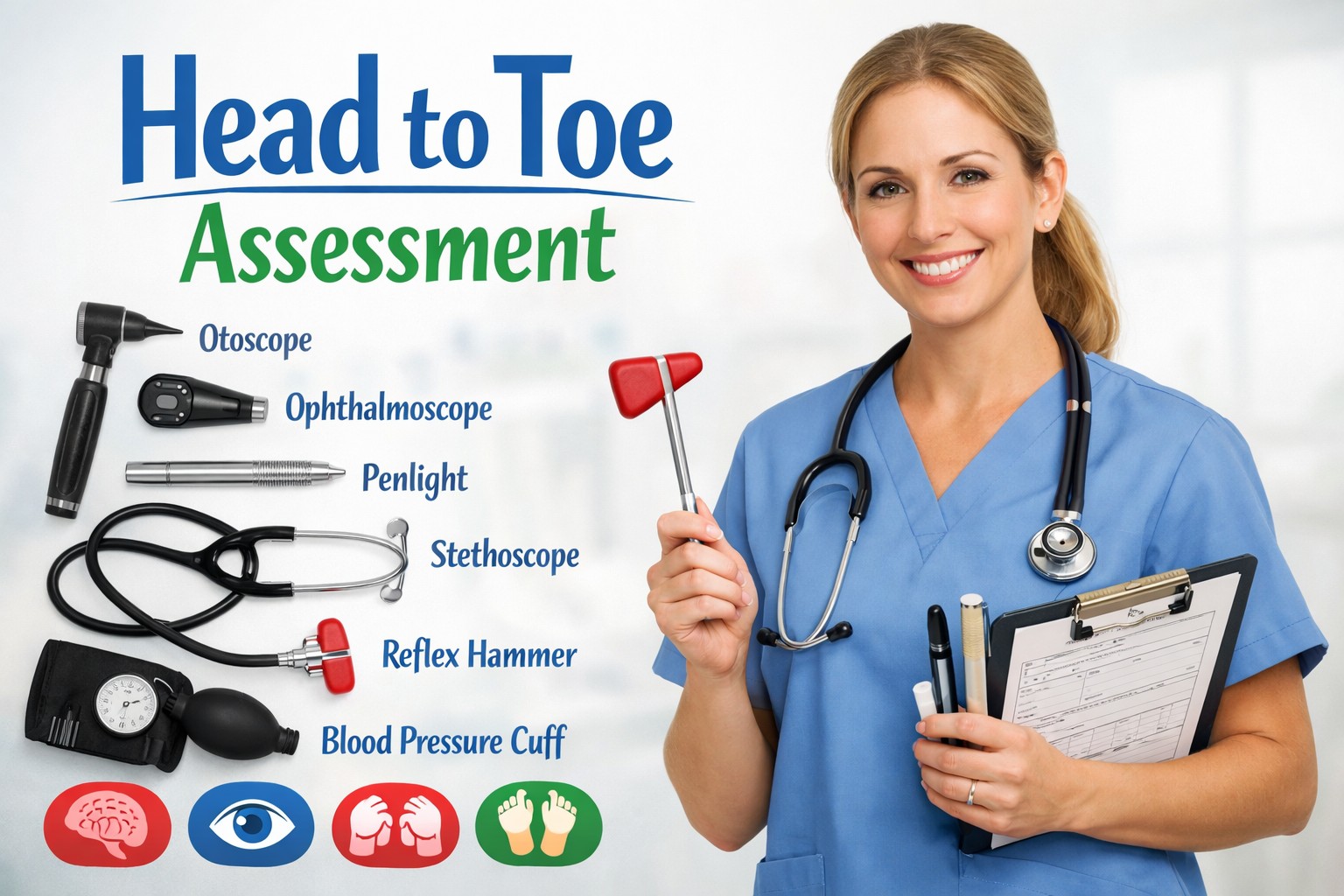
Before you carry out any assessment, it’s important to ensure that all necessary equipment is available and functioning properly. Having the right tools nearby prevents interruptions that could affect patient comfort and the accuracy of the findings. Some of the equipment you’ll need includes:
- Stethoscope
- Blood pressure cuffs
- Gloves
- Thermometer
- Alcohol swabs
- Penlight etc.
Techniques used for examination for head-to-toe assessment
Performing a successful assessment requires mastering four core examination techniques: inspection, palpation, percussion and auscultation. These methods form the foundation of physical examination skills and allow nurses to gather detailed information about a patient’s condition.
Inspection is the first technique used in almost every head to toe assessment. It involves carefully observing the patient for visible signs of abnormalities. Nurses look at skin color, posture, movement, facial expressions and symmetry. For example, pale skin or labored breathing during inspection signals an underlying health issue that requires immediate attention.
Palpation involves using the hands to feel different parts of the body. During a head to toe physical assessment, nurses palpate areas to assess temperature, texture, tenderness, and swelling. This technique is particularly useful when examining lymph nodes, the abdomen, or extremities. Proper hand hygiene and gentle pressure are essential to ensure patient comfort and accurate findings.
Percussion is a technique in which the nurse taps specific areas of the body to produce sounds that indicate underlying structures. It is commonly used during abdominal and respiratory assessments as part of the head to toe assessment. Different sounds can suggest fluid buildup, air pockets, or dense tissue, helping nurses interpret the patient’s condition.
Auscultation involves listening to internal body sounds using a stethoscope. During a head to toe assessment, nurses listen to heartbeats, lung sounds, and bowel movements. Recognizing normal and abnormal sounds is a skill developed through practice and experience. If you’re a nursing student, use a nursing head to toe assessment checklist to ensure you remember when and where to apply each technique.
How to perform a head to toe assessment
Every hospital visit begins with patient identification using name and date of birth to ensure that the correct patient receives the care. Comfort is equally important. You need to adjust the bed height, provide privacy curtains and explain the procedure to reduce anxiety. Patients who understand the purpose of the assessment are more likely to cooperate and provide accurate information. Establishing trust at this stage sets the tone for the rest of the examination.
Initial assessment
The initial stage of the head to toe assessment focuses on general observations. Nurses evaluate the patient’s level of consciousness, posture and orientation. These observations provide immediate clues about the patient’s health status. During this stage, the nurse may also assess airway patency and breathing patterns. Observing whether the patient speaks clearly or appears distressed can reveal urgent concerns. This early overview is an essential part of any head to toe physical assessment because it helps identify priorities before moving into detailed examinations.
Vital signs
As a nurse, you need to take the patient's vital signs. These measurements include temperature, pulse, respiration rate, blood pressure, and oxygen saturation. Each vital sign provides critical information about the body’s basic functions. For instance, an elevated temperature may indicate infection, while abnormal blood pressure could signal cardiovascular issues. Recording accurate vital signs during the initial assessment allows nurses to detect illness and respond to changes in patient condition.
Hair/skin/nails
As a nurse, you examine skin color, moisture and temperature. You also look for rashes, wounds, bruises and signs of infection. Hair and scalp infection help you identify infestations or lesions, while nail assessment focuses on color and shape that indicate oxygenation problems or nutritional deficiencies.
Head, eyes and ears
Examining the head, eyes, and ears is another important step in the head to toe assessment. Nurses inspect the head for symmetry and tenderness. Eye assessment includes checking pupil size, reaction to light, and visual tracking. Ear examination involves assessing hearing ability and inspecting the outer ear for abnormalities. Using a penlight and following a nursing head to toe assessment checklist ensures that no detail is overlooked during this stage.
Mouth, throat, nose and sinus
During this portion of the assessment, nurses examine the oral cavity, throat, and nasal passages. They look for redness, swelling, lesions, or unusual odors. Observing the condition of teeth and gums can reveal signs of infection or poor oral hygiene.
Sinus palpation may be performed to detect tenderness, indicating possible inflammation. This stage of the head to toe physical assessment helps identify respiratory and digestive concerns early.
Chest (respiratory and cardiovascular)
Chest assessment involves observing chest movements, listening to lung sounds and assessing breathing patterns. You also evaluate heart sounds using a stethoscope. Listening to heart rhythms helps detect irregularities, while lung auscultation reveals conditions such as wheezing or crackles.
Abdomen
Abdominal examination during the head to toe assessment involves inspection, auscultation, percussion, and palpation. Nurses observe the shape and movement of the abdomen before listening for bowel sounds. Palpation helps detect tenderness or masses, while percussion identifies fluid buildup. This section of the head to toe physical assessment provides important clues about digestive health and internal organ function.
Upper and lower extremities
The extremities are assessed during the head to toe assessment to evaluate movement, strength, and circulation. In the assessment, you check for difficulty in moving upper or lower extremities independently and check for strength. You also examine patients to check for dull or sharp sensations or signs of abnormalities in their extremities.
Neurological and musculoskeletal
Neurological evaluation is where nurses assess reflexes, coordination, and muscle strength. They also evaluate the patient’s ability to follow commands and maintain balance. Musculoskeletal assessment includes checking joint movement and posture. This stage of the physical assessment helps detect neurological disorders, injuries, and functional limitations.
Summary of findings and Documentation
The final step in the assessment involves summarizing findings and ensuring patient comfort. Nurses document all observations accurately and report any abnormalities to the healthcare team.
Reviewing results against a nursing head to toe assessment checklist ensures that every step has been completed. Proper documentation is essential because it guides treatment decisions and supports continuity of care.
Ongoing learning is crucial for conducting a head-to-toe assessment even after finishing nursing school and passing NCLEX in 30 days. Healthcare practices evolve, and nurses must stay updated on new techniques and guidelines. Many health care professionals continue to rely on a nursing head to toe assessment checklist as a reference tool. If you want to excel in nursing school, you need to combine nursing and clinical skills with theoretical knowledge.


No comments yet. Be the first to comment!