ABCs or Maslow? Which One Comes First in NCLEX Priority Questions
Understanding how to answer NCLEX priority questions is an important skill that nursing students must develop before exam day. Many students struggle not because they lack knowledge, but because they feel unsure about how to decide which patient or action comes first. Questions that involve prioritization often seem confusing, especially when both ABCs and Maslow’s Hierarchy seem to apply.
Learn how to use reliable nursing prioritization frameworks to remove guesswork and help you focus on patient safety. These frameworks are not just exam tools, but reflect the same decision-making process nurses use every day in clinical practice. Once you understand when to apply ABCs, when to apply Maslow, and how to combine both, you’ll be ready for NCLEX priority questions.
Why NCLEX Priority Questions Matter
Priority questions in modern NCLEX exam measure your clinical judgement. In nursing practice, you are expected to make decisions quickly while ensuring patient safety. For instance, you have to determine which patient needs attention first and which intervention is the most urgent. This is exactly what NCLEX priority questions are designed to evaluate.
How priority questions test clinical judgement
NCLEX priority questions challenge you to think like a nurse rather than a student. Instead of recalling facts, you are asked to analyze patient information and determine the safest action. For example, a question may describe four patients with different symptoms and ask which one should be assessed first. The correct answer depends on identifying which patient is at greatest risk of harm.
These questions test your ability to recognize life-threatening situations and apply nursing prioritization frameworks logically. They measure your readiness to respond to emergencies, prevent complications and promote patient safety.
Relationship between prioritization and nursing practice
In clinical settings, prioritization is a daily responsibility. As a nurse, you care for multiple patients at once, and each has different needs. Knowing which patient requires immediate attention prevents delays in treatment and reduces the risk of serious complications. This real-world responsibility explains why NCLEX priority questions are heavily emphasized. The exam ensures that new nurses can make safe decisions under pressure.
Understanding the ABC framework in Nursing
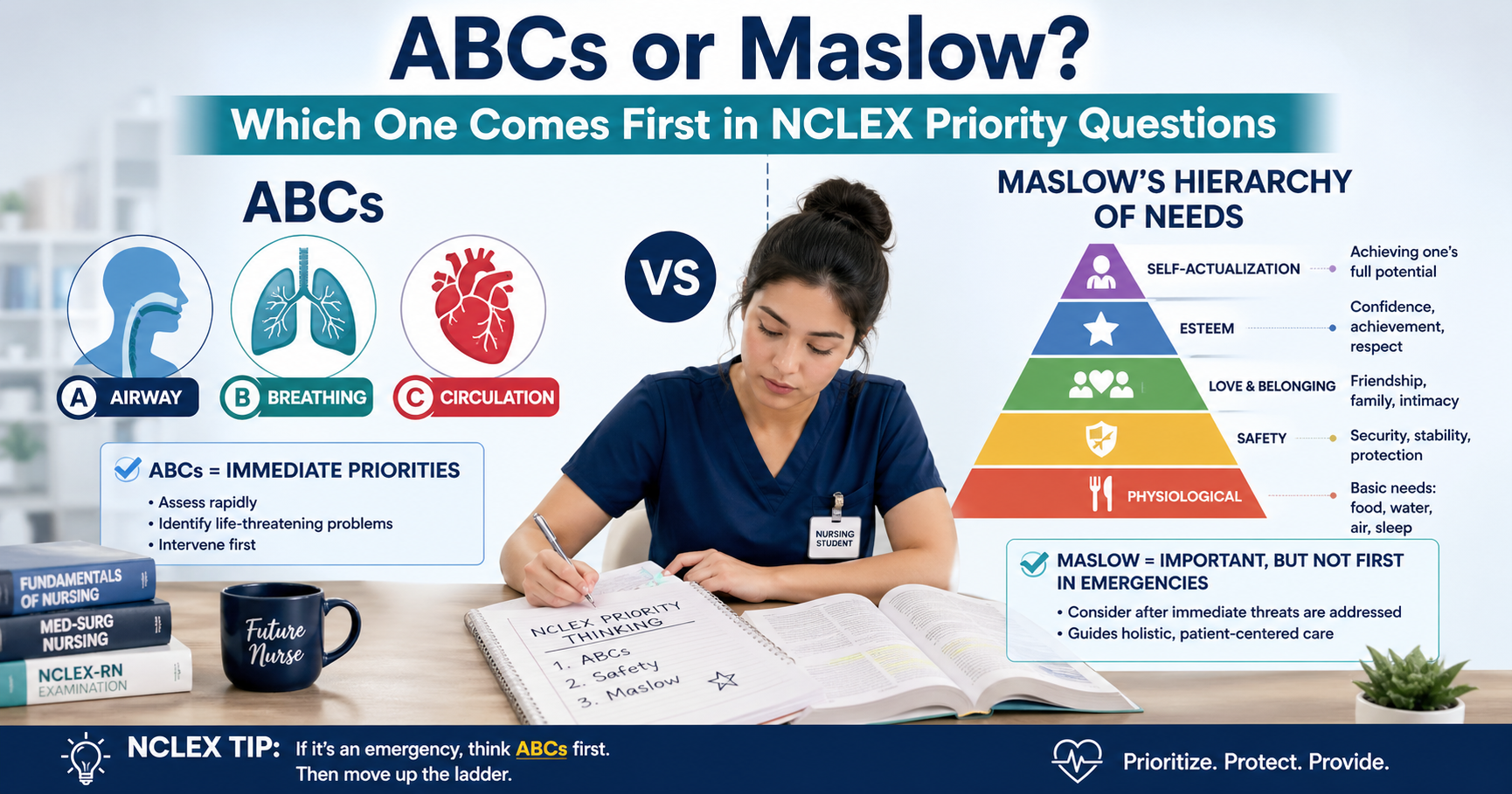
The ABC framework is one of the most essential frameworks used in NCLEX priority questions. ABC stands for Airway, Breathing and Circulation, and it provides an order for addressing life-threatening conditions.
ABC explained
Airway refers to whether the patient’s airway is open and unobstructed. Breathing refers to the patient’s ability to exchange oxygen effectively. Circulation involves blood flow and heart function.
When answering NCLEX priority questions, airway problems are always considered first because oxygen is necessary for survival. Without an open airway, breathing cannot occur, and without breathing, circulation becomes ineffective.
Why are airway problems always treated first?
Airway obstruction is immediately life-threatening. Conditions such as choking, swelling of the throat, or foreign body obstruction can stop oxygen from reaching the lungs. Even a short delay in addressing airway problems can lead to brain injury or death.
This is why ABCs are considered the highest priority in many NCLEX priority questions. Nurses must act quickly when signs of airway compromise appear. Symptoms such as stridor, inability to speak, or visible obstruction require immediate action.
How to apply ABCs to NCLEX questions
When reviewing patient options, always scan for airway, breathing or circulation problems. Look for symptoms such as shortness of breath, low oxygen saturation and cyanosis. For example, if one patient reports anxiety and another has oxygen saturation of 85%, the patient with low oxygen saturation takes priority. Applying ABC reasoning makes it easier to select the correct answer in NCLEX priority questions.
Understanding Maslow’s Hierarchy
Maslow’s Hierarchy is an important nursing prioritization framework used when patients are stable. The Maslow’s Hierarchy in nursing organizes human needs into levels. Physiological needs form the base and include oxygen, fluids, body temperature and elimination. Safety needs mean physical and psychological safety. Higher levels include emotional needs, self-esteem and personal growth. In nursing, physiological needs always take priority because they are necessary for survival.
How Maslow helps prioritize among stable patients
When you’re faced with a “What do you do first?” question in nursing school or the NCLEX exam, using Maslow’s nursing prioritization frameworks, here is what to do:
- Look for the killer first: Is there a physiological need that is unmet?
- Move up the pyramid: If the patient is breathing and stable, is there a safety risk that needs to be addressed? For instance, a confused patient trying to climb out of bed needs to be assisted, and wounds need to be cleaned.
- Address the emotional needs of the patient: Only after the patient is safe and stable do you focus on self-esteem or long-term goals.
Always remember that physiological needs always trump psychosocial needs in NCLEX priority questions.
ABCs vs Maslow NCLEX: Which one Comes First?
One of the most common causes of confusion in NCLEX priority questions is deciding whether you should apply ABCs or Maslow's Hierarchy first. Understanding how these nursing prioritization frameworks interact prevents second-guessing and reduces confusion during NCLEX exams. The general rule is simple: ABC take priority when life-threatening conditions exist.
If a patient has airway obstruction, breathing difficulty or circulation problems, ABCs override Maslow. Life-threatening issues must always be addressed immediately. However, when all patients are stable, Maslow’s Hierarchy becomes the guiding principle. Think of Maslow as the “big picture” and ABCs as the “magnifying glass” and use them as a combined filtering system for who to see first.
When to Use ABCs in NCLEX Priority Questions
ABCs should be used whenever a patient shows signs of respiratory or circulatory distress. Many NCLEX priority questions involve identifying patients who are deteriorating rapidly. Signs such as cyanosis, chest pain, or decreased consciousness suggest airway or breathing problems. These situations require immediate intervention.
When to use Maslow’s Hierarchy
Maslow’s Hierarchy is useful when patients are stable and not experiencing life-threatening conditions. In these cases, physiological needs still take priority over emotional or psychological concerns.
For example, in NCLEX priority questions, a patient experiencing nausea should be prioritized over one requesting emotional support. Both needs matter, but physical comfort must be addressed first.
A nurse has just received the morning shift report for the following four patients. Which patient should the nurse assess first?
How to apply ABCs and Maslow together
Many NCLEX priority questions require combining both ABCs and Maslow rather than choosing one exclusively. If you were to combine both in your exam, here is the step-by-step application:
- Look for airway problems such as choking or stridor.
- Check for breathing issues such as respiratory distress or low oxygen saturation.
- Evaluate circulation by checking for bleeding or shock.
- Handle any safety issues like risk of injury.
- Deal with pain and discomfort. Issues such as severe chest pain are addressed in ABCs.
- Psychosocial needs, such as anxiety and emotional needs, are dealt with next.
A nurse is assigned to the following patients in the medical-surgical unit. Which patient should the nurse assess first?
Mistakes students make with priority questions
Many students struggle with NCLEX priority questions because of common mistakes that interfere with logical thinking. Some of the common mistakes include:
The pain trap
Most students make the mistake of choosing the patient in pain because they’re the loudest or most distressed. According to Maslow's Hierarchy, pain is a psychosocial or comfort need, while ABCs are physiological. Unless it is crushing chest pain, which could be a sign of a circulation issue, pain is never a priority over breathing or stable circulation. You are expected to choose the breathless patient over the screaming patient with a broken toe.
Ignoring acute vs. chronic
It’s a mistake to choose a patient with a severe condition that has been part of their medical history. For example, a patient with COPD (chronic obstructive pulmonary disease) will be considered more stable with an oxygen saturation of 88%, unlike a patient whose saturation just dropped to 91% for the first time. As a thumb rule, look for sudden changes and new onset of symptoms.
Practice Tips to Master ABCs vs Maslow NCLEX Questions
Mastering prioritization requires consistent practice. The more exposure you have to NCLEX priority questions, the easier it becomes to recognize patterns and apply logical reasoning.
- Practice daily priority questions: Daily practice tests build familiarity with question styles. Even answering five to ten questions per day improves recognition of key patterns.
- Use rationales to understand answers: Read explanations for both correct and incorrect answers to understand the rationales. This will teach you how to apply nursing prioritization frameworks.
- Identify keywords such as first, immediate and priority: The keywords signal that prioritization is required.
- Study patient scenarios: Realistic scenarios help you develop clinical reasoning, and reviewing case studies prepares you for the decisions required in NCLEX priority questions.
By understanding how to apply ABCs, Maslow, and other nursing prioritization frameworks, you can approach NCLEX priority questions with confidence instead of uncertainty. These skills are not only valuable for passing exams but also essential for providing safe and effective patient care throughout your nursing career.



No comments yet. Be the first to comment!