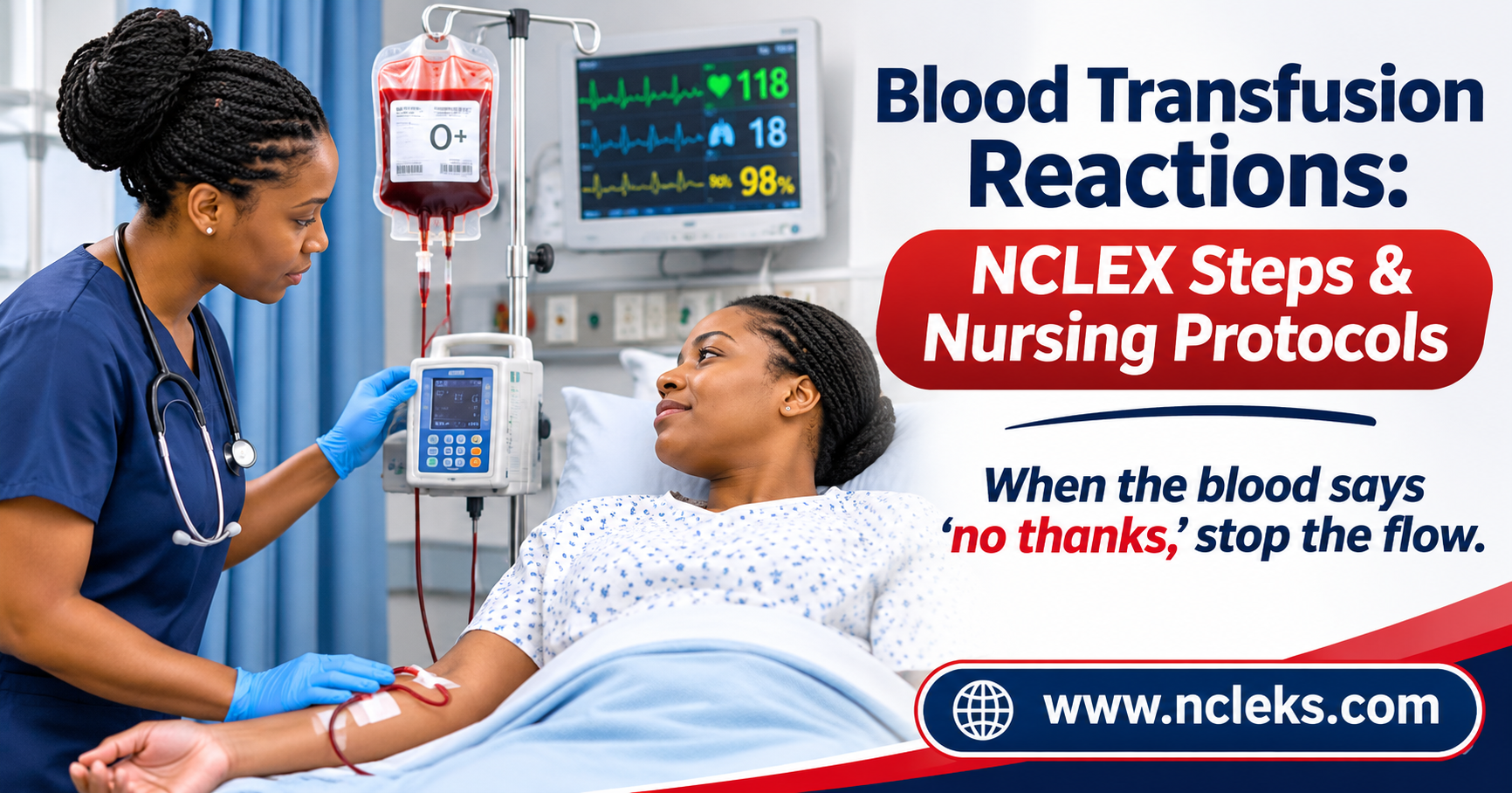
Blood Transfusion Reactions: NCLEX Steps & Nursing Protocols
Why Blood Transfusion Reactions Show Up on the NCLEX
Few clinical situations test your judgment as quickly as a blood transfusion reaction. One minute your patient is resting comfortably with a unit of packed red blood cells infusing. The next, they report chills, back pain, and a feeling that something is wrong. These events are high risk and time sensitive. That is why NCLEX blood transfusion questions appear regularly in the Safety and Infection Control and the Pharmacological and Parenteral Therapies categories of the test plan. Examiners want to know whether you can recognize a reaction early, act in the correct order, and protect the patient from further harm.
The good news is that blood transfusion reactions follow a predictable pattern on exams. Learn the main reaction types and memorize one core sequence of transfusion reaction nursing interventions, and most questions become much easier to answer. The same principle repeats every time: stop the source of harm first, keep the vein open, then assess and notify. This mirrors the broader approach explained in what immediate action means on the NCLEX.
This guide covers four areas:
- Safety checks before the transfusion
- The reaction types you must tell apart
- The exact steps to take when a reaction occurs
- Less obvious complications, such as fluid overload and electrolyte shifts
Three practice questions at the end let you apply what you learn. If lab interpretation still feels shaky, keep the ultimate nursing lab values cheat sheet open while you study. Hemoglobin, potassium, and calcium values often appear in transfusion scenarios.
Before the Transfusion: Safety Checks That Prevent Reactions
Most serious blood transfusion reactions are preventable. Many NCLEX blood transfusion questions actually test the steps that happen before the first drop of blood reaches the patient. Start by confirming signed informed consent and a current type and crossmatch. Obtain baseline vital signs, including temperature, so you have a reference point if the patient's condition changes. A fever that exists before the transfusion means something very different from one that develops 20 minutes in.
Venous access matters as well. An 18 or 20 gauge catheter is generally preferred for adults because it allows adequate flow without damaging red cells. Facility policy may permit smaller catheters for some patients. Review how to start an IV if you need a refresher on site selection and securement.
Prime the blood administration set with 0.9% sodium chloride only. Dextrose solutions can cause red cells to clump and hemolyze. Lactated Ringer's contains calcium, which can trigger clotting in the tubing. Neither belongs with blood products, and you should never add medications to a blood line.
Verification is the single most important safety step. At the bedside, two qualified licensed staff members check:
- The patient's identity, using two identifiers
- The blood product label and unit number
- ABO and Rh compatibility
- The expiration date
Once the unit arrives from the blood bank, begin the infusion within about 30 minutes and complete it within 4 hours to limit bacterial growth. Start slowly and stay with the patient for the first 15 minutes. Acute hemolytic reactions usually show up early and may occur after only a small volume. Repeat vital signs after those first 15 minutes, then according to policy until the transfusion ends. Careful preparation is the first layer of transfusion reaction nursing interventions, since the best reaction is the one that never happens.

Types of Blood Transfusion Reactions You Must Recognize
To choose the right transfusion reaction nursing interventions, you first need to recognize what kind of reaction you are seeing.
The acute hemolytic reaction is the most dangerous. It is usually caused by ABO incompatibility, often from a clerical or identification error. The recipient's antibodies destroy the donor red cells. Signs include fever, chills, low back or flank pain, chest tightness, tachycardia, hypotension, dark or red urine, and a sense of impending doom. It can progress to shock, acute kidney injury, and disseminated intravascular coagulation.
A febrile nonhemolytic reaction is the most common type. Antibodies react to donor white blood cells, causing fever and chills without hemolysis. Leukocyte-reduced blood products help prevent it, and providers may order an antipyretic. On NCLEX blood transfusion questions, a fever alone still requires stopping the transfusion, because early hemolysis can look identical at first.
Allergic reactions come from sensitivity to donor plasma proteins. They typically present with urticaria, itching, and flushing. Mild allergic reactions are often treated with an antihistamine. Some protocols allow the transfusion to resume slowly once symptoms resolve, but only with a provider's order.
An anaphylactic reaction is a severe allergic response, classically linked to IgA deficiency in the recipient. Watch for wheezing, stridor, angioedema, and sudden hypotension. It requires epinephrine and airway support.
Bacterial contamination causes septic reactions, with high fever, rigors, and profound hypotension. It often happens because a unit hung too long.
A delayed hemolytic reaction can appear days to weeks later. Look for a falling hemoglobin, mild fever, and jaundice.
Any blood transfusion reaction involving breathing problems or hypotension is an airway or circulation issue first. That is why reviewing ABCs versus Maslow in priority questions pays off here.

The NCLEX Steps: Transfusion Reaction Nursing Interventions in Order
Regardless of the blood transfusion reaction type, the NCLEX expects one consistent sequence of transfusion reaction nursing interventions.
The first action is always to stop the transfusion immediately. Every additional milliliter of incompatible or contaminated blood increases harm. Stopping comes before calling, assessing, or documenting. Disconnect the blood tubing at the hub closest to the patient rather than simply clamping it, because the existing tubing still contains blood product.
Next, keep the IV access open. Infuse 0.9% sodium chloride through new primed tubing connected directly to the catheter. Do not flush the remaining blood in the old line into the patient. An open vein preserves access for emergency treatment such as epinephrine, fluids for hypotension, or diuretics.
Then assess the patient, starting with airway, breathing, and circulation, and obtain a full set of vital signs. A patient who is wheezing or hypotensive is unstable and needs a rapid response. The guide on stable versus unstable patients explains how to make that judgment quickly.
Once the patient is assessed and supported, notify the provider and the blood bank. A structured format such as SBAR keeps your report concise and complete; see how to give an SBAR report for examples. Follow orders for treatment, which may include antihistamines, antipyretics, fluids, corticosteroids, vasopressors, or epinephrine.
Return the blood bag and attached tubing to the blood bank for testing. Collect any ordered blood samples and a urine specimen to check for hemoglobinuria. Keep monitoring vital signs and urine output closely, because hemolysis can damage the kidneys.
On NCLEX blood transfusion questions, the answer that stops the infusion will almost always beat answers that notify, document, or slow the rate.

TACO, TRALI, and Massive Transfusion Complications
Not every blood transfusion reaction is immune-mediated. The NCLEX likes to test whether you can tell volume overload apart from lung injury.
Transfusion-associated circulatory overload, or TACO, happens when blood is infused faster than the circulation can handle. Older adults and patients with heart failure or kidney disease are at highest risk. Signs include dyspnea, crackles, distended neck veins, a bounding pulse, and rising blood pressure. Stop or slow the transfusion per protocol, sit the patient upright, give oxygen, and anticipate a loop diuretic such as furosemide. Prevention is one of the most overlooked transfusion reaction nursing interventions. It includes slower infusion rates and, for at-risk patients, sometimes a diuretic between units.
Transfusion-related acute lung injury, or TRALI, looks similar at first: sudden respiratory distress and hypoxemia, usually within 6 hours. The key difference is that TRALI is a noncardiogenic pulmonary edema. The patient is often hypotensive and may be febrile, and diuretics are not the main treatment. Management is supportive, with oxygen and sometimes mechanical ventilation. If a question shows hypertension and JVD, think TACO. If it shows hypotension with sudden hypoxia, think TRALI.
Massive or rapid transfusion brings its own risks:
- Hyperkalemia: stored blood can raise serum potassium as cells break down.
- Hypocalcemia: the citrate used as an anticoagulant binds calcium. This can cause tingling, muscle cramps, and a positive Chvostek or Trousseau sign.
- Hypothermia: a blood warmer may be used during rapid infusion.
Electrolyte findings after multiple units are a favorite angle in NCLEX blood transfusion questions. Review hypocalcemia versus hypercalcemia and hypokalemia versus hyperkalemia to connect these changes to their ECG and neuromuscular findings.

Delegation, Documentation, and Exam Day Strategy
Delegation is a frequent twist in NCLEX blood transfusion questions. Assessment, initiating the transfusion, and evaluating for a reaction belong to the registered nurse. Unlicensed assistive personnel may take vital signs on a stable patient and report findings. Depending on facility policy, they can often transport the blood product. They cannot verify the unit or decide whether symptoms represent a reaction. LPN scope rules vary by state and facility, so the exam usually expects the RN to keep the verification and assessment roles. Refresh these boundaries with delegation rules for LPNs and UAPs.
Documentation is the final piece of transfusion reaction nursing interventions. Record:
- The times the transfusion started and stopped
- The volume infused
- The patient's symptoms and vital signs
- The interventions performed
- Who was notified
- The patient's response
Most facilities also require a transfusion reaction report. If you are unsure how to structure a clear narrative entry, writing a nursing progress note walks through SOAP and focus charting formats.
On exam day, read the stem for timing and symptoms. Early fever with back pain points toward hemolysis. Hives point toward an allergic reaction. Crackles with hypertension point toward overload. Then ask which option removes the cause of harm.
A suspected blood transfusion reaction is never managed by slowing the rate and watching, and never by flushing the old line. Practice this order until it is automatic: stop, disconnect, keep the vein open with saline, assess, notify, and return the bag. That sequence of transfusion reaction nursing interventions will serve you in clinicals, school exams, and the NCLEX.





No comments yet. Be the first to comment!