Top 5 Highest-Demand Nursing Specialties (And How to Match Into Them Early)
Why High-Demand Nursing Specialties Matter Before You Graduate
Most nursing students spend their first two years focused on passing exams and surviving clinicals, and that focus makes sense. But the students who land their dream jobs right after graduation usually started thinking about high-demand nursing specialties well before their final semester. Hospitals hire for certain units constantly, and those units often run structured training programs designed specifically for the new graduate nurse. If you understand where the demand is, you can shape your clinical placements, part-time work, and certifications around a clear goal.
Demand in nursing is driven by a few predictable forces: an aging population with more chronic and complex illness, ongoing staff turnover in high-acuity units, and growing recognition of behavioral health needs. These pressures mean that some units post openings almost year-round, while others rarely hire beginners at all. Knowing the difference saves you from applying blindly and getting discouraged.
Choosing a nursing specialty early does not lock you in forever. Plenty of nurses change paths several times over a career. What early planning does is give you a story to tell hiring managers, showing that your experience, interests, and skills all point in the same direction. If you are still deciding which license fits your goals, our comparison of key differences between LPN and RN programs is a helpful starting point, since most of the specialties below require RN licensure. The sections that follow break down five specialties with strong, consistent demand and then explain exactly how to position yourself to match into one early.
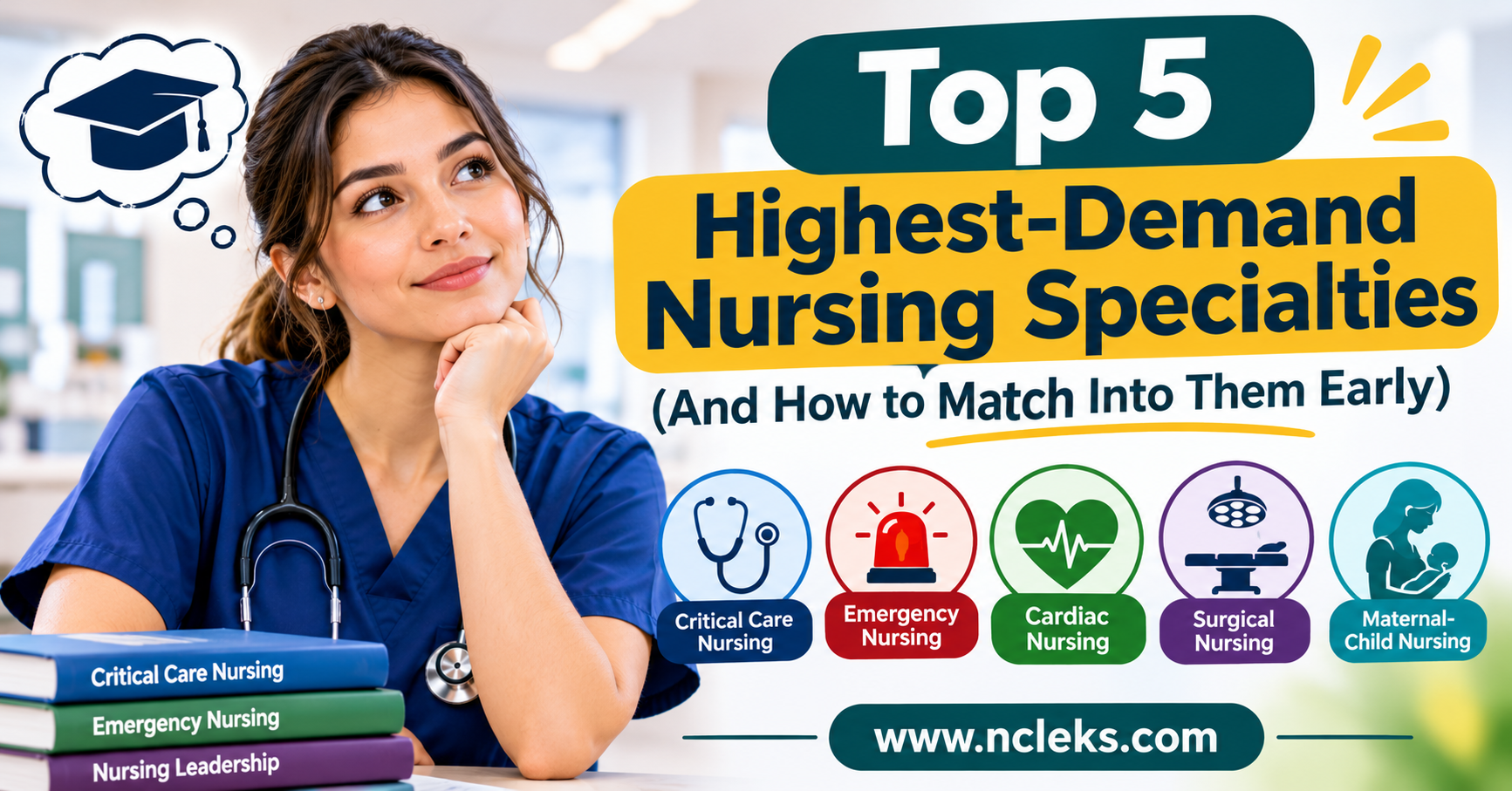
Specialties 1 and 2: Critical Care and Emergency Nursing
Critical care, often called ICU nursing, sits at the top of almost every list of high-demand nursing specialties. ICU nurses care for patients on mechanical ventilators, continuous vasoactive drips, and invasive monitoring. Nurse-to-patient ratios are low, usually one or two patients per nurse, because these patients can deteriorate within minutes. Turnover and burnout in the ICU are real, which is exactly why many hospitals now offer critical care fellowships that accept a new graduate nurse directly instead of requiring two years of med-surg experience first.
Success in the ICU depends on strong assessment skills and an instinct for recognizing subtle changes. Students who want this path should take every opportunity to practice a thorough head-to-toe assessment and learn to connect findings with lab values, hemodynamics, and medication effects.
Emergency nursing is the second powerhouse. Emergency departments see constant volume, and they need nurses who can triage quickly, start IVs under pressure, and shift priorities from one minute to the next. The ED rewards nurses who think in terms of airway, breathing, and circulation and who can identify which patient is unstable at a glance. That is the same reasoning tested on the NCLEX, so reviewing how to tell stable from unstable patients builds both exam skill and ED readiness. Certifications like ACLS and PALS are often required within the first months of hire, and earning them before graduation makes your application stand out.

Specialties 3, 4, and 5: Perioperative, Psychiatric, and Labor and Delivery Nursing
Perioperative nursing covers preoperative holding, the operating room, and the post-anesthesia care unit. Surgical volume keeps rising, and many experienced OR nurses are nearing retirement, which has created a serious staffing gap. Hospitals respond with perioperative training programs, sometimes called Periop 101, that teach sterile technique, circulating, and scrubbing from the ground up. If surgery interests you, our guide to mastering perioperative nursing concepts covers the content you will see on exams and in practice.
Psychiatric and mental health nursing is one of the fastest-growing areas in health care. Inpatient psychiatric units, crisis stabilization centers, and emergency behavioral health teams all struggle to fill positions. This nursing specialty relies heavily on therapeutic communication, de-escalation, and safety planning. Students who are comfortable having honest conversations about suicide risk, substance use, and trauma often thrive here, and many units are eager to train a motivated new graduate.
Labor and delivery rounds out the list. L&D units need nurses who can monitor fetal heart rate patterns, recognize obstetric emergencies like postpartum hemorrhage, and support families through high-emotion moments. Competition for L&D jobs is fierce because the specialty is popular, but demand remains strong, especially in rural and community hospitals. An NRP certification and a capstone placement on an obstetric unit can make the difference between an interview and a rejection email.
How to Match Into a Nursing Specialty While Still in School
The single most powerful move you can make is working in your target unit before you graduate. Many hospitals hire nursing students as patient care technicians, nurse externs, or unit secretaries. These roles let managers see your work ethic firsthand, and a manager who already knows you is far more likely to hire you as a nurse. Our list of flexible jobs for nursing students includes several hospital-based roles that fit around a demanding class schedule.
Next, treat clinical rotations as extended job interviews. Arrive prepared, ask thoughtful questions, and volunteer for skills. Nurses on the unit talk to their managers, and a strong reputation travels quickly. Knowing what to bring to clinicals and showing up organized signals professionalism from day one.
Your final capstone or preceptorship deserves special attention. Most programs let students request a placement, and you should request a unit in your chosen nursing specialty as early as the process allows. Write a short statement explaining your interest and any related experience. If your school offers a limited number of ICU or L&D spots, a well-prepared request often wins.
Finally, build credentials that match your goal. Join a student chapter of a specialty organization, such as the Emergency Nurses Association or the Association of PeriOperative Registered Nurses. Earn BLS and, when eligible, ACLS, PALS, or NRP. These small steps show a hiring committee that you have been committed for a long time, not just during application season.

Nurse Residency Programs and the New Graduate Nurse Application
Nurse residency programs are the main doorway into high-demand nursing specialties for beginners. These are paid, structured programs lasting six to twelve months, combining classroom education, simulation, and a dedicated preceptor. Many hospitals open applications four to six months before graduation, which means you may be applying while still finishing coursework. Mark the opening dates for your target hospitals on a calendar, since some cohorts fill within days.
A strong new graduate nurse application usually includes a tailored resume, a cover letter that names the specific unit you want, and references from clinical instructors or preceptors who watched you work. Highlight concrete experiences: the number of hours in your capstone, skills you performed, and any patient situations where you recognized a change and escalated appropriately. Hiring managers care less about grades than about evidence that you are safe and teachable.
Interviews often use behavioral questions such as describing a time you made a mistake or handled a difficult family. Practice answers using a simple situation, action, and result structure. Some units also include clinical scenario questions, so be ready to talk through how you would respond to a patient with sudden chest pain or a dropping oxygen saturation. The confidence you built during simulation lab check-offs transfers directly to these conversations.
If you do not match on your first try, do not panic. Many nurses start in med-surg, build a year of strong experience, and then transfer internally. Our step-by-step guide on what to do after finishing nursing school walks through those next moves.
Using NCLEX Prep to Strengthen Your Specialty Goals
Every residency offer is contingent on passing the NCLEX, so your licensing exam is the final gate between you and your chosen nursing specialty. Some hospitals will rescind an offer if a candidate does not pass within a set window, which makes early, steady preparation essential. Following a focused plan like this 30-day NCLEX study plan keeps you on track during the busy weeks after graduation.
The good news is that NCLEX content overlaps heavily with what high-demand nursing specialties expect from day one. Prioritization, delegation, recognizing deterioration, and safe medication administration are the core of both the exam and real bedside practice. When you work through practice questions, notice which topics you enjoy most. A student who loves cardiac rhythms may be drawn to critical care, while one who excels at therapeutic communication may find a home in psychiatric nursing.
Use the NCLEKS practice exams and flashcards to build speed and accuracy, and take a Final Readiness Assessment to identify weak areas before test day. A new graduate nurse who walks into orientation already confident in clinical judgment adapts faster, earns a preceptor's trust sooner, and is better prepared to grow within any of the high-demand nursing specialties. Planning your career and preparing for your license are not separate tasks; they reinforce each other at every step.

No comments yet. Be the first to comment!