How to Use ChatGPT in Nursing School Ethically (Without Getting Expelled)
Why ChatGPT in Nursing School Is a Gray Area Every Student Should Understand
Using ChatGPT in nursing school has quickly become one of the most debated topics among students and faculty. Some students treat it like a personal tutor that never sleeps. Others avoid it entirely because they are afraid of being accused of cheating. The truth sits somewhere in the middle. AI in nursing school can be a strong study partner when you use it to understand concepts, but it can also end your academic career if you use it to replace your own thinking on graded work.
Nursing programs hold students to a higher standard than most majors because the profession depends on trust. When you submit a care plan, a reflection paper, or a medication card, your instructor assumes the clinical reasoning on that page is yours. Many programs do not treat a violation of academic integrity in nursing as a minor slip. They see it as evidence that a student may not be safe or honest in patient care. That is why dishonesty policies are often tied to dismissal rather than a simple grade penalty.
If you are already under pressure from heavy reading loads and back-to-back exams, a tool that promises quick answers will feel tempting. Before you reach for shortcuts, build a routine you can sustain. This step-by-step survival guide for overwhelmed nursing students is a good place to start. This article shows you exactly where the ethical line is, so you can benefit from AI without putting your seat in the program at risk.
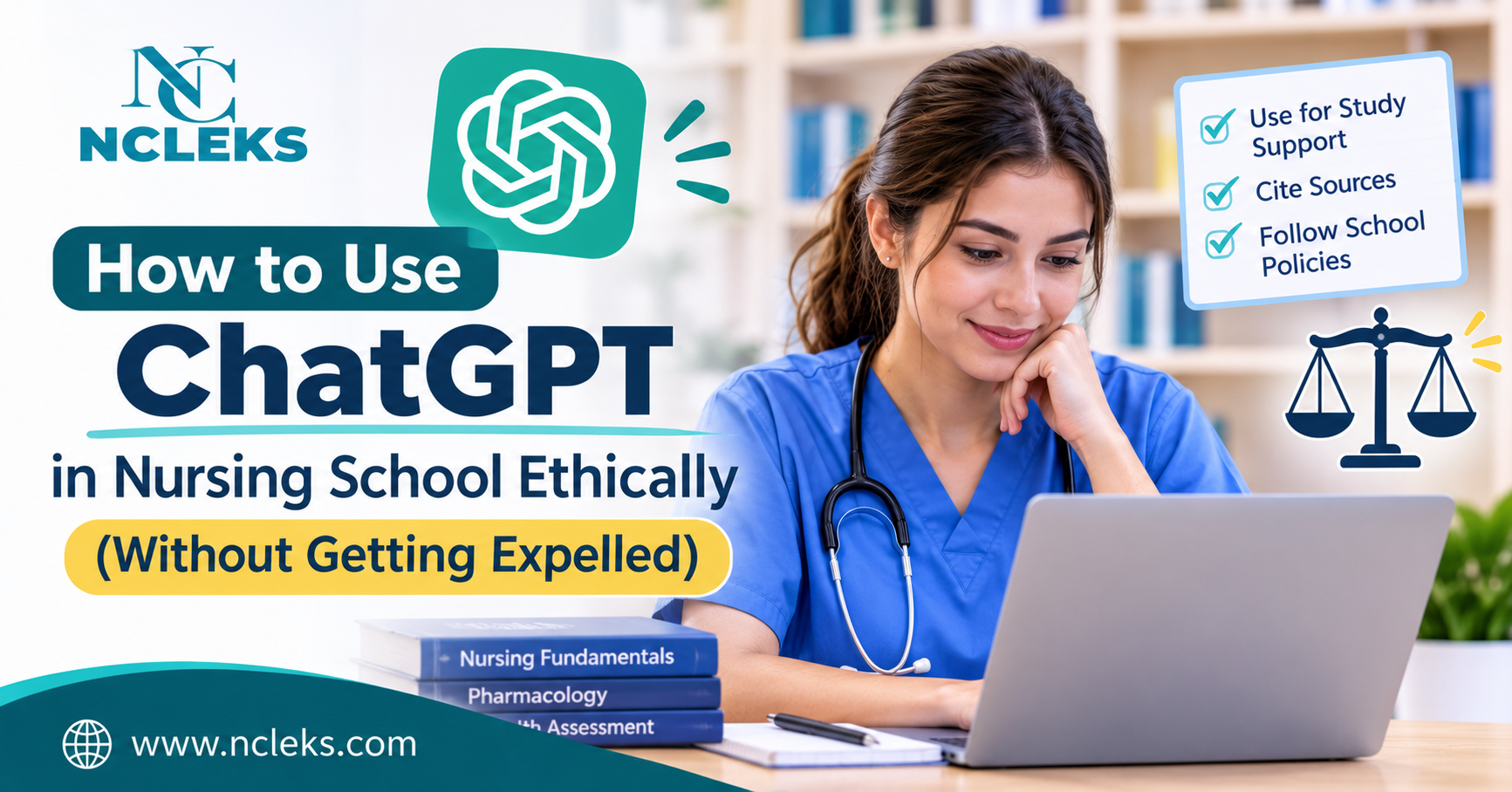
Know Your Program's AI Policy Before You Use ChatGPT in Nursing School
Every nursing program sets its own rules, and those rules can differ from course to course within the same school. One instructor may let you use ChatGPT to brainstorm topics for an evidence-based practice paper, while another may ban AI tools completely. Start by reading the student handbook, the course syllabus, and any academic integrity policy your college publishes. Look for phrases like 'generative AI,' 'unauthorized assistance,' and 'original work,' because these usually define what is allowed.
When a policy is vague, ask. A short email to your instructor might say, 'Is it acceptable to use ChatGPT to quiz myself on cardiac medications, as long as I do not use it on graded assignments? ' This protects you in two ways. It shows good faith, and it gives you a written record if questions come up later. Students who assume AI in nursing school is automatically fine are the ones who most often end up in a dean's office.
The early weeks of a program matter most, because instructors watch closely for professionalism and honesty. This breakdown of what could get you dropped from class in the first four weeks of nursing school explains why integrity issues are taken seriously from day one. Many schools now use AI-detection software, and instructors also compare your writing style across assignments. Detectors are imperfect, but a paper that sounds nothing like your in-class writing can still trigger a review. When in doubt, disclose how you used AI, or do not use it for that task.

Ethical Ways to Use ChatGPT in Nursing School for Studying
The most ethical and effective way to use ChatGPT in nursing school is as a study coach rather than a ghostwriter. A good starting point is asking it to explain a difficult concept in plain language. If the renin-angiotensin-aldosterone system still confuses you after lecture, ask for a simpler explanation. Then compare it against your textbook to confirm it is correct. This builds your understanding instead of replacing it.
You can also ask AI to generate practice questions from your own notes. Paste in a summary you wrote yourself about heart failure, then ask for five NCLEX-style questions with rationales. Answering them forces active recall, one of the methods described in this guide to smart study methods to retain information and pass the NCLEX. Another useful technique is teach-back. Explain a topic like insulin peak times to the chatbot, then ask it to point out gaps or errors in your explanation.
AI in nursing school also helps you organize your time. You can ask it to build a weekly study schedule around your clinical days, or to turn a long chapter outline into a checklist of review topics. For pharmacology, asking it to group drugs by class and suffix can make memorization easier. You should still rely on trusted resources, such as this guide on how to study pharmacology without memorizing everything. In every case, the thinking and the final work stay yours, which keeps your use within the boundaries of academic integrity.
Where AI in Nursing School Crosses the Line: Care Plans, Papers, and Exams
The clearest violation is submitting AI-generated work as your own. That includes copying a ChatGPT-written discussion post, reflection journal, or evidence-based practice paper and turning it in with minor edits. Care plans deserve special attention. A care plan shows your clinical judgment: how you assessed a specific patient, prioritized problems, and chose interventions. If a chatbot writes your nursing diagnoses and outcomes, you skip the exact skill the assignment is meant to build. You also lose practice with the nursing process (ADPIE), which the NCLEX tests heavily.
Using any AI tool during a quiz, dosage calculation exam, or proctored test is cheating. The same goes for take-home exams unless your instructor has explicitly permitted AI. Fabricated references are another hidden trap. ChatGPT is known to invent journal articles, authors, and DOIs that look real but do not exist. Most programs treat citing a fake source in an APA paper as falsification and an academic integrity violation, even if you did not mean to deceive anyone.
Before using ChatGPT in nursing school on any assignment, ask yourself, 'Could I explain and defend every sentence of this work to my instructor without notes?' If the answer is no, you have likely crossed the line. Choosing legitimate practice resources over leaked or copied material comes from the same mindset. We explain our approach to why NCLEKS Nursing does not offer real-word-for-word ATI questions.
Protecting Patient Privacy: The HIPAA Rule Most Students Forget
Even students who use ChatGPT in nursing school responsibly in the classroom can make a serious mistake in the clinical setting: entering patient information into a chatbot. Typing a patient's name, date of birth, room number, medical record number, or a unique combination of diagnosis and demographics into a public AI tool can violate HIPAA and your clinical agency's confidentiality agreement. Public chatbots are not covered entities, and anything you enter may be stored or reviewed. A privacy breach can get you removed from a clinical site immediately, which usually means failing the course.
If you want help understanding a clinical situation, remove every identifier and keep the scenario general. Instead of describing 'Mr. Johnson in room 412 with a history of CHF,' ask, 'What are priority assessments for an older adult admitted with a heart failure exacerbation?' That question supports learning without exposing anyone's health information. Never photograph charts, medication administration records, or monitors to upload into an app. Never use AI to draft clinical paperwork with real patient data on a personal device.
Your clinical instructor and the facility set the rules for any technology on the unit. Review those expectations along with this list of what you should bring to nursing clinicals. Protecting patient privacy is part of using AI in nursing school ethically. It is also a core NCLEX topic under Management of Care. Taking confidentiality seriously now prepares you for the standard you will be held to as a licensed nurse.
Fact-Checking AI: Why Accuracy Matters for the NCLEX and Patient Safety
ChatGPT can sound confident even when it is wrong. It may give an outdated lab range, mix up two drugs with similar names, or describe an intervention that is no longer best practice. In nursing, a confident error is dangerous. Before you trust anything an AI tool tells you, check it against an approved source such as your textbook, a nursing drug handbook, your lecture notes, or your instructor. Responsible use of AI in nursing school always includes this step, and it mirrors what nurses do on the job, where every medication and order is double-checked.
Pharmacology and lab values are where AI mistakes are most common and most costly. If a chatbot gives you the therapeutic range for digoxin or the potassium level that requires holding a medication, confirm it against reliable references. Our NCLEX pharmacology cheat sheet and our guide on how to answer NCLEX lab value questions are written and reviewed with exam accuracy in mind.
AI cannot replace practice with high-quality, exam-style questions. Use ChatGPT in nursing school to clarify why an answer is correct after you have attempted a question, not to hand you the answer before you think. Pair it with the practice exams and flashcards on NCLEKS so your preparation is grounded in content built for the NCLEX-RN and NCLEX-PN. Accuracy is also an academic integrity issue, because submitting false information in a paper or presentation damages your credibility.

Building an Academic Integrity Habit That Lasts Into Your Nursing Career
The habits you form now follow you into practice. Nurses keep legally binding records, give high-alert medications, and are trusted with vulnerable patients. A student who learns to take shortcuts on care plans may later be tempted to chart assessments that were never done. Building strong academic integrity in school is really about building the professional integrity that boards of nursing expect.
A practical approach is to write a personal AI rule set. For example, you might decide to use ChatGPT in nursing school only for explaining concepts, generating self-quiz questions, and planning study time. You might add that you will never use it on graded work without permission and never enter patient information. Write these rules down and revisit them each semester as policies change. If you realize you used AI in a way that may have broken a policy, talking with your instructor early is almost always better than waiting to be discovered.
AI in nursing school is not going away, and future nurses will likely use AI tools built into electronic health records and clinical decision support. Using them responsibly, with verification and respect for privacy, is a skill in itself. When graduation approaches, this guide on how to know when you're truly ready for the NCLEX will help you measure your progress honestly. Use AI to sharpen your thinking, never to replace it, and you will protect both your seat in the program and your future license.


No comments yet. Be the first to comment!