The 12 Cranial Nerves Made Easy: Mnemonics and Assessment Tricks
Why the 12 Cranial Nerves Matter for Nursing Students
Few topics make nursing students groan like the 12 cranial nerves. There are twelve names, twelve Roman numerals, three function types, and a set of bedside tests that blur together the night before a neuro exam. You do not need brute force to learn them. With a few well-chosen cranial nerve mnemonics and some practical tricks, you can lock in the names, functions, and testing methods in one focused study session and keep them through the NCLEX.
Cranial nerves come up constantly in nursing. You will test them during neuro checks, during a head-to-toe assessment in nursing, after a stroke or head injury, and any time a patient receives a medication that can damage hearing or balance. On exams, cranial nerve assessment is tested less as trivia and more as clinical judgment. The question is usually what a finding means and what the nurse should do first. Both the Physiological Adaptation and the Reduction of Risk Potential categories in the 2026 NCLEX-RN test plan draw on this knowledge.
This guide covers four things: the names mnemonic, the function mnemonic, a simple bedside test for each nerve, and the red-flag findings that NCLEX often turns into priority questions. Read it once, then quiz yourself out loud. Saying the nerves and their tests from memory works far better than rereading your notes.
Cranial Nerve Mnemonics for Remembering the Names
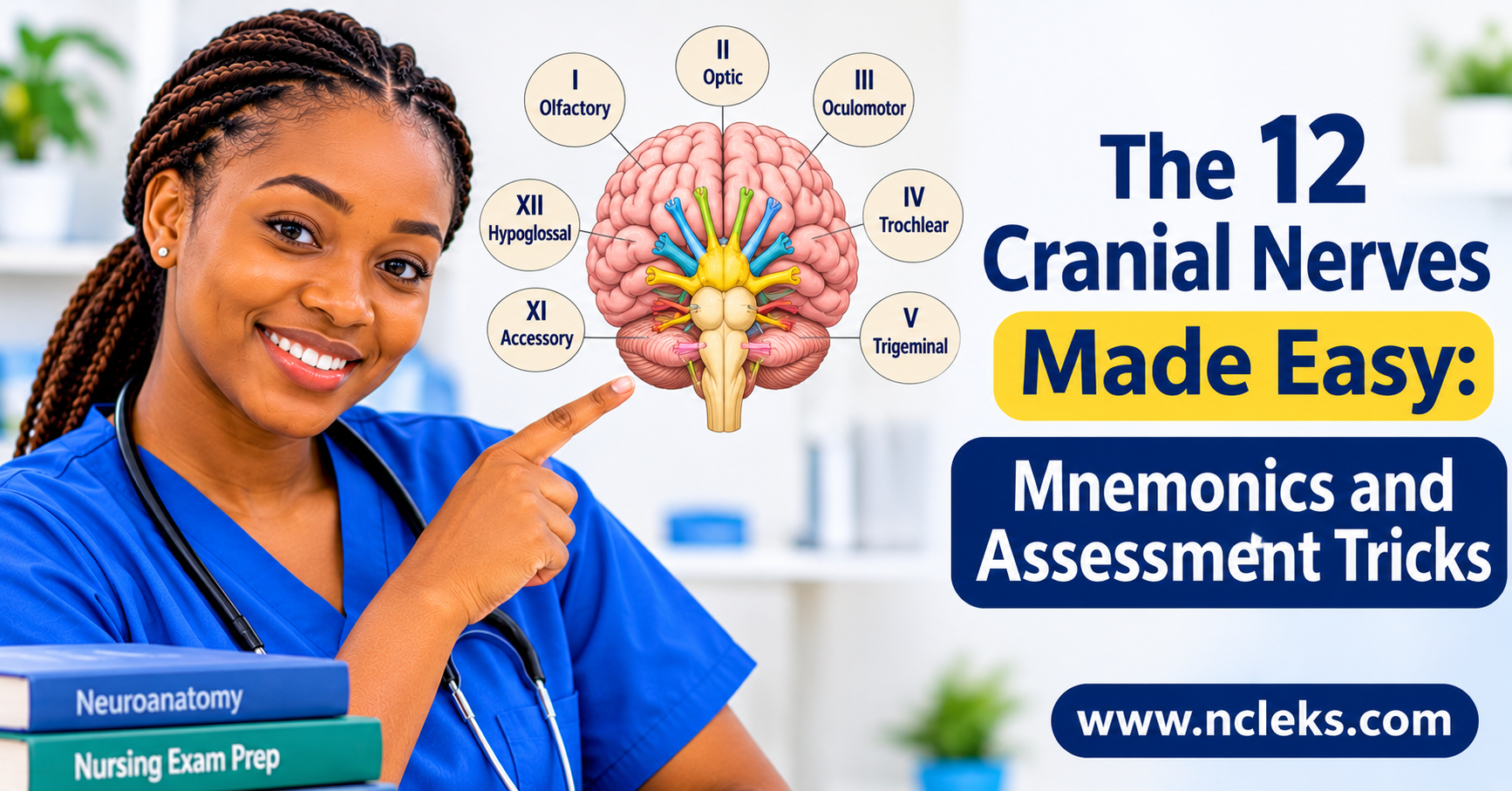
The cranial nerves are numbered I through XII and are ordered roughly from front to back as they leave the brain. In order, they are the olfactory (I), optic (II), oculomotor (III), trochlear (IV), trigeminal (V), abducens (VI), facial (VII), vestibulocochlear (VIII), glossopharyngeal (IX), vagus (X), accessory (XI), and hypoglossal (XII). The first set of cranial nerve mnemonics you need simply puts these names in order.
The most popular version is Oh Oh Oh, To Touch And Feel Very Good Velvet, Such Heaven. Each first letter matches a nerve in order. “Such” stands for the spinal accessory nerve, and Heaven stands for hypoglossal. You may also see the older version, On Old Olympus Towering Tops, A Finn And German Viewed Some Hops, which uses the outdated term “auditory” for CN VIII. Either one works. Pick the one that sticks and use it consistently.
The three O's trip up many students, so anchor them with logic. Olfactory comes first because the nose sits at the very front of the face. Optic comes second because the eyes are next. Oculomotor is third, and its name tells you what it does: ocular plus motor, so it moves the eye. The trochlear and abducens nerves also move the eyes, which means III, IV, and VI share eye movement.
Write the mnemonic at the top of a blank page every day for a week and fill in the full names underneath. Active recall paired with spaced review is one of the smart study methods that help you retain information for the NCLEX. Cranial nerve mnemonics only work if you retrieve them over and over.

Sensory, Motor, or Both: The Function Mnemonic
Once you know the names, you need to know whether each nerve carries sensory information, motor commands, or both. The second of the core cranial nerve mnemonics is Some Say Marry Money, But My Brother Says Big Brains Matter More. S means sensory, M means motor, and B means both. Lined up with the names, it shows that I, II, and VIII are sensory. III, IV, VI, XI, and XII are motor. V, VII, IX, and X are both.
Here is what each nerve actually does:
- The olfactory nerve handles smell, and the optic nerve handles vision.
- The oculomotor nerve controls most eye movements, raises the eyelid, and constricts the pupil.
- The trochlear nerve controls the superior oblique muscle, which moves the eye down and inward.
- The trigeminal nerve provides sensation to the face, controls the chewing muscles, and carries the sensory side of the corneal reflex.
- The abducens nerve controls the lateral rectus, which moves the eye outward.
- The facial nerve controls facial expression and eyelid closure, and it carries taste from the front two-thirds of the tongue.
- The vestibulocochlear nerve handles hearing and balance.
- The glossopharyngeal nerve carries taste from the back third of the tongue and contributes to swallowing and the gag reflex.
- The vagus nerve controls the palate, pharynx, and larynx and carries parasympathetic signals to the heart and gut.
- The accessory nerve powers the sternocleidomastoid and trapezius muscles.
- The hypoglossal nerve moves the tongue.
For eye movement, use the formula LR6SO4; all the rest 3. The lateral rectus is controlled by CN VI, the superior oblique by CN IV, and every other extraocular muscle by CN III. Like the mnemonic tricks for nursing lab values, these shortcuts turn a long list into something you can rebuild under pressure.

Cranial Nerve Assessment Tricks for Clinicals and Check-Offs
A complete cranial nerve assessment takes only a few minutes once you have a routine. Always work from I to XII so you never skip a nerve, and explain each step to the patient before you do it.
For CN I, have the patient close their eyes, block one nostril, and identify a familiar scent such as coffee or peppermint. Avoid ammonia or alcohol, because they stimulate the trigeminal nerve instead of the olfactory nerve. For CN II, check acuity with a Snellen chart and test visual fields by confrontation. Test CN III, IV, and VI together by having the patient follow your finger through the six cardinal fields of gaze in an H pattern. While you are there, check the pupils for size, equality, and reaction to light and accommodation. For CN V, touch the forehead, cheek, and jaw with a cotton wisp, then ask the patient to clench their teeth while you feel the masseter muscles.
For CN VII, ask the patient to smile, frown, puff out the cheeks, raise the eyebrows, and squeeze the eyes shut while you gently try to open them. Look for asymmetry. For CN VIII, use the whisper test and know the Weber and Rinne tuning fork tests. Test CN IX and X together by having the patient say ah while you watch the uvula and soft palate rise evenly, then check the gag reflex and swallowing. For CN XI, have the patient shrug and turn the head against resistance. For CN XII, ask the patient to stick out the tongue and move it side to side.
In the simulation lab, instructors often grade whether you say out loud what you are testing during a cranial nerve assessment. A statement like 'I am now assessing cranial nerve VII' shows clinical reasoning and earns points. These tips to pass your practical check-offs in the simulation lab can help you perform with confidence. Afterward, record any deficits clearly in your nursing progress note.

Red-Flag Findings the NCLEX Loves to Test
Knowing the normal exam is only half the job. NCLEX questions about cranial nerves usually present an abnormal finding and ask what it means or what the nurse should do. A careful cranial nerve assessment helps you spot these problems early, and a few findings deserve special attention.
A newly dilated, sluggish, or fixed pupil on one side suggests compression of CN III, often from rising intracranial pressure or impending brain herniation. This is an emergency. The patient is unstable rather than stable, so the nurse notifies the provider immediately and continues frequent neuro checks.
A weak or absent gag reflex points to CN IX and X dysfunction and puts the patient at risk for aspiration. After a stroke, after sedation, or after a throat procedure, the nurse must confirm the gag and swallow reflexes before giving anything by mouth, including oral medications. This follows directly from using ABCs to prioritize NCLEX questions, because aspiration is an airway problem.
Facial drooping needs a closer look. In Bell's palsy, a peripheral CN VII problem, the entire side of the face is weak, including the forehead, and the patient may be unable to close the eye. In a stroke, the forehead is usually spared because it receives input from both sides of the brain. Patients with Bell's palsy need lubricating eye drops during the day and the eye taped or patched at night to prevent corneal abrasion.
Two deviation patterns are easy to mix up. With hypoglossal damage, the tongue deviates toward the side of the lesion. With a vagus lesion, the uvula deviates away from the affected side. Finally, trigeminal neuralgia (CN V) causes sudden, stabbing facial pain triggered by chewing, cold air, or light touch, so teaching focuses on avoiding those triggers.

Applying Cranial Nerve Assessment to Pharmacology and NCLEX Questions
One of the most testable links connects CN VIII to ototoxic drugs. Aminoglycosides such as gentamicin and tobramycin, vancomycin, and loop diuretics such as furosemide given rapidly IV can damage the vestibulocochlear nerve. A patient on these drugs who reports tinnitus, decreased hearing, or dizziness needs to be reported to the provider right away, and the next dose may need to be held. Review when to hold a medication on NCLEX questions to strengthen this connection.
When you see a neuro question, translate in two steps. First, turn the finding into a nerve: tongue deviation points to CN XII, a drooping eyelid to CN III, and weakness with shrugging to CN XI. Second, turn the nerve into a risk: airway, aspiration, injury, or worsening neurologic status. This translation changes a memorization topic into a clinical judgment question, which is how the NCLEX frames cranial nerve assessment today.
To make the material stick, build flashcards with the nerve number on the front. On the back, write the name, function, bedside test, and one red flag, and add your cranial nerve mnemonics at the top of the deck. Then work through NCLEX-style practice questions on NCLEKS and pair them with broader nursing test-taking strategies for clinical judgment. With steady practice, the 12 cranial nerves can become some of your most reliable points on exam day.




No comments yet. Be the first to comment!