How to Tic-Tac-Toe ABGs: The Easiest Way to Pass Your Arterial Blood Gas Exam
Why ABG Interpretation Feels So Hard (and How Tic-Tac-Toe Fixes It)
If arterial blood gas questions make your stomach drop, you are in good company. ABG interpretation is one of the topics nursing students most often struggle with. The usual reason is that they try to memorize dozens of patterns instead of learning one reliable system. The tic-tac-toe ABG method replaces that guesswork with a simple grid you can sketch on scratch paper in under ten seconds. Once you learn it, every question becomes a matter of placing three values into columns and reading the result.
ABGs show up everywhere in nursing school. You will see them in med-surg, in critical care, and on the NCLEX. They are often embedded in case studies about COPD exacerbations, diabetic ketoacidosis, or postoperative patients who received too much opioid. If you have heard students call med-surg the hardest class in nursing school, acid-base balance is a big reason why.
The good news is that this topic is extremely formulaic. Many clinical questions require you to weigh several plausible answers. An arterial blood gas, by contrast, has one definite correct interpretation, so a consistent method pays off on every single question.
Before you start, make sure your foundation in normal ranges is solid. Our nursing lab values cheat sheet covers the numbers and memory tricks that pair well with this method. By the end of this article, you will be able to do three things. You will interpret any ABG, determine compensation, and connect the numbers to what the patient actually needs from you.
The Three Normal Values Every Arterial Blood Gas Question Depends On
The tic-tac-toe ABG method only works if you know the normal ranges cold. For acid-base questions, you need three numbers.
The first is pH, with a normal range of 7.35 to 7.45. A pH below 7.35 means acidosis, and a pH above 7.45 means alkalosis. The pH tells you what is happening in the body overall. It does not tell you why.
The second value is PaCO₂, with a normal range of 35 to 45 mmHg. This is the respiratory component, and the lungs control it. Carbon dioxide combines with water to form carbonic acid, so think of CO₂ as an acid. The critical trick is that PaCO2 moves opposite to pH. A high PaCO2 means more acid, and a low PaCO₂ means less acid, which pushes toward alkalosis. A helpful memory cue is that the CO₂ range, 35 to 45, mirrors the last two digits of the pH range.
The third value is HCO₃, or bicarbonate, with a normal range of 22 to 26 mEq/L. This is the metabolic component, and the kidneys control it. Bicarbonate is a base. A high HCO3 points toward alkalosis, and a low HCO₃ points toward acidosis.
You may also see PaO2 (80 to 100 mmHg) and SaO2 (95 to 100 percent). These describe oxygenation rather than acid-base status. Still, they matter for priority decisions.
Many students lose points on arterial blood gas questions because they mix up the direction of CO2, not because they misunderstand the concept. For more practice reading numbers under pressure, review how to answer NCLEX lab value questions.

How to Use the Tic-Tac-Toe ABG Method Step by Step
Start by drawing a simple grid with three columns. Label the columns Acid, Normal, and Base from left to right. You will place three values in this grid, one row at a time: pH, PaCO₂, and HCO₃..
First, place the pH. A pH of 7.30 goes under Acid. A pH of 7.40 goes under Normal. A pH of 7.50 goes under Base.
Next, place the PaCO₂, and remember the reversal. A PaCO₂ above 45 goes under Acid, because excess carbon dioxide is acidic. A PaCO₂ below 35 goes under Base.
Finally, place the HCO₃ the way it reads. A value above 26 goes under Base, and a value below 22 goes under Acid.
Now look for the match. Whichever value sits in the same column as the pH is the cause of the imbalance. Suppose pH and PaCO₂ both land under Acid. That is respiratory acidosis. Suppose pH and HCO₃ both land under Base. That is metabolic alkalosis. The pH names the problem (acidosis or alkalosis). The matching value names the system (respiratory or metabolic).
Occasionally, both PaCO₂ and HCO₃ land in the same column as the pH. This is a mixed, or combined, disorder. An example is a patient in cardiac arrest who is both hypoventilating and producing lactic acid. These cases are less common on exams, but the grid makes them instantly visible.
This is why ABG interpretation becomes almost mechanical with tic-tac-toe. You are no longer asking yourself what a number means in the abstract. You are simply sorting values into boxes and reading the pattern.
Determining Compensation: The Step Most Students Miss
Identifying the primary disorder is only half of most exam questions. The answer choices usually include the words uncompensated, partially compensated, or fully compensated. The grid handles this too. Compensation is the body's attempt to bring pH back to normal: the system that did not cause the problem pushes in the opposite direction.
If the value that did not match the pH sits in the Normal column, the result is uncompensated. The body has not yet responded.
If the pH is still abnormal and the non-matching value sits in the opposite column, the result is partially compensated. The body is trying, but it has not fully restored the pH.
If the pH falls within 7.35 to 7.45 but both PaCO₂ and HCO₃ are abnormal and in opposite columns, the result is fully compensated. Here is where students get stuck. With a normal pH, how do you know which system started the problem? Use 7.40 as the midpoint. A pH from 7.35 to 7.39 leans acidic, so write it under Acid. A pH from 7.41 to 7.45 leans basic, so write it under Base. Then match it to the value in the same column as usual.
This is the portion of ABG interpretation that separates a passing score from a high one. Exam writers love fully compensated values because they look normal at first glance. The tic-tac-toe ABG grid forces you to slow down and check every arterial blood gas value instead of stopping at the pH. If you tend to rush through questions that look easy, our guide to nursing test-taking strategies can help you build better habits.

Practice Walkthrough: Three ABGs Solved With Tic-Tac-Toe
Example 1: pH 7.30, PaCO₂ 52, HCO₃ 25. The pH of 7.30 is below the normal range (7.35- 7.45), so it is acidic. A PaCO₂ of 52 is high, so it also goes under Acid. An HCO₃ of 25 is normal. The pH matches the PaCO₂, so this is respiratory acidosis. Because the HCO₃ is still normal, it is uncompensated. Picture a patient with a sudden opioid overdose who has not had time to compensate.
Example 2: pH 7.48, PaCO₂ 30, HCO₃ 20. The pH is below the base range. A PaCO₂ of 30 is low, so it also goes under Base. An HCO₃ of 20 is low, so it goes under Acid. The pH matches the PaCO₂, which makes this a respiratory alkalosis. The pH is still abnormal, and the HCO₃ has moved to the opposite column, so it is partially compensated. This pattern fits a patient who has been hyperventilating for some time, such as during prolonged anxiety or at high altitude.
Example 3: pH 7.36, PaCO₂ 28, HCO₃ 16. The pH is normal, but 7.36 is below 7.40, so it goes under Acid. A PaCO₂ of 28 is low, so it goes under Base. An HCO₃ of 16 is low, so it goes under Acid. The pH matches the HCO₃, making this metabolic acidosis. The pH is within the normal range, so it is fully compensated. A patient with chronic renal failure who breathes faster to blow off CO₂ could produce this arterial blood gas.
Notice that each example took the same few steps. That consistency is the real power of tic-tac-toe ABG practice. On the Next Generation NCLEX, ABG results often appear inside longer scenarios with vital signs and nurses' notes. Pair this method with our guide on breaking down NextGen NCLEX case study questions so you can pull the right numbers out of the chart quickly. Strong ABG interpretation inside a case study often unlocks several follow-up items at once.
Connecting ABG Results to Causes and Nursing Priorities
Exams rarely stop at naming the imbalance. You also need to know what caused it and what to do about it.
Respiratory acidosis comes from hypoventilation. Common causes include COPD, opioid or sedative overdose, neuromuscular weakness, and airway obstruction. Respiratory alkalosis comes from hyperventilation, as seen with anxiety, pain, fever, early pulmonary embolism, or overly aggressive mechanical ventilation.
Metabolic acidosis occurs when the body gains acid or loses bicarbonate. Typical causes are diabetic ketoacidosis, lactic acidosis, renal failure, and severe diarrhea. Watch for Kussmaul respirations as the lungs try to compensate. Metabolic alkalosis occurs when the body loses acid or gains base. Typical causes are prolonged vomiting, nasogastric suction, overuse of antacids, and loop or thiazide diuretics.
A classic backup mnemonic is ROME, which stands for Respiratory Opposite, Metabolic Equal. In respiratory disorders, pH and PaCO2 move in opposite directions. In metabolic disorders, pH and HCO3 move in the same direction. Use ROME to double-check your tic-tac-toe ABG answer when time allows.
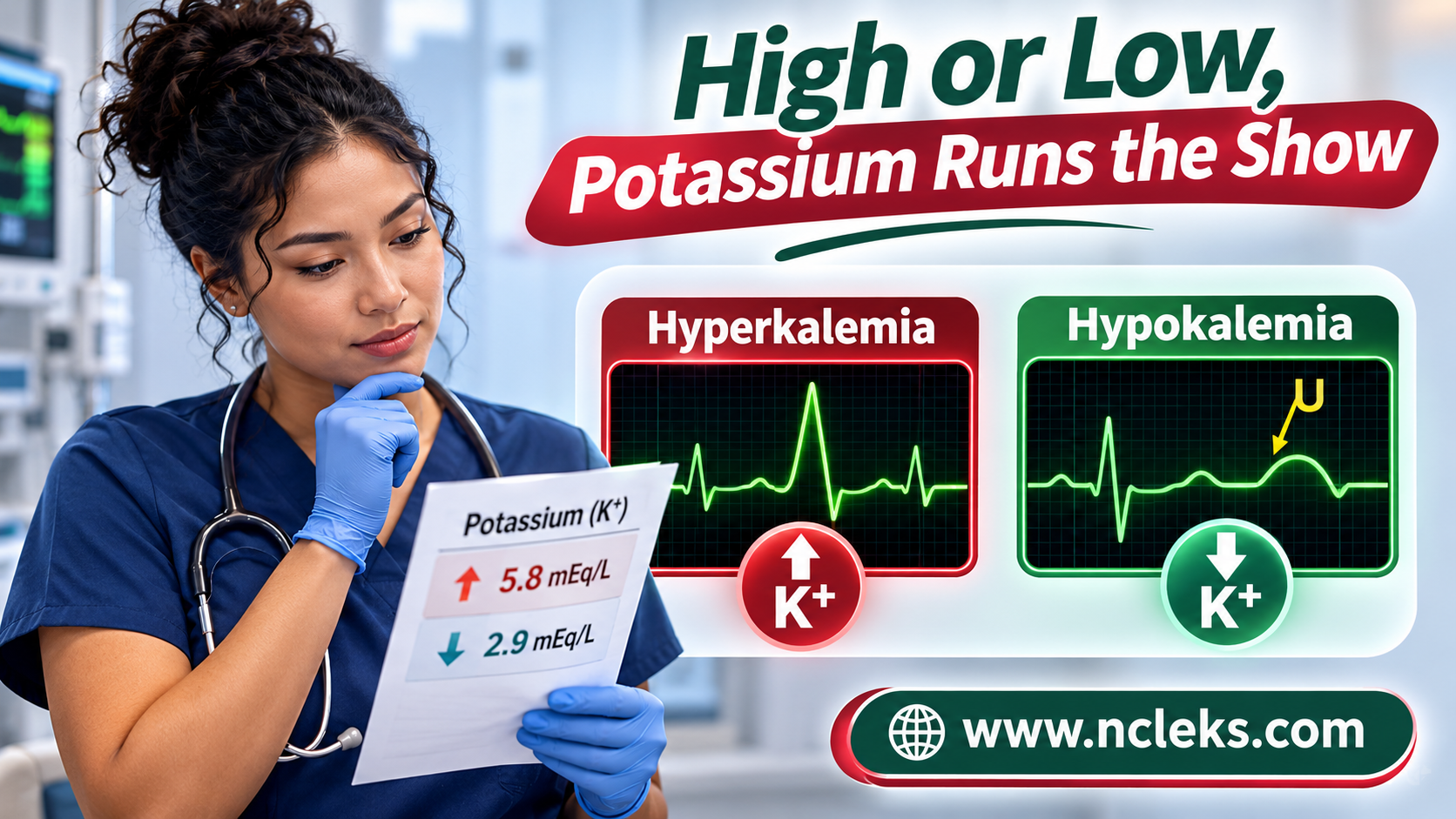
Potassium is closely tied to ABG interpretation. In acidosis, hydrogen ions move into cells and potassium shifts out, which can cause hyperkalemia. In alkalosis, the opposite happens, and hypokalemia becomes a risk. Review hypokalemia vs hyperkalemia to understand the cardiac implications.
When an arterial blood gas question asks for the priority action, think about airway and breathing first. A post-operative patient in respiratory acidosis from opioids needs ventilation support well before anyone considers other interventions. If priority questions trip you up, see ABCs or Maslow and which comes first.

A Simple Study Plan to Master Tic-Tac-Toe ABGs Before Your Exam
Understanding the method once is not enough. You need to practice it until drawing the grid is automatic.
Spend your first study session memorizing the three normal ranges until you can recite them without hesitation. Then write out ten practice ABGs and solve each one using the full grid, even when the answer seems obvious. Speed comes from repetition, not from skipping steps.
Over the next several days, aim for ten to fifteen mixed problems per day. Include uncompensated, partially compensated, and fully compensated values, along with a few mixed disorders. After you name each result, add one sentence describing a likely cause and one sentence describing a nursing action. This turns rote ABG interpretation into clinical reasoning, which is exactly what NCLEX items measure. Flashcards work well here, with the numbers on the front and the interpretation, cause, and priority on the back.
Active recall and spaced repetition will help this stick long after your unit exam. Our article on smart NCLEX study methods for retention explains how to space your reviews. If you are already in board prep mode, fold ABG drills into a structured schedule like the one in how to pass the NCLEX in 30 Days.
On test day, write the grid on your scratch paper before you read the first arterial blood gas question. That small habit keeps you calm and consistent. With steady practice, the tic-tac-toe ABG method will turn one of the most feared topics in nursing school into a reliable source of points.



No comments yet. Be the first to comment!