HESI vs TEAS: Which Nursing Entrance Exam Is Easier?
HESI vs TEAS: The Short Answer Most Students Need
If you are applying to nursing programs, you have probably noticed that some schools require the ATI TEAS while others require the Elsevier HESI A2. Most applicants quickly want to know which one is easier. The HESI vs TEAS debate comes up constantly among pre-nursing students, and the honest answer is that neither nursing entrance exam is truly easy. One of them will probably feel easier to you, though, depending on your academic strengths, your timeline, and how well you handle time pressure.
Students who have taken both tests usually describe the HESI A2 as more straightforward and the TEAS 7 as more demanding. The HESI A2 tends to test recall of vocabulary, grammar rules, and basic math in a predictable format. The TEAS 7 asks you to interpret passages, analyze charts, and apply anatomy and physiology concepts under tighter time limits. For a closer look at scoring and difficulty, our comparison of TEAS 7 vs HESI A2 difficulty covers score expectations in detail.
This article focuses on a practical question. When you weigh HESI vs TEAS, which nursing entrance exam gives you the better chance at a competitive score? Keep in mind that you usually do not get to choose freely, because each program specifies the test it accepts. If you are applying to several schools, however, knowing the differences can help you decide where to apply first and how to divide your study time. Admission is tight, and understanding how competitive nursing school admissions are will show you why every percentage point counts.
How the TEAS 7 Is Structured
The ATI TEAS 7 is a standardized nursing entrance exam with 170 questions completed in 209 minutes. Of those questions, 150 are scored, and 20 are unscored pretest items mixed in throughout the test. Because you cannot tell which items are pretest questions, you need to treat every question as if it counts.
The test is divided into four sections. Reading has 45 questions in 55 minutes and covers key ideas, craft and structure, and integration of knowledge. Math has 38 questions in 57 minutes and focuses on numbers, algebra, measurement, and data interpretation, with an on-screen calculator provided. Science is the largest section, with 50 questions in 60 minutes. English and Language Usage is the fastest section, with 37 questions in 37 minutes, which works out to roughly one minute per question.
Science is the section that separates strong TEAS scores from average ones. Human anatomy and physiology make up the largest share of the science questions, followed by biology, chemistry, and scientific reasoning. Many applicants underestimate how detailed the body systems questions can be. Our TEAS 7 anatomy and physiology study guide breaks down which systems appear most often.
The TEAS reports a total composite score along with section scores, and every school requires the full test. You cannot skip a section you dislike. That fixed structure is one reason many students find the TEAS harder overall, and our article on whether the TEAS 7 exam is hard explains what most applicants struggle with.

How the HESI A2 Is Structured
The HESI A2 works differently because each nursing school decides which sections you take. Elsevier offers academic sections in math, reading comprehension, vocabulary and general knowledge, grammar, anatomy and physiology, biology, chemistry, and physics. There are also unscored learning style and personality profile sections that some programs include. A common combination is math, reading, vocabulary, grammar, and anatomy and physiology, but your school may add or remove sections.
Most academic sections contain around 50 questions, while the science sections such as anatomy and physiology, biology, and chemistry are typically shorter at about 25 questions each. Time limits are also set by the school, and a full battery can take around four hours. Because the time per question is usually more generous than on the TEAS, many students say the HESI A2 feels less rushed.
Scores are reported for each section along with a cumulative score. Many programs look for section scores of 75 to 80 percent or higher, and some set a minimum score for specific sections like math or anatomy and physiology. Before you begin studying, confirm exactly which sections your school requires. Our overview of the HESI A2 format, subjects, and passing tips is a good starting point.
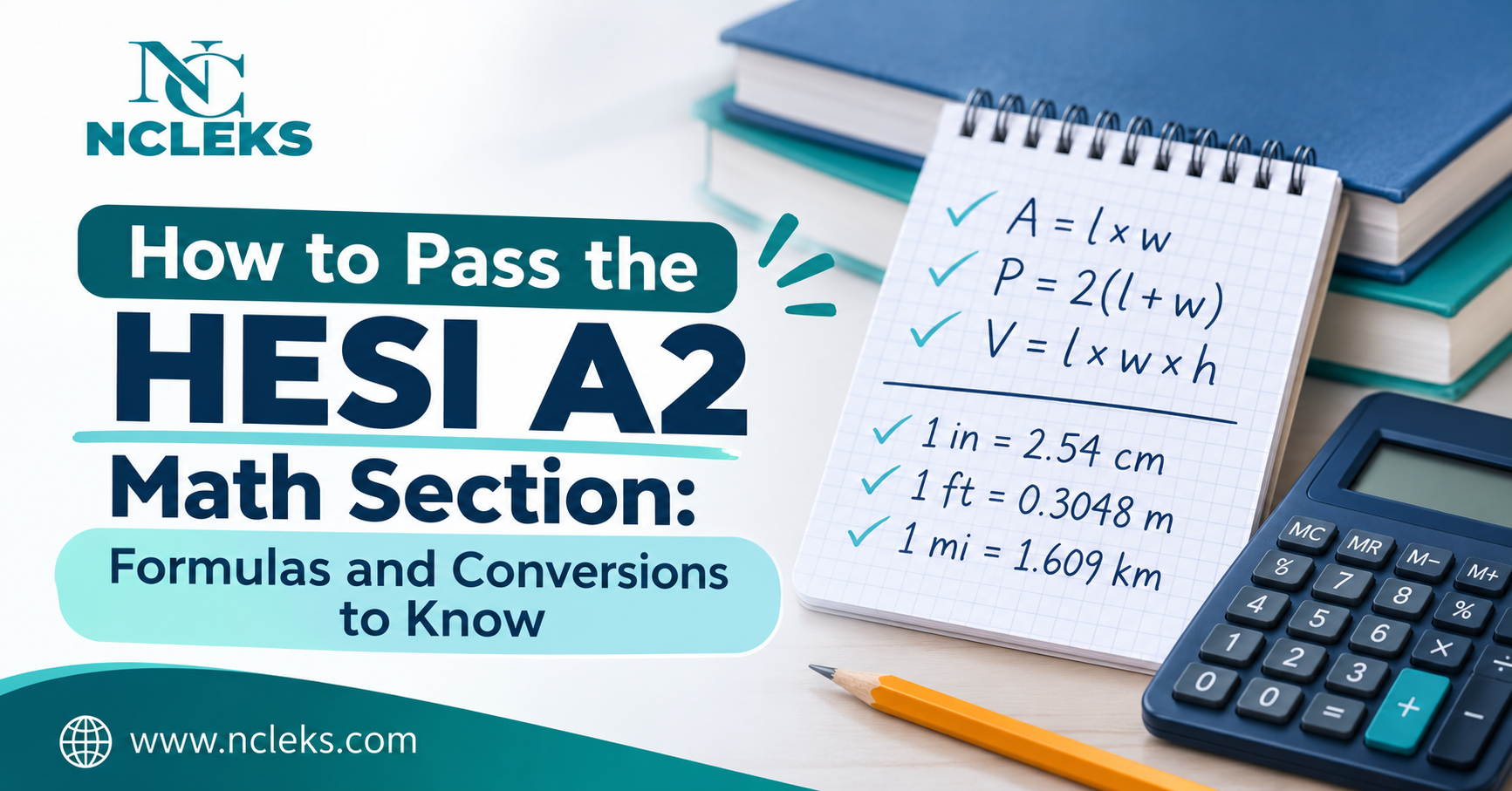
In the HESI vs TEAS comparison, this flexibility is a real advantage. If your program does not require chemistry or physics, you can put your energy into the sections that count. The math section deserves early attention, since it relies on conversions and formulas that are easy to master with practice. Review our guide to HESI A2 math formulas and conversions to get started.
Section by Section: Where Each Nursing Entrance Exam Gets Harder
Comparing HESI vs. TEAS one subject at a time gives you a clearer picture than an overall ranking. In math, the HESI A2 focuses heavily on practical skills such as fractions, decimals, ratios, household and metric conversions, Roman numerals, and military time. These topics connect directly to medication math. TEAS math includes more algebra, word problems, and data interpretation from tables and graphs. Students who are confident with arithmetic but weaker in algebra often score higher on the HESI.
Reading also differs. HESI reading passages tend to ask direct questions about main ideas, supporting details, and author purpose. TEAS reading adds more analytical tasks, such as evaluating arguments, comparing sources, and interpreting graphics, so you have to read more carefully in less time.
For language skills, the HESI separates grammar and vocabulary into distinct sections. The vocabulary section includes many healthcare terms, which means focused memorization pays off quickly. TEAS English blends grammar, punctuation, sentence structure, and vocabulary in context, all under a one-minute-per-question pace. Our post on essential grammar rules for the TEAS English section covers the rules that show up most often.
Science is the biggest difference between the two tests. The TEAS science section is broad and includes scientific reasoning questions that ask you to interpret experiments. The HESI splits science into shorter, separate sections, and many schools only require anatomy and physiology. If you are taking the TEAS, review our list of high-yield TEAS biology topics so that cell structure, genetics, and macromolecules do not catch you off guard.

Which Exam Will Feel Easier for You?
The best way to settle the HESI vs. TEAS question is to think about how you learn and how you perform under pressure. If you are a strong memorizer who does well with flashcards, vocabulary lists, and formula sheets, the HESI A2 will probably feel easier. Much of its content rewards recall, and a disciplined student can raise a score significantly in a few weeks of focused review.
If you are a reasoning-based learner who enjoys analyzing data and connecting ideas, you may actually prefer the TEAS. Its questions reward understanding over memorization, and students with strong science backgrounds from courses like anatomy and physiology or general chemistry often feel at home in the science section. The challenge is speed, so if you tend to run out of time on tests, the TEAS pacing will be your main obstacle.
Your previous coursework also matters. Applicants who completed anatomy and physiology recently have a clear advantage on either nursing entrance exam, but especially on the TEAS. Applicants who have been out of school for several years often find the HESI more manageable because its sections are shorter and more predictable.
Testing logistics can also shape your experience. The TEAS can be taken at a testing center or, at some schools, through remote proctoring, and each setting has its own pros and cons. Our article on taking the TEAS online vs. at a testing center can help you choose the environment where you will focus best. Whatever the format, choosing the right setting reduces stress and protects your score.

How to Prepare for Either Nursing Entrance Exam
Whichever test your school requires, the preparation process is similar. Start with a timed diagnostic practice test before you open a single review book. Your baseline score shows you which sections need the most work, so you do not waste hours reviewing material you already know. Retake practice tests every one to two weeks to track your progress and adjust your plan.
Plan for about four to eight weeks of consistent study, with short daily sessions rather than occasional marathon days. Spend the most time on your weakest section, but review every section at least once a week so nothing slips. For the HESI, build vocabulary and conversion flashcards early and review them daily. For the TEAS, practice timed science and reading sets so the pace feels normal by test day. Practice questions are more valuable than passive rereading because they train you to recognize how each nursing entrance exam phrases its questions.
As test day approaches, shift from learning new content to reinforcing what you know. A structured final week helps you stay calm and focused, and our 7-day guide for the week before the TEAS exam works well as a template for HESI students too. Get enough sleep, confirm your testing location and ID requirements, and avoid cramming the night before.
In the end, the HESI vs TEAS question matters less than how well you prepare. A student who studies strategically for the harder test will outscore a student who coasts into the easier one. Use the practice exams and flashcards on NCLEKS to build confidence, and treat your entrance exam as your first step toward thinking like a nurse.

No comments yet. Be the first to comment!