How to Pass the TEAS English Section: Essential Grammar Rules to Know
What the TEAS 7 English Section Actually Tests
Many nursing applicants underestimate the TEAS English section. They spend weeks on science and math and then assume their everyday reading and writing habits will carry them through English. That assumption costs points. The test does not reward sounding good. It rewards knowing the specific grammar, punctuation, and usage conventions that test writers use to build wrong answers. The good news is that a focused set of TEAS grammar rules covers most of what you will see. Once you learn them, this section can become one of your most reliable scores.
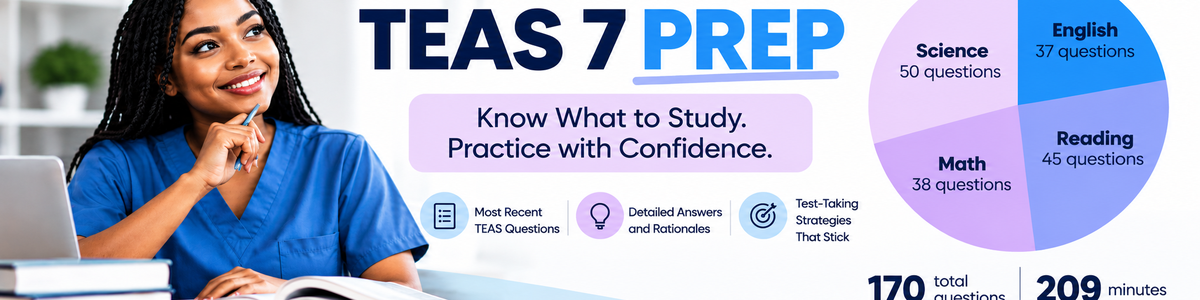
The TEAS 7 English and Language Usage test contains 37 questions in 37 minutes. Thirty-three are scored, and four are unscored pretest items. You will not know which ones are unscored, so treat every question as if it counts. The content falls into three areas. Conventions of Standard English covers spelling, punctuation, and sentence structure. Knowledge of language covers grammar, style, and how tone and context shape meaning. Using Language and Vocabulary to Express Ideas in Writing covers word meaning, context clues, and word parts such as roots, prefixes, and suffixes.
That works out to about one minute per question, so speed matters as much as knowledge. If you are wondering how this section compares to the rest of the exam, our breakdown of how hard the TEAS 7 exam really is explains where most applicants struggle. Because programs often weigh English scores in admission decisions, it also helps to understand how competitive getting into nursing school can be.
Subject-Verb Agreement and Pronoun Rules
If you master only one area before test day, make it an agreement. Subject-verb agreement and pronoun agreement show up constantly in the TEAS English section because they are easy to disguise. The core rule is simple. A singular subject takes a singular verb, and a plural subject takes a plural verb. The trap is that the test separates the subject from the verb with a prepositional phrase. In the sentence "The list of medications is on the chart," the subject is "list," not “medications,” so the verb must be “is.” A reliable strategy is to cross out any phrase starting with "of," "in," "with," or “along with” and read the sentence again.
Indefinite pronouns are another favorite. Words like each, everyone, either, neither, nobody, and anybody are singular, so "Each of the nurses has a badge" is correct. Compound subjects joined by and are usually plural. When subjects are joined by "or" or “nor,” the verb agrees with the subject closest to it, as in "Neither the doctor nor the nurses were available."
Pronoun agreement follows the same logic. A pronoun must match its antecedent in number and be clear about which noun it replaces. “When the patient spoke to the nurse, she seemed upset" is unclear, because she could mean either person. You also need to know pronoun case. Use subject pronouns such as I, he, she, we, and they as subjects. Use object pronouns such as me, him, her, us, and them after verbs and prepositions. "Between you and me" is correct; "between you and I" is not. Applicants comparing entrance exams will find this area tested heavily on both, as our guide on TEAS 7 vs. HESI A2 explains.
Punctuation Rules That Appear Again and Again
Punctuation questions on the TEAS 7 English test are predictable once you know the patterns. Commas do most of the work. Use a comma before a coordinating conjunction (for, and, nor, but, or, yet, so) when it joins two complete sentences. Use commas after introductory phrases, around nonessential information, and between items in a series. A comma alone cannot join two independent clauses. That error is called a comma splice, and it is one of the most heavily tested TEAS grammar rules.
Semicolons fix comma splices. A semicolon joins two closely related independent clauses without a conjunction: "The patient refused breakfast; she said she felt nauseated. " Semicolons also come before conjunctive adverbs such as "however," "therefore," and “consequently” when they connect two complete thoughts, followed by a comma. Colons introduce a list, an explanation, or a quotation, but only after a complete sentence. "The kit includes gloves, gauze, and tape" is incorrect because the words before the colon do not form a full sentence.
Apostrophes show possession or contraction, never plurals. One nurse's station takes 's, while several nurses' stations place the apostrophe after the s. Watch the most common apostrophe trap of all. It's always means "it is" or "it has," while its is possessive. If you can replace the word with "it is," use the apostrophe. Quotation marks also appear occasionally; in American English, periods and commas go inside the closing quotation mark. Building a habit of checking punctuation the way you check science terms, like you would when working through our TEAS 7 anatomy and physiology study guide, will pay off across the whole exam.
Sentence Structure: Fragments, Run-Ons, Modifiers, and Parallelism
The TEAS English section frequently asks you to identify which version of a sentence is correct or to choose the best way to combine two sentences. To answer quickly, you need to recognize four structural problems. A fragment is an incomplete sentence missing a subject, a verb, or a complete thought. "Because the patient was dizzy" is a fragment, since the word “because” makes it dependent. A run-on joins two independent clauses with no punctuation at all, and the fix is a period, a semicolon, or a comma plus a coordinating conjunction.
Misplaced and dangling modifiers are subtle but very testable. A modifier should sit right next to the word it describes. In "Walking into the room, the monitor beeped loudly," the sentence suggests the monitor was walking. A correct version names who was walking: "Walking into the room, the nurse heard the monitor beep loudly." When you see an introductory phrase ending in a comma, immediately ask who or what is performing that action.
Parallel structure means items in a list or comparison share the same grammatical form. "The nurse is responsible for assessing, documenting, and educating patients" breaks parallelism; the fix is "assessing, documenting, and educating." You should also know the four sentence types the test may name: simple, compound, complex, and compound-complex. A complex sentence has one independent clause and at least one dependent clause, while a compound-complex sentence has two or more independent clauses plus a dependent clause. Science passages, such as those in our review of TEAS 7 hormones you must know, are full of complex sentences, so practicing structure helps your reading comprehension too.
Spelling, Commonly Confused Words, and Context Clues
A large share of TEAS 7 English questions focus on vocabulary and word choice rather than strict grammar. Commonly confused words appear often, so learn the pairs that test writers love. “Affect” is usually a verb and effect is usually a noun. Than compares, while then refers to time. Their, there, and they're show possession, place, and "they are." “Accept” means to receive,, and “except” means to exclude. “Principal” refers to a person or main idea, while “principle” means a rule or belief. Write these pairs on flashcards with a sample sentence for each.
Spelling rules matter as well. Remember "i before e except after c" along with its exceptions such as "weird" and “neither.” When adding a suffix to a word ending in silent e, drop the e before a vowel suffix (hope becomes hoping), but keep it before a consonant suffix (hopeful). Know the plural rules for words ending in y, f, and o.
For unfamiliar vocabulary, use context clues and word parts. Medical-style roots such as cardi- (heart), hepat- (liver), and -itis (inflammation), along with prefixes like hypo-, hyper-, and dys-, appear frequently. If you are also considering programs that use a different entrance test, our overview of the HESI A2 nursing entrance exam shows that vocabulary skills transfer well. Applicants returning to school after years away may find our article on getting into nursing school without prerequisites useful for planning their path.

A Study Plan and Test-Day Strategy for the TEAS English Section
Rather than reading a grammar textbook cover to cover, organize your study around the TEAS grammar rules covered in this guide. Spend the first week on agreement and punctuation, since they generate the most questions. Use the second week for sentence structure and modifiers, and the third for vocabulary, spelling, and word parts. Each day, complete 15 to 20 practice questions and keep an error log listing the rule behind every question you miss. Patterns appear fast, and reviewing that log is far more efficient than rereading notes. Our article on smart study methods to retain information explains spaced repetition and active recall, which work just as well for grammar as for nursing content.
On test day, pace yourself at roughly one question per minute. Read the full sentence before looking at the answers, and try to spot the error yourself first. When two answers both seem correct, the shorter, clearer option is usually right, because the TEAS English section rewards concise writing over wordy phrasing. Read each answer choice back into the sentence quietly in your head; many errors become obvious when you hear them. Never leave a question blank, since there is no penalty for guessing.
Finally, be realistic about your schedule. Short, consistent sessions beat occasional marathons, and our guide on how many hours a day to study for a nursing exam can help you build a plan that fits your life. With steady practice on these TEAS 7 English topics, you can walk into the exam confident that grammar will strengthen your application rather than hold it back.

No comments yet. Be the first to comment!