How to Pass the HESI A2 Math Section: Formulas and Conversions to Know
What the HESI A2 Math Section Actually Tests
If math makes you nervous, you are not alone. The HESI A2 math section is one of the most important parts of the entrance exam because nursing programs use it to predict how well you will handle dosage calculations later in school. The good news is that the test does not cover calculus or advanced algebra. Instead, it focuses on practical skills. You will see fractions, decimals, ratios, proportions, percentages, basic algebra, Roman numerals, and military time. You will also see the HESI A2 conversions between household and metric units that nurses use every day.
Most versions of the exam contain about 50 math questions. Roughly 40 are scored, and about 10 are unscored pilot items that you cannot identify, so treat every question as if it counts. Your school sets the time limit, but plan for around 50 minutes. An on-screen basic calculator is usually available. It will not save you, however, if you set up a problem incorrectly or forget a conversion factor. That is why memorizing the core HESI A2 math formulas matters more than speed on the keypad.
If you are still learning about the overall format, read our overview of what the HESI A2 nursing entrance exam includes. If you are deciding between entrance tests, it can also help to compare TEAS 7 vs HESI A2 difficulty. The math content on the two exams overlaps, but the emphasis differs. Many programs set minimum math scores of 75 to 80 percent, and some competitive schools expect higher. Taking this section seriously can make or break your application.
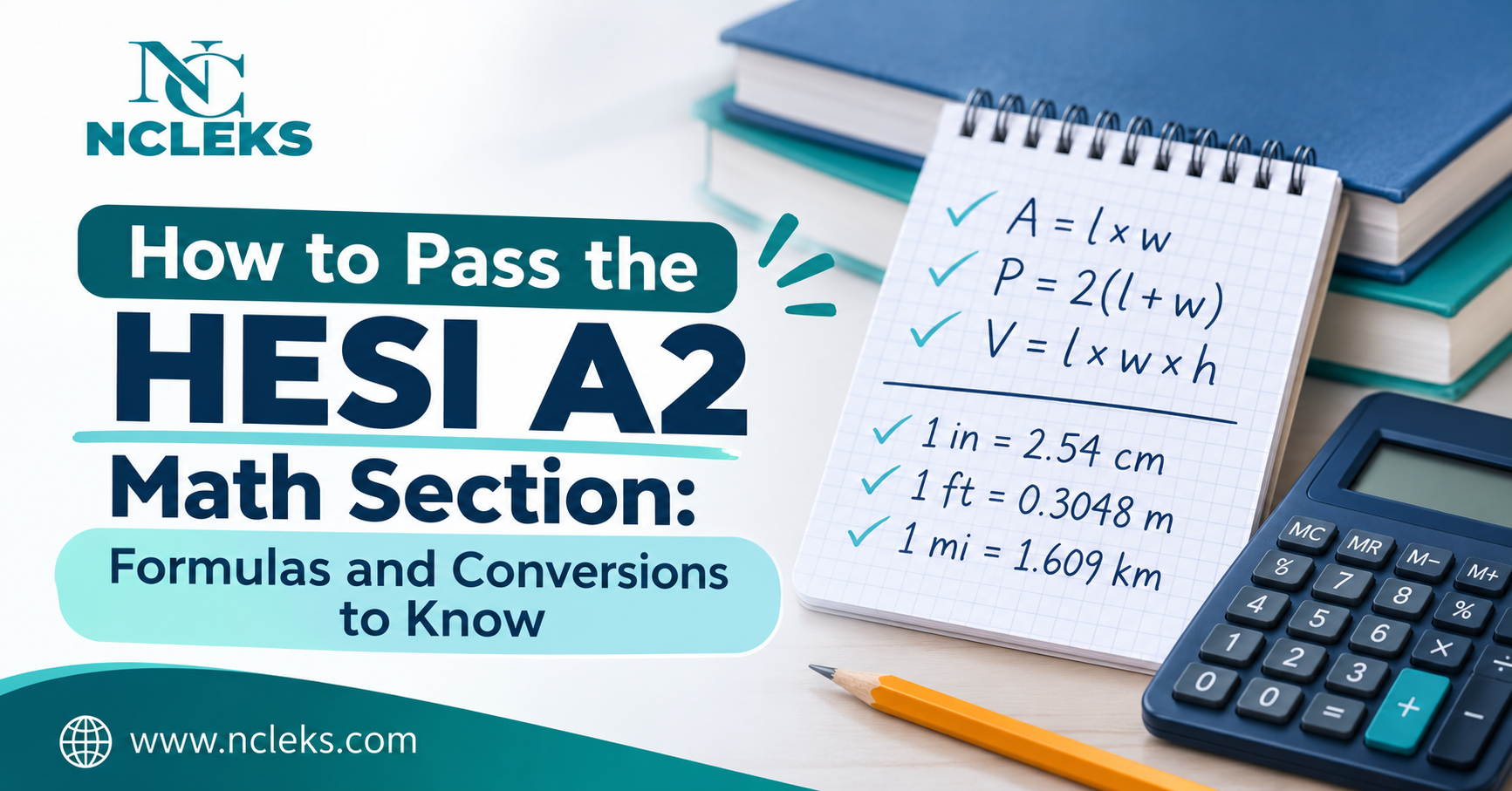
HESI A2 Math Formulas for Fractions, Decimals, Percentages, and Ratios
Fractions show up constantly, so start here. To add or subtract fractions, find a common denominator first. To multiply, multiply the numerators together and the denominators together, then simplify. To divide, keep the first fraction, flip the second, and multiply. Mixed numbers like 2 3/4 should be converted to improper fractions (11/4) before you do anything else. This one habit prevents a large share of careless errors.
For decimals and percentages, remember that converting a decimal to a percent means moving the decimal point two places to the right, so 0.35 becomes 35 percent. Going from percent to decimal moves it two places to the left. The most useful percentage formula is part = percent x whole. For example, 20 percent of 150 is 0.20 x 150, which equals 30. Percent change uses a separate formula: subtract the old value from the new value, divide by the old value, and multiply by 100.
Ratios and proportions are the backbone of the HESI A2 math formulas you will carry into nursing school. Set up two equal fractions, cross-multiply, and solve for the unknown. If 3 tablets contain 750 mg, how much is in 5 tablets? Write 3/750 = 5/x, cross-multiply to get 3x = 3750, and solve for x = 1250 mg. Label your units in every fraction so the setup stays consistent.
Short daily practice works better than marathon sessions for these skills. Our guide on how many hours a day to study for a nursing exam can help you build a realistic schedule around work and family.
The HESI A2 Conversions You Must Memorize
The HESI A2 conversions are where many students lose easy points. They are pure memorization, and the exam rarely provides them for you. Start with the metric system, which works in multiples of 1,000 for the units nurses use most. One kilogram equals 1,000 grams. One gram equals 1,000 milligrams, and one milligram equals 1,000 micrograms. One liter equals 1,000 milliliters, and one milliliter is the same as one cubic centimeter. To move from a larger unit to a smaller one, multiply. To move from a smaller unit to a larger one, divide.
Next, learn the bridges between household and metric measurements. One kilogram equals 2.2 pounds, and one inch equals 2.54 centimeters. One fluid ounce equals 30 milliliters. One teaspoon equals 5 milliliters, and one tablespoon equals 15 milliliters, which means three teaspoons make one tablespoon. One cup equals 8 ounces, or 240 milliliters.
Household volume builds in a predictable chain. Two cups make a pint, two pints make a quart, and four quarts make a gallon. For weight, one pound equals 16 ounces. For length, 12 inches make a foot, and 3 feet make a yard.
Write these on flashcards and quiz yourself in both directions, because the exam may ask you to convert 45 mL into tablespoons just as easily as tablespoons into mL. These same facts reappear in dosage calculation, so learning them now pays off later. When you reach that stage, our tips on studying pharmacology without memorizing everything will build on this foundation.

Temperature, Military Time, and Roman Numerals
Three smaller topics round out the list of HESI A2 math formulas, and they are some of the easiest points on the test once you know the rules.
Temperature conversion requires two formulas. To convert Celsius to Fahrenheit, multiply by 9/5 (or 1.8) and add 32. To convert Fahrenheit to Celsius, subtract 32 first and then multiply by 5/9. A helpful check is to anchor yourself to known values. Normal body temperature is about 37 degrees Celsius, or 98.6 degrees Fahrenheit, and a fever of 38 degrees Celsius equals 100.4 degrees Fahrenheit. If your answer is wildly different from these anchors, recheck the order of your operations.
Military time counts hours from 0000 at midnight to 2359. For any time from 1:00 PM onward, add 12 to the hour, so 3:45 PM becomes 1545. Going the other way, subtract 12 from any hour greater than 12. Two tricky spots catch students often. Midnight is 0000, and 12:30 PM stays 1230. Hospitals chart in military time, so you will use this skill as soon as you start clinicals. Our article on what to expect in your first nursing semester explains how quickly these skills come into play.
Roman numerals use seven symbols: I is 1, V is 5, X is 10, L is 50, C is 100, D is 500, and M is 1,000. When a smaller numeral comes before a larger one, subtract it, so IX equals 9 and XL equals 40. When it comes after, add it, so XV equals 15. These questions are among the most common HESI A2 conversions, and they take only seconds once the subtraction rule is automatic.
How to Set Up Dosage and Word Problems Without Errors
The HESI A2 math section often frames calculations as short clinical word problems. Read the question once for the story and a second time to pull out the numbers and units. Then decide what the question actually wants. Many wrong answer choices are the result of solving for the wrong unit, such as giving pounds when the question asked for kilograms.
Two methods work well. The first is the ratio and proportion setup described earlier. The second is the desired over have formula, which you will use for years in nursing school. Divide the dose ordered (desired) by the dose on hand (have), then multiply by the quantity or vehicle. If a provider orders 500 mg and tablets contain 250 mg each, 500 divided by 250 equals 2 tablets. For liquids, if the order is 250 mg and the bottle contains 125 mg per 5 mL, the calculation is 250/125 x 5, which equals 10 mL.
Always convert units before plugging numbers into any formula. If the order is in grams and the supply is in milligrams, use your HESI A2 conversions first, then calculate. Finally, ask whether the answer makes sense. A patient will not take 40 tablets, and an adult will not weigh 9 kilograms. This quick reasonableness check catches decimal slips that the calculator cannot.
For more ways to work efficiently rather than endlessly, see how to pass nursing school exams without studying all day. To see how these setups evolve into medication math, preview our pharmacology exam 1 questions and answers.

Study Strategy and Test-Day Tips for HESI A2 Math
Begin with a diagnostic practice test to find out where you actually struggle. Many students assume fractions are their weakness when the real problem is forgetting HESI A2 conversions under pressure. Once you know your gaps, spend about two-thirds of your study time on weak areas and one third keeping your strengths sharp. Two to four weeks of consistent practice is enough for most students, especially if you complete 15 to 20 mixed problems a day.
Create a one-page sheet of HESI A2 math formulas and conversion factors. Rewrite it from memory every few days until you can produce it perfectly. On test day, many students jot key facts on their provided scratch material as soon as permitted. That way, they never have to recall 2.2 or 2.54 while also juggling a word problem. Use the on-screen calculator for arithmetic, but do your setup on paper first. If a question stalls you for more than a minute or two, make your best choice and move on, because time spent on one item steals time from easier ones.
Your math score can strongly influence admission decisions. This is especially true at schools where seats are limited, as explained in our breakdown of how competitive nursing school admission is. If you are working toward entry from a nontraditional path, our guide on getting into nursing school without prerequisites offers additional options. With focused review of the HESI A2 math formulas, solid recall of every conversion, and regular timed practice, a strong HESI A2 math score is well within reach.


No comments yet. Be the first to comment!