TEAS Biology High-Yield Topics: Cell Structure, Genetics, and Macromolecules
Why TEAS Biology High-Yield Topics Matter for Your Science Score
If you are preparing for the ATI TEAS 7, the TEAS biology questions can feel like a small but slippery part of the science section. The science portion gives you 50 questions in 60 minutes, and 44 of them count toward your score. Biology makes up roughly nine of those scored items, which sounds manageable until you realize that every missed question pulls down a science score that many nursing programs weigh heavily. If you are wondering how much effort the exam really demands, our breakdown of whether the TEAS 7 exam is hard offers a realistic picture.
The good news is that TEAS biology is predictable. The same three areas appear again and again: cell structure, genetics, and macromolecules. These topics are the foundation for everything you will later learn in anatomy, physiology, pharmacology, and pathophysiology, so the time you invest now pays off well beyond test day. A student who understands why the mitochondria matter will later understand why cells starve during shock, and a student who knows protein structure will later grasp why a high fever can damage enzymes.
Admissions committees know this too. Nursing programs are selective, and a strong science score can separate you from hundreds of other applicants. Our guide on how competitive nursing school admissions are explains why every point counts. In the sections below, you will learn exactly what to know about each high-yield topic and how to study it efficiently.
Cell Structure Essentials: Organelles and Their Jobs
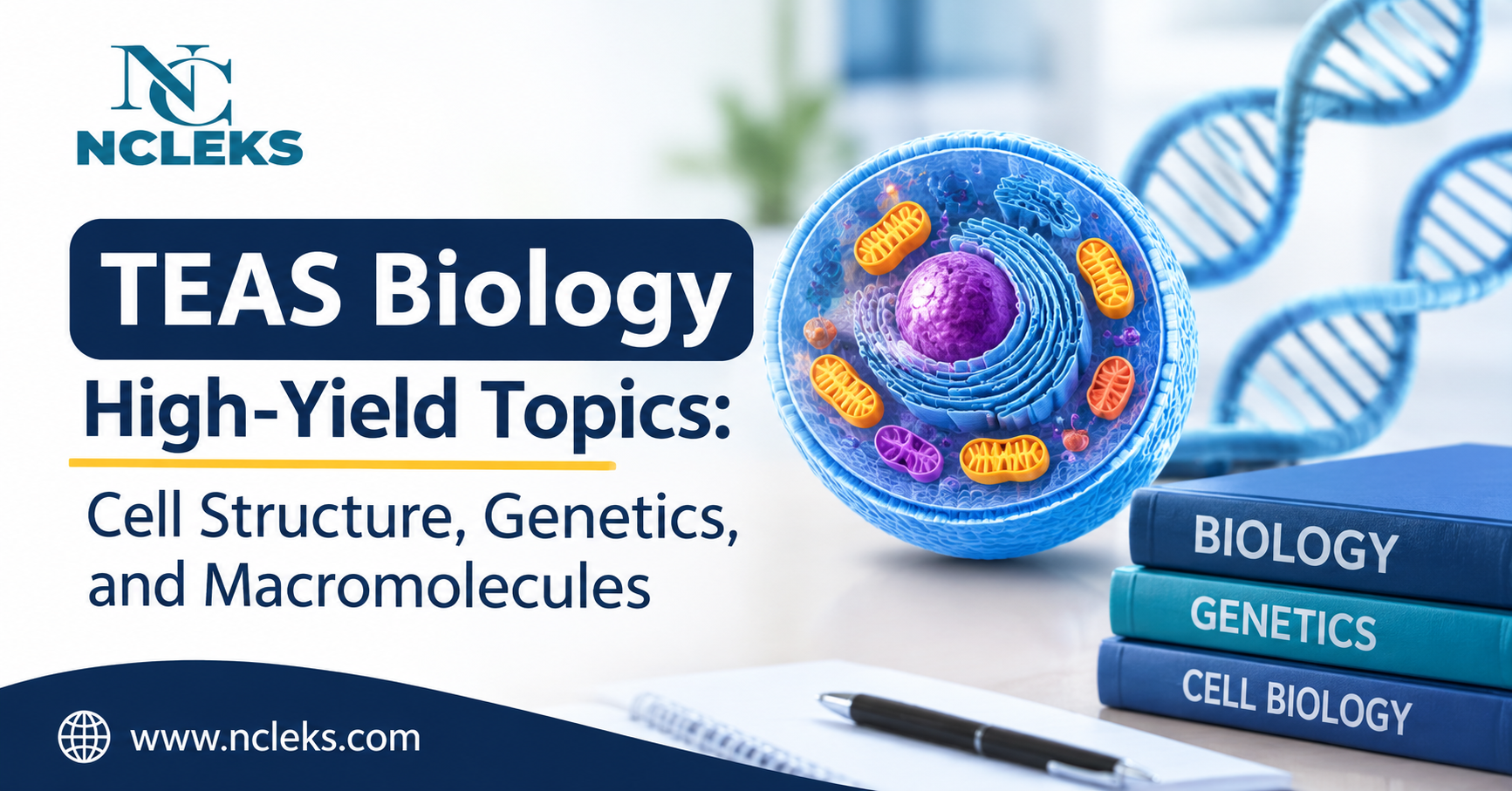
Questions about cell structure usually test whether you can match an organelle to its function. Think of the cell as a small factory. The nucleus is the control center that stores DNA and directs cell activity. The mitochondria are the power plants, carrying out cellular respiration to produce ATP, which is why muscle and heart cells contain so many of them. Ribosomes build proteins, and they can float freely in the cytoplasm or attach to the rough endoplasmic reticulum, giving it its bumpy appearance.
The smooth endoplasmic reticulum lacks ribosomes and focuses on lipid synthesis and detoxification, which explains why liver cells have plenty of it. The Golgi apparatus modifies, sorts, and packages proteins for transport, much like a shipping department. Lysosomes contain digestive enzymes that break down waste and worn-out cell parts. The cytoskeleton provides shape and support, while centrioles help organize the spindle fibers during cell division.
The TEAS also expects you to compare cell types. Prokaryotic cells, such as bacteria, lack a nucleus and membrane-bound organelles, while eukaryotic cells have both. Plant cells differ from animal cells because they have a cellulose cell wall, chloroplasts for photosynthesis, and a large central vacuole for water storage. A common trick question asks which structure appears in both plant and animal cells; the answer is often the cell membrane, mitochondria, or ribosomes. Pairing this review with our TEAS 7 anatomy and physiology study guide helps you connect organelles to the tissues and organs they support.
The Cell Membrane, Transport, and Cell Division
No review of cell structure is complete without the cell membrane. It is a phospholipid bilayer, with hydrophilic phosphate heads facing outward toward water and hydrophobic fatty acid tails facing inward. Embedded proteins act as channels, carriers, and receptors. This arrangement makes the membrane selectively permeable, meaning it controls what enters and leaves the cell.
Transport questions come in two flavors. Passive transport requires no energy and moves substances from high to low concentration. This includes simple diffusion, facilitated diffusion through protein channels, and osmosis, which is the movement of water across a membrane. Active transport requires ATP and moves substances against their concentration gradient. The classic example is the sodium-potassium pump, which moves three sodium ions out of the cell and two potassium ions in. You will see this pump again in nursing school when you study electrolytes and cardiac function, and it is a favorite topic in hormone and nerve signaling questions covered in our post on TEAS 7 hormones you must know.
Cell division rounds out this topic. Mitosis produces two genetically identical diploid daughter cells and is used for growth and tissue repair. Its phases follow the order prophase, metaphase, anaphase, and telophase (PMAT), followed by cytokinesis. Meiosis, in contrast, involves two divisions and produces four genetically unique haploid cells, which are the gametes. Crossing over during prophase I creates genetic variation. If a question mentions sperm, eggs, or halving the chromosome number, think meiosis.

Genetics on the TEAS: DNA, RNA, and Punnett Squares
Many students lose easy points in genetics because they rush through the vocabulary. Start with DNA, a double helix made of nucleotides. Its bases pair in a fixed pattern: adenine with thymine and guanine with cytosine. RNA is single-stranded, uses the sugar ribose instead of deoxyribose, and replaces thymine with uracil. So in RNA, adenine pairs with uracil.
Next, understand protein synthesis. Transcription happens in the nucleus, where DNA is copied into messenger RNA. Translation happens at the ribosome, where transfer RNA reads each three-base codon on the mRNA and delivers the matching amino acid. If a question gives you a DNA sequence such as TAC and asks for the mRNA, the answer is AUG.
Mendelian genetics is the other heavy hitter in TEAS biology. Know that the genotype is the genetic makeup, such as Aa, while the phenotype is the physical trait you can observe. Homozygous means two identical alleles (AA or aa), and heterozygous means two different alleles (Aa). When you cross two heterozygous parents, the Punnett square gives a 3:1 phenotype ratio and a 1:2:1 genotype ratio, meaning a 25 percent chance of a recessive offspring. Also recognize non-Mendelian patterns. In incomplete dominance, a red and white flower produce a pink offspring. In codominance, both alleles show fully, as in type AB blood. Practicing a few Punnett squares daily is far more effective than rereading definitions, a principle that also appears in our guide on how many hours a day to study for a nursing exam.
Macromolecules: Carbohydrates, Lipids, Proteins, and Nucleic Acids
The four biological macromolecules are carbohydrates, lipids, proteins, and nucleic acids, and the TEAS loves to test their building blocks, functions, and elements. Carbohydrates contain carbon, hydrogen, and oxygen. Their monomers are monosaccharides such as glucose, which link into disaccharides like sucrose and polysaccharides like starch, glycogen, and cellulose. Glycogen is how animals store glucose in the liver and muscles, while cellulose gives plant cell walls their rigidity.
Lipids include triglycerides, phospholipids, and steroids. Triglycerides are built from glycerol and three fatty acids and serve as long-term energy storage. Saturated fats have no double bonds and are solid at room temperature, while unsaturated fats have double bonds and are usually liquid. Steroids such as cholesterol, estrogen, and testosterone are lipids too, which surprises many students.
Proteins are made of amino acids joined by peptide bonds, and they contain nitrogen in addition to carbon, hydrogen, and oxygen. Enzymes, antibodies, hemoglobin, and many hormones are proteins. Heat or extreme pH can denature a protein, changing its shape and destroying its function. Nucleic acids, DNA and RNA, are built from nucleotides, each containing a phosphate group, a five-carbon sugar, and a nitrogenous base. Because of that phosphate, nucleic acids are the macromolecules that contain phosphorus.
Finally, remember how these molecules are built and broken down. Dehydration synthesis joins monomers by removing water, and hydrolysis breaks polymers apart by adding water. If you can explain that sentence in your own words, you have mastered a concept that appears frequently on the exam.
How to Study TEAS Biology Efficiently and Avoid Common Traps
The most effective way to study TEAS biology is to build comparison tables by hand: organelle vs. function, mitosis vs. meiosis, DNA vs. RNA, and each macromolecule with its monomer, bond, and example. The exam frames its questions around comparison, so practicing it trains your brain to spot differences quickly. Then test yourself with flashcards rather than rereading notes, since active recall builds stronger memory.
Watch for common traps. Students often confuse the Golgi apparatus with the endoplasmic reticulum, mix up genotype and phenotype, or forget that RNA uses uracil. Read every answer choice before selecting, because two options may both sound correct until you notice one detail, such as haploid versus diploid. Strong reading habits help here, and the same careful approach you use in our guide to passing the TEAS English section applies to science questions too.
Plan your test environment early as well. Whether you test remotely or in person can affect your focus, so review taking the TEAS online versus at a testing center before you register. If your first attempt does not go as planned, our article on how long to wait to retake the TEAS lays out policies and a smarter retake strategy. Mastering cell structure, genetics, and macromolecules now gives you a solid foundation, and you can reinforce it with the practice exams and flashcards available on NCLEKS.COM.


No comments yet. Be the first to comment!