Taking the TEAS Test Online vs. at a Testing Center: Which Is Easier?
TEAS Test Online vs. TEAS Testing Center: Understanding Your Options
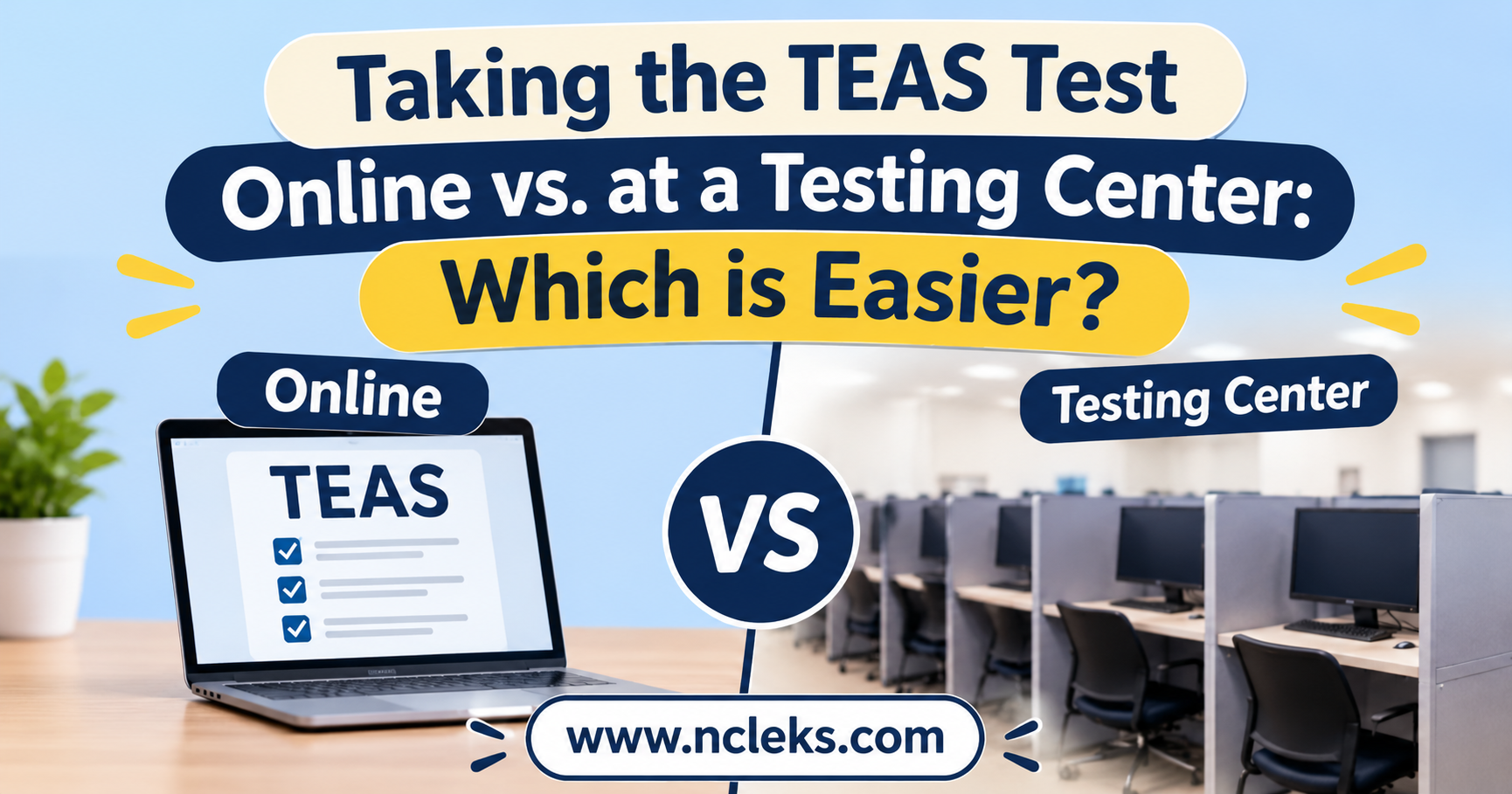
Choosing where to sit for the ATI TEAS can seem like a minor detail, but the setting you pick affects your comfort, your stress level, and sometimes whether your nursing program will accept your score. Most applicants have two main choices. You can take the TEAS test online with a remote proctor from home, or you can sit for the exam in person at a TEAS testing center, such as a PSI location or your nursing school's own testing lab.
The test itself is the same in both settings. You get the same TEAS 7 content, the same four sections (Reading, Math, Science, and English and Language Usage), 170 total questions, and about 209 minutes of testing time. The difficulty of the questions does not change based on where you test. What changes is everything around the questions: the room, the rules, the technology, and the people monitoring you.
That means "easier" depends on your personal situation. A quiet home with reliable internet can make remote testing feel relaxed. A crowded apartment or a weak Wi-Fi signal can turn it into a stressful experience. Before you choose, check your program's admission requirements carefully. Some schools only accept scores from their own campus or an approved in-person site, while others accept remote scores sent through ATI. Admissions committees take these details seriously, as explained in this guide on how competitive getting into nursing school really is. If you are still deciding how much to worry about the exam overall, read whether the TEAS 7 exam is hard before you register.
How Taking the TEAS Test Online Actually Works
When you take the TEAS test online, you register through your ATI account and choose the remote proctored option. On test day, a live or recorded proctor monitors you through your webcam and microphone for the entire exam. You will show your government-issued photo ID to the camera and complete a room scan that displays your desk, walls, floor, and the space around your computer.
The technical requirements are strict. You generally need a desktop or laptop computer with a working webcam, a microphone, and a stable internet connection. Tablets, phones, and many Chromebooks are not supported, so confirm your device meets ATI's current system requirements and run any compatibility check well before your appointment. Your testing room should be private, quiet, and well-lit, with a clear desk and no notes, extra screens, or other people walking through.
Behavior rules matter just as much as equipment. Looking away from the screen for long periods, reading questions aloud, wearing headphones, or having someone enter the room can get your session flagged or ended. The ATI TEAS includes one scheduled 10-minute break after the math section, and you should stay within view of the camera unless the proctor says otherwise. A built-in on-screen calculator is available during math, so you do not need to bring your own.
Many students find remote testing comfortable once they know these expectations. Plan your study schedule so you finish content review a few days early and have time for a full technical run-through. This realistic daily study plan for nursing exams can help you build that buffer.

What to Expect at a TEAS Testing Center
Sitting for the exam at a TEAS testing center feels more like a traditional standardized test. You arrive early, check in with staff, present your ID, and store your phone, bag, watch, and any snacks in a locker. Staff then seat you at an individual workstation, often a small cubicle, where the ATI TEAS is already loaded and ready to begin.
One of the biggest advantages is that someone else handles the technology. If your computer freezes or the exam software has a problem, an on-site proctor can step in immediately. You do not need to worry about your home internet dropping, your webcam failing, or a family member accidentally interrupting your session. Most centers provide scratch paper or a dry-erase board and an on-screen calculator, so you only need to bring yourself and your identification.
There are trade-offs. You may be testing alongside other people taking different exams, which can mean typing sounds, coughing, and people entering or leaving the room. Some centers offer noise-reducing headphones or earplugs, but not all do. You also have to factor in travel time, parking, and limited appointment dates, which can be a real challenge if the nearest TEAS testing center is an hour or more away.
Preparing for an in-person exam is similar to preparing for any proctored licensing test later in your career. Reviewing a checklist like what to bring on NCLEX test day is good practice for building organized test-day habits now, especially around ID requirements and arrival times.
Pros and Cons: Which Format Is Really Easier?
The honest answer is that neither format makes the questions easier, but one may make the experience easier for you. Taking the TEAS test online removes your commute, lets you test in a familiar space, and often gives you more flexibility with appointment times. For students who feel anxious in unfamiliar environments, being at home can lower stress and help them focus.
However, remote testing brings its own pressure. Some students feel uneasy knowing a proctor is watching every movement, and they worry about being flagged for innocent behavior like glancing away while thinking. Technical issues are the biggest risk. A dropped connection, an outdated operating system, or a webcam that stops working can delay or cancel your exam, and solving those problems while the clock is running can be rattling.
A TEAS testing center offers a controlled, predictable environment with technical support on site. You show up, test, and leave. The downsides are travel, fixed schedules, and the possibility of distractions from other test takers. For students with long commutes, the stress of driving and finding parking can offset some of the benefits of a stable setting.
Think about which risks you can control. If your home setup is solid and quiet, remote testing removes many logistical hassles. If your home life is unpredictable, the center protects you from interruptions you cannot prevent. Students comparing entrance exams often weigh similar trade-offs, which this breakdown of TEAS 7 vs. HESI A2 difficulty discusses in more detail.

Who Should Choose Each Testing Option
Some student profiles fit the TEAS test online especially well. If you live in a rural area far from the nearest testing site, work irregular hours, or care for children and cannot easily arrange a long trip, testing from home can save you hours. It also works well for students who have a dedicated, private room with a door that closes, a reliable wired or strong wireless connection, and a computer that passes ATI's system check without issues. Parents in particular should plan childcare for the full testing window, since even a brief interruption can be a problem. This guide for balancing motherhood and nursing school exams offers practical ideas for protecting your focus time.
A TEAS testing center is usually the better choice if you share your living space with roommates or family members who may be home, if your internet is inconsistent, or if you use an older laptop. It is also a smart option for students who know they get anxious about technology failing or who find it hard to sit perfectly still in front of a webcam. Some people simply concentrate better in a formal setting that signals "this is test time."
Your program's policies should be the final deciding factor. If your school requires an in-person ATI TEAS, the decision is made for you. If both options are accepted, choose the environment where you are least likely to be distracted, not the one that sounds most convenient on paper. A calm, focused testing session is what helps your score reflect what you actually know.
Preparing for Test Day No Matter Where You Test
Your testing location matters far less than your content preparation. The ATI TEAS rewards students who know the material well, especially in Science, which many applicants find to be the most challenging section. Anatomy and physiology questions make up a large share of that section, so build a strong foundation with this high-yield TEAS 7 anatomy and physiology study guide. Endocrine concepts appear frequently as well, and reviewing the TEAS 7 hormones you must know can help you pick up quick points.
Practice under conditions that match your chosen format. If you plan to take the TEAS test online, complete full-length timed practice tests at the same desk and computer you will use on exam day. Sit for the full time without checking your phone, and get used to using an on-screen calculator. If you will test at a TEAS testing center, try practicing in a library or another public space where small background noises happen, so you are not thrown off by a cough or a door closing.
Treat timing seriously in both settings. Each section has its own time limit, and you cannot move back to a previous section once it ends. Learning to pace yourself, flag hard questions, and keep moving is one of the most valuable skills you can build. Use NCLEKS practice exams and flashcards to strengthen weak areas and track your progress week by week.
If Test Day Does Not Go as Planned
Even with careful planning, things can go wrong. A remote session might end because of a technical failure, or you may simply not reach the score your program requires. If a technical issue interrupts your remote exam, contact ATI support as soon as possible and document what happened, including screenshots or error messages if you can capture them. Testing center staff typically file a report for you if a problem occurs on site, which is another reason some students prefer in-person testing.
If your score falls short, remember that many applicants take the ATI TEAS more than once. Each school sets its own rules about how many attempts it accepts and how long you must wait between tests, so review those policies before scheduling again. This guide on how long to wait before retaking the TEAS test walks you through common policies and smart retake strategies.
A retake is also a good time to reconsider your testing format. If distractions at home affected your performance, try a testing center next time. If travel and an unfamiliar environment raised your anxiety, a well-prepared remote setup may suit you better. Some programs also accept a different entrance exam, so if you are applying to multiple schools, it may help to learn about the HESI A2 format and subjects. Whichever path you choose, focus on preparation first and logistics second, and your score will follow.


No comments yet. Be the first to comment!