Therapeutic Communication in Nursing: Examples and Phrases for Mental Health Exams
Why Therapeutic Communication Matters on Mental Health Nursing Exams
If you have ever stared at four answer choices that all sound kind, you already know why therapeutic communication is one of the most tested and most misunderstood topics in mental health nursing. On a psych nursing exam, on ATI and HESI specialty tests, and on the NCLEX, communication questions rarely ask you to define a technique. Instead, they give you a client statement and ask which nurse response is most appropriate. Every option may sound polite, but only one keeps the focus on the client, invites them to share more, and protects their safety.
Therapeutic communication is purposeful, client-centered interaction designed to encourage expression of feelings, build trust, and support the client's own problem-solving. It differs from social conversation, where both people share personal stories and offer opinions. In a therapeutic relationship, the nurse's own feelings, experiences, and advice stay in the background. That one idea—keep the focus on the client—will help you eliminate at least two options in most exam questions.
These questions matter beyond your psych course. The NCLEX tests psychosocial integrity across every client population, so a postpartum mother, a newly diagnosed cancer patient, and a teenager with an eating disorder may all appear in communication items. Pairing this skill with broader nursing test-taking strategies for NCLEX-style questions will make these items far more predictable. The rest of this guide gives you exact phrases, the traps to avoid, and the scenarios that show up most often.

Therapeutic Communication Techniques and Example Phrases to Know
Most correct answers on a psych nursing exam use one of a small group of techniques. Open-ended questions and broad openings invite the client to lead, such as “What would you like to talk about today?” or “Tell me more about what happened last night.” Offering self shows availability without conditions: “I will sit with you for a while.” This works especially well for withdrawn or depressed clients who are not ready to talk yet.
Restating and reflecting send the client's words or feelings back so they feel heard. If a client says, “My husband never listens to me,” a reflecting response would be, “You feel ignored by your husband.” Clarifying asks the client to explain something vague: “I'm not sure I follow. Can you give me an example?” Focusing narrows a scattered conversation to one topic, which helps anxious clients: “Let's talk more about the argument with your mother.”
Silence is a legitimate technique. Purposeful silence gives the client time to organize thoughts, and exam writers sometimes make “Sit quietly with the client” the correct answer. Making observations, such as “I notice you are clenching your fists,” points out behavior without judging it. Presenting reality is used with hallucinations or confusion: “I don't hear any voices, but I understand they seem real to you.” Summarizing ties the key points together at the end of an interaction.
When you study these, convert each technique into a phrase you would actually say out loud. The goal on mental health nursing exams is fast recognition, so the more examples you read, the quicker you will spot the correct pattern. Many correct responses also gather more data before the nurse acts, which connects directly to the assessment step of the nursing process (ADPIE).

Nontherapeutic Responses That Show Up as Wrong Answers
Knowing what not to say is just as valuable as knowing the right phrases. Exam writers build distractors from a predictable set of nontherapeutic responses, and once you can name them, you can cross them out quickly.
False reassurance is the most common trap. Statements like “Everything will be fine” or “Don't worry, your doctor is the best” dismiss the client's feelings and promise outcomes the nurse cannot guarantee. Asking “why” questions, such as “Why did you stop taking your medication?”, tends to make clients defensive because it demands justification. A better version is “Tell me what led you to stop your medication.”
Giving advice (“If I were you, I would leave him”) takes problem-solving away from the client. Giving approval or disapproval (“That's a good decision” or “You shouldn't feel that way”) imposes the nurse's values. Changing the subject, especially when the client raises something uncomfortable like death, signals that the topic is off-limits. Defending (“Our staff would never ignore you”) protects the facility instead of exploring the client's concern. Clichés, belittling feelings, and closed yes-or-no questions also appear frequently.
One rule helps here: if a response focuses on the nurse, the provider, the hospital, or the distant future, it is probably wrong. If it focuses on the client's present feelings, it is probably right. This elimination process mirrors the reasoning behind the difference between “first” and “best” on NCLEX questions, because communication items almost always ask for the best or most appropriate response. In select-all-that-apply items, run the same filter on each option independently, as explained in this guide to tackling SATA questions on the NCLEX.

Therapeutic Communication Examples for Common Psych Scenarios
Certain client situations appear on nearly every psych nursing exam, and each one has a characteristic correct response. Learning these patterns saves time and reduces second-guessing.
Suicidal statements require direct questioning. If a client says, “It won't matter after this weekend,” the correct response is to ask plainly, “Are you thinking about killing yourself?” Asking directly does not plant the idea; it is the expected nursing action and opens the door to assessing plan, means, and intent. Avoid answers that reassure, change the subject, or ask vague questions like “What do you mean by that?” when a direct question is available.
Hallucinations call for acknowledging the experience, presenting reality, and checking safety. A strong response is, “I don't hear the voices, but I understand they are real to you. Are they telling you to hurt yourself or anyone else?” Never argue with or reinforce the hallucination. Delusions follow a similar rule: do not argue and do not agree. Focus on the feeling underneath, such as, “That sounds frightening,” then redirect to reality-based activities.
For severe anxiety or panic, the nurse stays with the client, speaks in short, simple sentences, and lowers stimulation. This is not the time to explore causes or teach coping skills; that comes after the anxiety decreases. Grieving clients need permission to express feelings, while angry or manipulative clients need calm, consistent limit setting. In mental health nursing, these responses also translate into interventions for your nursing care plans, so practicing them pays off twice.

When Safety Comes Before Feelings on a Psych Nursing Exam
Here is where many students lose points. In most communication questions, the most therapeutic response is correct. However, when a question shifts from “What should the nurse say?” to “What should the nurse do first?”, physical safety can override therapeutic communication entirely.
Consider a client who is pacing, shouting, and clenching their fists while moving toward another client. Exploring feelings is appropriate early in escalation, but if harm appears imminent, the priority becomes protecting everyone on the unit by calling for help and following de-escalation or emergency protocols. Similarly, a client with a specific suicide plan and access to means needs immediate safety measures, such as one-to-one observation, before any deeper conversation. A client in alcohol withdrawal who begins to seize needs airway protection, not reflective listening.
On a psych nursing exam, read the stem carefully for clues about physical risk: weapons, a stated plan, rapidly rising agitation, abnormal vital signs, or withdrawal symptoms. When those cues appear, apply the same frameworks you would use on a medical-surgical question. Reviewing how to answer risk-based NCLEX questions and whether ABCs or Maslow comes first will help you recognize when the question has crossed from communication into prioritization.
A useful mental check is to ask yourself, “Is anyone in physical danger right now?” If the answer is yes, safety wins. If the answer is no, choose the response that keeps the client talking and keeps the focus on their feelings.
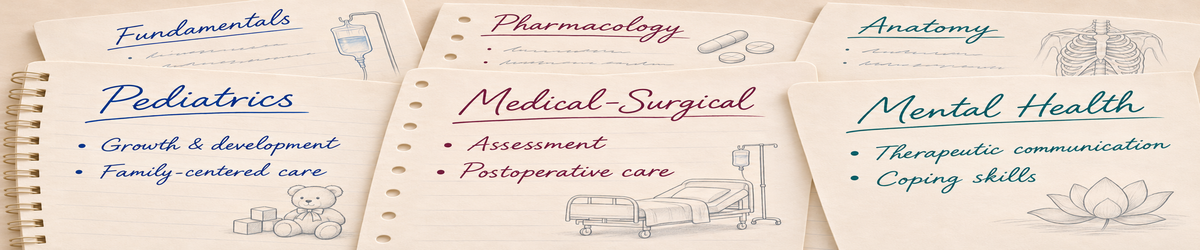
How to Study Therapeutic Communication for Mental Health Nursing Exams
Reading a list of techniques once will not prepare you for tricky exam wording. The students who master therapeutic communication build a personal phrase bank. For each technique, write the name, a one-line definition, and two sample phrases. Then do the same for each nontherapeutic response, writing what the wrong phrase sounds like and how you would rewrite it correctly. Reviewing this bank for ten minutes a day is more effective than one long cram session, a principle covered in these smart NCLEX study methods for retaining information.
Practice questions are essential because they train pattern recognition. After each question, read the full rationale, including why the wrong answers were wrong. Label each distractor by its nontherapeutic category, such as false reassurance or giving advice. Over time, you will notice that a psych nursing exam reuses the same traps in slightly different clothing.
Role-play also helps. Have a classmate read client statements aloud while you respond without looking at notes. Saying phrases out loud makes them feel natural, which carries over to clinical rotations as well. Next Generation NCLEX case studies often include communication within a larger clinical story, so practice breaking down NextGen NCLEX case study questions that involve psychiatric clients.
Finally, remember that strong therapeutic communication is not about sounding perfect. It is about staying curious, nonjudgmental, and focused on the person in front of you. Master that mindset, and mental health nursing questions will become some of the most reliable points on your exam.


No comments yet. Be the first to comment!