Shoulder Dystocia: McRoberts Maneuver and OB Nursing Priorities for the NCLEX
What Is Shoulder Dystocia?
Few moments in labor and delivery move as fast as shoulder dystocia. The fetal head delivers, and everyone expects the body to follow with the next push. Then nothing happens. The anterior shoulder is wedged behind the mother's pubic symphysis, and the clock starts ticking on fetal oxygenation. This is a high-stakes obstetric emergency, and it shows up on maternity exams, HESI specialty exams, and the NCLEX-RN because it tests whether you can recognize a problem quickly and act in the correct order.
Shoulder dystocia is generally defined as a vaginal birth in which the head delivers but gentle downward traction fails to deliver the shoulders, so additional obstetric maneuvers are needed. It is largely unpredictable, and many cases occur in infants of normal weight with no identifiable risk factors. Because you cannot reliably predict it, every labor nurse needs to know the McRoberts maneuver, the correct use of suprapubic pressure, and the OB nursing priorities that protect both mother and baby.
If maternity content is on your study list right now, pair this guide with our review of high-yield maternity and pediatrics exam topics. It shows how labor emergencies fit into the bigger picture of what you will be tested on.
Risk Factors and the Turtle Sign
Although it cannot be reliably predicted, certain factors raise the likelihood of shoulder dystocia. The most commonly tested is fetal macrosomia, usually defined as an estimated fetal weight over 4,000 to 4,500 grams. Maternal diabetes, both pregestational and gestational, increases risk because high fetal insulin levels drive fat deposition in the shoulders and trunk. This makes the shoulders wide relative to the head. Other risk factors include maternal obesity, excessive weight gain during pregnancy, post-term pregnancy, a prior history of the complication, a prolonged second stage of labor, and operative vaginal birth with forceps or vacuum.
The classic warning sign is the turtle sign. The fetal head delivers and then retracts tightly back against the perineum, much like a turtle pulling its head into its shell. The face may look puffy and dusky, and restitution, the natural external rotation of the head after delivery, may not occur. When you see this, the emergency has begun. Announce it clearly to the team so the response can start immediately.
Exam questions often describe a diabetic patient with a large-for-gestational-age fetus and ask what the nurse should anticipate. Recognizing that risk profile shapes OB nursing priorities before birth. It points you toward answers about alerting the neonatal team early, keeping a step stool at the bedside for suprapubic pressure, and making sure the bed can be adjusted so the patient can be placed in the McRoberts maneuver quickly. For more on reading labor situations, our guide to fetal heart rate monitoring with VEAL CHOP covers the tracings that often accompany a prolonged second stage.

How the McRoberts Maneuver Works
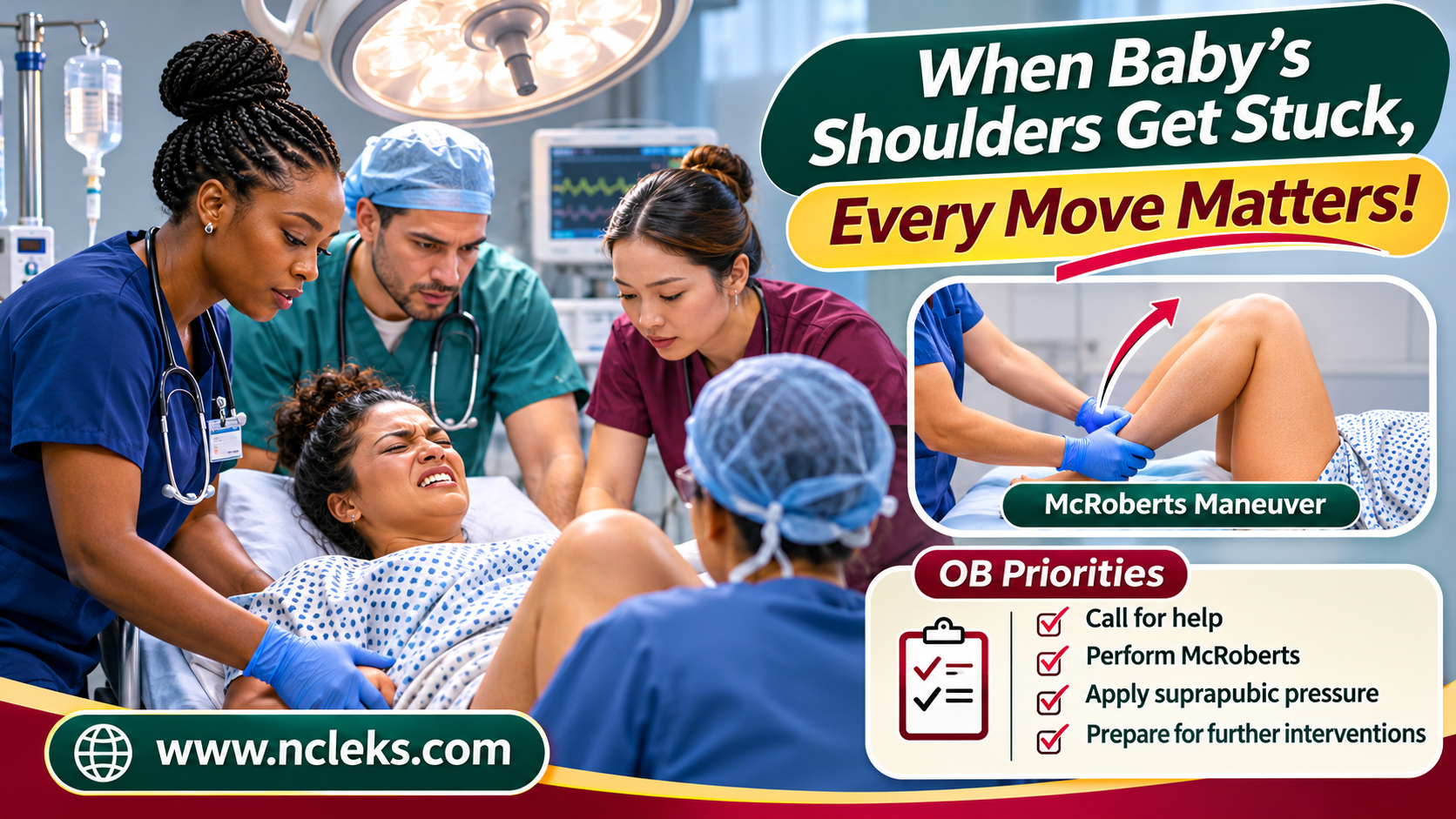
The McRoberts maneuver is almost always the first maneuver attempted because it is quick, noninvasive, and effective in a large share of cases. The nurses take the patient's legs out of the stirrups, lay the head of the bed flat, and sharply hyperflex the thighs back toward the abdomen. The knees move toward the patient's chest and slightly outward, and one assistant holds each leg.
Understanding the mechanism makes the maneuver easier to remember. Hyperflexing the thighs straightens the lumbosacral angle, flattens the sacrum, and rotates the pubic symphysis upward toward the mother's head. That rotation can free the impacted anterior shoulder by changing the angle of the pelvis relative to the fetus. It does not significantly enlarge the bony pelvis. It changes the pelvis's orientation, and that is often enough.
Students sometimes confuse this position with lithotomy or Trendelenburg. Lithotomy is the standard delivery position with the legs in stirrups. Trendelenburg tilts the whole bed head-down, which does nothing to free the shoulder. If an answer choice asks how the nurse should position a patient during shoulder dystocia, look for sharp hyperflexion of the thighs onto the abdomen. Positioning is a frequent exam theme, and our article on which patient position is best in NCLEX questions explains how to reason through these items.
The McRoberts maneuver is usually combined with suprapubic pressure, and the nurse often performs one or both. Rehearse the motion mentally so you can act without hesitation when it happens in clinical practice.

Suprapubic Pressure and the HELPERR Mnemonic
Suprapubic pressure is applied by a nurse standing on the side of the bed that the fetal back faces, usually on a step stool for leverage. The nurse places the heel of one hand just above the pubic bone over the anterior shoulder, with the other hand on top in a CPR-style grip. Pressure is directed downward and laterally to push the shoulder toward the fetal chest. This adducts the shoulder, narrows the shoulder width, and helps it slip under the symphysis. The provider may direct steady pressure or a rocking motion.
The most important safety point is the difference between suprapubic pressure and fundal pressure. Fundal pressure is contraindicated in shoulder dystocia because pushing on the top of the uterus drives the shoulder harder into the pubic bone. That worsens the impaction and increases the risk of uterine rupture and fetal injury. On exams, treat any answer involving fundal pressure as a distractor.
Many units teach the HELPERR mnemonic to organize the response. It stands for Help (call for help), Evaluate for episiotomy, Legs (the McRoberts maneuver), Pressure (suprapubic), Enter maneuvers (internal rotation such as Rubin or Woods screw), Remove the posterior arm, and Roll the patient onto hands and knees (the Gaskin maneuver). The provider performs the internal maneuvers. The nurse's main hands-on roles are managing the legs, applying pressure, and helping the patient roll onto all fours if needed.
Because HELPERR is a sequence, it lends itself to ordered-response and select-all items. Our guide to answering select all that apply questions will help you handle those formats with more confidence.

OB Nursing Priorities During a Shoulder Dystocia Emergency
When the turtle sign appears, OB nursing priorities shift to speed, teamwork, and clear communication. The first action is to call for help by activating the obstetric emergency response. This brings additional nurses, the obstetrician or senior provider, anesthesia, and the neonatal resuscitation team to the bedside. One nurse cannot hold two legs and apply suprapubic pressure at the same time.
The second priority is to note the time the head delivered and call out elapsed time at regular intervals, often every 30 seconds. The head-to-body interval matters because the risk of hypoxic injury rises the longer the shoulders stay impacted. A designated recorder documents each maneuver, who performed it, and when it started and stopped. Clear, closed-loop communication is essential here, and the skills you use when giving an SBAR report to a provider carry directly into emergencies.
Other OB nursing priorities include lowering the head of the bed flat in preparation for the McRoberts maneuver, removing pillows, and moving the patient's buttocks to the edge of the bed. Instruct the patient to stop pushing until the provider is ready, because pushing against an impacted shoulder accomplishes little. The nurse never applies fundal pressure and should speak up about excessive downward traction on the fetal head, which is a major cause of brachial plexus injury. Throughout the emergency, give the patient and support person brief, calm explanations, since a sudden crowd in the room can be frightening.
If you struggle to decide what comes first in emergencies like this, review what immediate action means on NCLEX so you can match your choice to the wording of the stem.

Postdelivery Care for Mother and Newborn
Once the baby delivers, OB nursing priorities divide between two patients. The neonate may be depressed at birth and need resuscitation, which is why the neonatal team should already be in the room.
After the newborn is stabilized, the nurse assesses for birth injuries. Brachial plexus injury, most commonly Erb palsy involving the C5 and C6 nerve roots, presents as an arm that hangs limp, extended, and internally rotated, with the wrist flexed in the classic waiter's tip position. A key clue is an asymmetric Moro reflex, in which the affected arm does not abduct and extend. Clavicle fracture is another common injury. Look for crepitus, swelling, limited arm movement, or an asymmetric Moro reflex. Humerus fracture and hypoxic-ischemic injury are less common but serious.
The mother faces her own risks. Shoulder dystocia increases the likelihood of postpartum hemorrhage from uterine atony and lacerations, as well as third- and fourth-degree perineal tears, especially after an episiotomy or internal maneuvers. Assess the fundus for firmness and position, monitor lochia and vital signs closely, and be ready to massage the fundus and give uterotonics as ordered. Our article on priority nursing actions for postpartum hemorrhage walks through those steps in detail.
Documentation completes the picture. The nurse's note should include the time of head delivery and body delivery, the maneuvers used in order, which shoulder was anterior, the personnel present, and the newborn's condition. If your charting skills need work, see how to write a nursing progress note. Finally, take time to talk with the family. Parents often have questions about their baby's arm and need reassurance and appropriate referrals.

How to Answer Shoulder Dystocia Questions on the NCLEX
NCLEX items on this topic usually test three things: recognizing the emergency, choosing the correct first action, and identifying unsafe interventions. When a question describes the head retracting against the perineum, treat it as an emergency and think about getting help and positioning first.
If both calling for help and a physical intervention appear as options, read the stem carefully. A question asking for the nurse's first action at the moment of recognition often favors summoning help. A question stating that help is present and asking which intervention to perform points to the McRoberts maneuver. Our breakdown of the difference between first and best on NCLEX questions is especially useful here.
Eliminate answers that involve fundal pressure, Trendelenburg positioning, encouraging harder pushing against an impacted shoulder, or forceful traction on the head. Choose answers that reflect teamwork, timing, correct positioning, and post-birth assessment of the newborn's arm and the mother's fundus. In newborn questions, an asymmetric Moro reflex after a difficult delivery should make you think of brachial plexus injury or clavicle fracture.
The best way to lock in these OB nursing priorities is repetition with realistic questions. Work through the practice items below, then use the NCLEX practice exams and flashcards on NCLEKS to keep maternity emergencies fresh. Combine that practice with broader clinical judgment and prioritization strategies so you can apply the same reasoning to any emergency on exam day.




No comments yet. Be the first to comment!