Which Patient Position Is Best in NCLEX Questions
In clinical settings, patients spend a lot of time in bed, and as a nurse, you’re expected to keep them comfortable and ensure safety. Success with patient positioning NCLEX questions depends on how you understand body mechanics and align them to patient outcomes.
When a patient visits the hospital, positioning is often the first line of intervention before you do the head-to-toe assessment. There’s no need for equipment or any delay; just ensure patients are in a position that eases pain and discomfort while allowing for further examination. That’s exactly why it shows up frequently in testing.

What Are Nursing Patient Positions?
Nursing patient positioning is a standardized way of placing a patient’s body to assist with diagnosis, treatment and safety. These positions are grounded in anatomy and physiology, with each one designed to influence specific body systems. For example, elevating the upper body of a patient improves diaphragmatic movement and lung expansion, while side-lying can help protect the airway. Some nursing patient positions are procedural and important during examinations or surgeries, while others are therapeutic, aimed at improving clinical outcomes.
Patient positioning NCLEX questions usually come in the form of clinical scenarios. You know you’re ready for your NCLEX exam if you can interpret patient cues and align them with the appropriate position strategy.
The Role of Patient Positioning In Safe Nursing Practice
Patient positioning is a fundamental aspect of safe nursing care because it directly impacts vital body functions. If you choose the wrong position, you can exacerbate a condition, while the right positioning can prevent deterioration. Even minor adjustments can alter oxygenation, blood circulation and pressure distribution. This makes positioning both a therapeutic intervention and a preventive strategy.
One major application of patient positioning is respiratory support. When a patient experiences difficulty in breathing, elevating the head of the bed reduces pressure on the diaphragm and promotes better airflow. This simple adjustment improves oxygen saturation without the need for immediate pharmacological intervention.
Patient positioning also plays a crucial role in preventing complications. Immobile patients are vulnerable to pressure injuries due to prolonged compression of soft tissues. Regular repositioning redistributes pressure and maintains blood flow to vulnerable areas. Patient positioning NCLEX questions assess whether you can recognize a problem and implement a rapid but effective response using the simplest available means.

Types of Patient Positions That Every Nurse Should Master
Learning and understanding nursing patient positions in your nursing school is essential for clinical practice and pursuing your NCLEX exam. Each position has specific indications, benefits and limitations.
Fowler’s position
In Fowler’s position, you elevate the head of the patient’s bed to a semi-sitting position. The standard elevation will be between 45 and 60 degrees, but semi-fowler uses an angle of 30 to 45 degrees. On the other hand, in a high-fowler position, you place the patient in a near upright position from 60 to 90 degrees.
Fowler’s patient positioning NCLEX questions usually test your knowledge in alleviating breathing issues. Elevating a patient’s bed helps them breathe easily and provides comfort. For instance, a semi-fowler’s position allows moderate lung expansion while maintaining stability. High Fowler’s position is recommended for patients with respiratory distress since it maximizes chest expansion. In NCLEX practice tests, you’ll find that High Fowler’s is usually associated with acute breathing difficulties.
When using Fowler’s position, you need to watch out for neck flexion contractures by encouraging patients to spend some hours without a headrest.
Supine position
In the supine position, the patient lies flat on their back. It can be used in different variations depending on the nursing examination or assessment. For instance, nurses can place a patient in the supine position with their legs straight or slightly bent, with arms up or down. It is one of the most common nursing patient positions when nurses need to perform a procedure on the abdomen or thoracic area. Some procedures, such as cerebral angiography, also require patients to lie flat to minimize the risk of bleeding.
While it’s widely used for physical examinations and certain procedures, it’s not recommended for patients with compromised respiratory or cardiac function. In this position, abdominal organs exert pressure on the diaphragm, limiting lung expansion.
Prone Position
Prone is a technique where nurses place the patient to lie face down on their belly. It’s not common in routine care and physical assessment, but it has important applications in critical care settings, especially for patients on a ventilator. Prone positioning can improve oxygenation by redistributing ventilation and enhancing gas exchange for patients with acute respiratory distress syndrome(ARDS).
While studies show that the prone position lowers mortality rates for ARDS patients, there are still some risks. For instance, when moving the patient from supine to prone position, nurses may accidentally remove the endotracheal tube or venous catheter. The position may also lead to problems with blood pressure and blockage of the airways. That’s why every few hours, a patient in a prone position is moved to the supine position to rest and reduce the risk of complications.
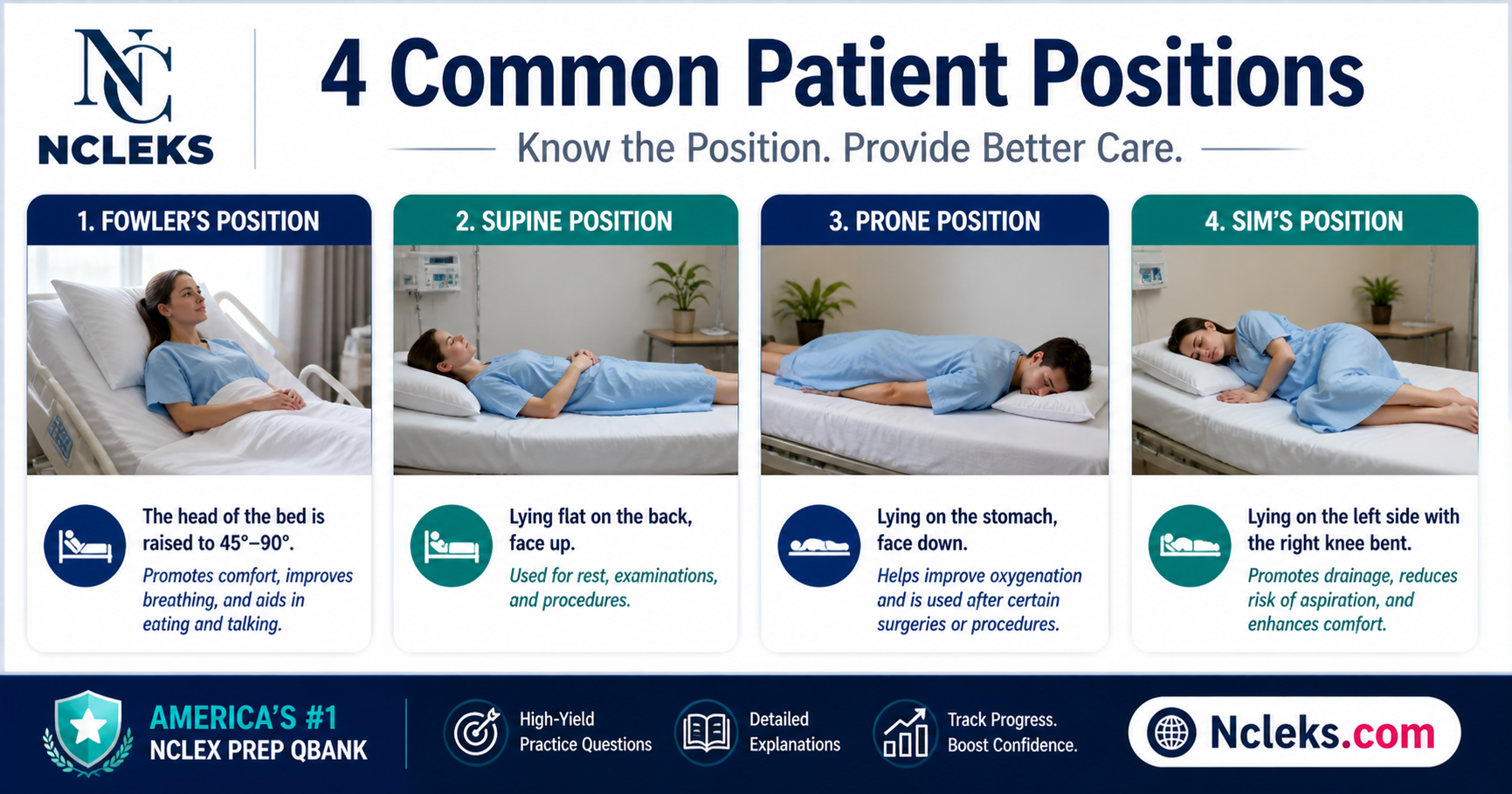
Sim’s position
Sim’s position is a side-lying posture, often with one leg bent towards the chest, quite similar to the lateral position. The positioning is usually used for different types of surgeries or certain examinations, such as rectal or vaginal wall prolapse.
The alignment that the Sim’s position provides promotes drainage of secretions and helps maintain airway patency. By allowing fluids to flow away from the airways, it reduces the chances of aspiration.
What You Should Expect In Patient Positioning NCLEX Questions
Patient positioning NCLEX questions are designed to assess how you apply your knowledge in positioning to patient care situations. If you can master how to handle these types of questions, you’re ready for your NCLEX exams.
Scenario-based clinical questions
Scenario-based patient positioning NCLEX questions present a patient case with symptoms, diagnosis or vital signs. Your task is to determine which positioning choice best addresses the patient’s condition. The trick in such questions is to identify the primary issue. For example, if your patient has breathing difficulty, the correct positioning should promote lung expansion.
A nurse is caring for a client admitted with acute respiratory distress. The client reports shortness of breath, is using accessory muscles to breathe, and has an oxygen saturation of 88% on room air. Which positioning interventions should the nurse implement to improve the client’s breathing? (Select all that apply.)
Priority and safety questions
If you’ve tackled NCLEX prioritization questions, priority and safety questions in positioning will be easy. They test your ability to determine the most immediate action that could save a patient’s life. In many cases, repositioning is the quickest way to stabilize a patient, while safety questions focus on minimizing risk while improving patient stability.
Positioning rules for NCLEX exams
Here are a few rules to simplify your decision-making during positioning:
- Elevate the head when breathing is compromised.
- Avoid flat positioning in patients at risk of aspiration.
- Use side-lying positions to protect the airways.
- Assess the risks of every position, especially circulatory support positions.
How To Practice Patient Positioning NCLEX Questions
If you want to be ready for the NCLEX exams within 30 days, you need to prepare effectively for patient positioning NCLEX questions. Passive reading is insufficient. Instead, your study approach should mirror real exam conditions.
Practice tests
Practice tests help you recognize how patient positioning NCLEX questions are framed, including common distractors and subtle wording tricks. Instead of simply checking whether your answer is correct, evaluate how you arrived at it. Ask yourself whether your choice was based on understanding or guesswork.
A nurse is caring for a patient who is experiencing shortness of breath and has an oxygen saturation of 88% on room air. The patient appears anxious and is using accessory muscles to breathe. Which position should the nurse place the patient in first?
Use visual aids and diagrams
Visual learning plays a critical role when studying nursing patient positions. Diagrams, charts, and illustrations help reinforce how each position looks and when it should be used. This is especially important because exam questions may describe a position rather than name it directly.
Focus on the rationale
Understanding the reasoning behind each answer is essential for acing your patient positioning NCLEX questions. Focus on learning the underlying principle of each position. How does this position improve the patient’s condition? If a position is ideal for a patient’s symptoms, you need to understand the benefits of the patient's positioning.

Review common conditions and positions
Linking clinical conditions to appropriate nursing patient positions is an effective study strategy. Many exam questions rely on predictable associations, such as positioning for breathing support, circulation or safety. Organize your study notes by condition. For instance, you can group respiratory disorders and post-operative care scenarios matched with the most suitable patient positioning.
Use elimination strategies
When tackling challenging patient positioning NCLEX questions, use the elimination method. Start by removing options that contradict the patient’s condition. For instance, if a patient has difficulty breathing, any answer involving a flat position is ruled out immediately.
The nurse is preparing to perform an abdominal examination on a client. The nurse would place the client in which position for this examination?
By combining practice tests, visual learning, rationale review and elimination techniques, you develop a structured approach to patient positioning NCLEX questions. This not only improves test performance but also strengthens your readiness for real clinical situations.



No comments yet. Be the first to comment!