Losing Your First Patient as a Nursing Student: Coping With Grief and Post-Mortem Care
Losing Your First Patient: Why It Hits Nursing Students So Hard
Losing your first patient as a nursing student is a moment most people never forget. You may have cared for this person for only one shift. You may also have followed them across several clinical days, learning their routines, their family members' names, and the way they liked their coffee. Then their condition changes, sometimes slowly and sometimes in minutes, and they die. Even when the death was expected, such as on a hospice or palliative unit, the experience can feel shocking, surreal, and deeply personal. Part of what makes losing your first patient so heavy is that nursing school trains you to fix things. You learn to assess, intervene, and evaluate, and you are graded on outcomes. When a patient dies, it can feel like a failure even when nothing could have changed the outcome.
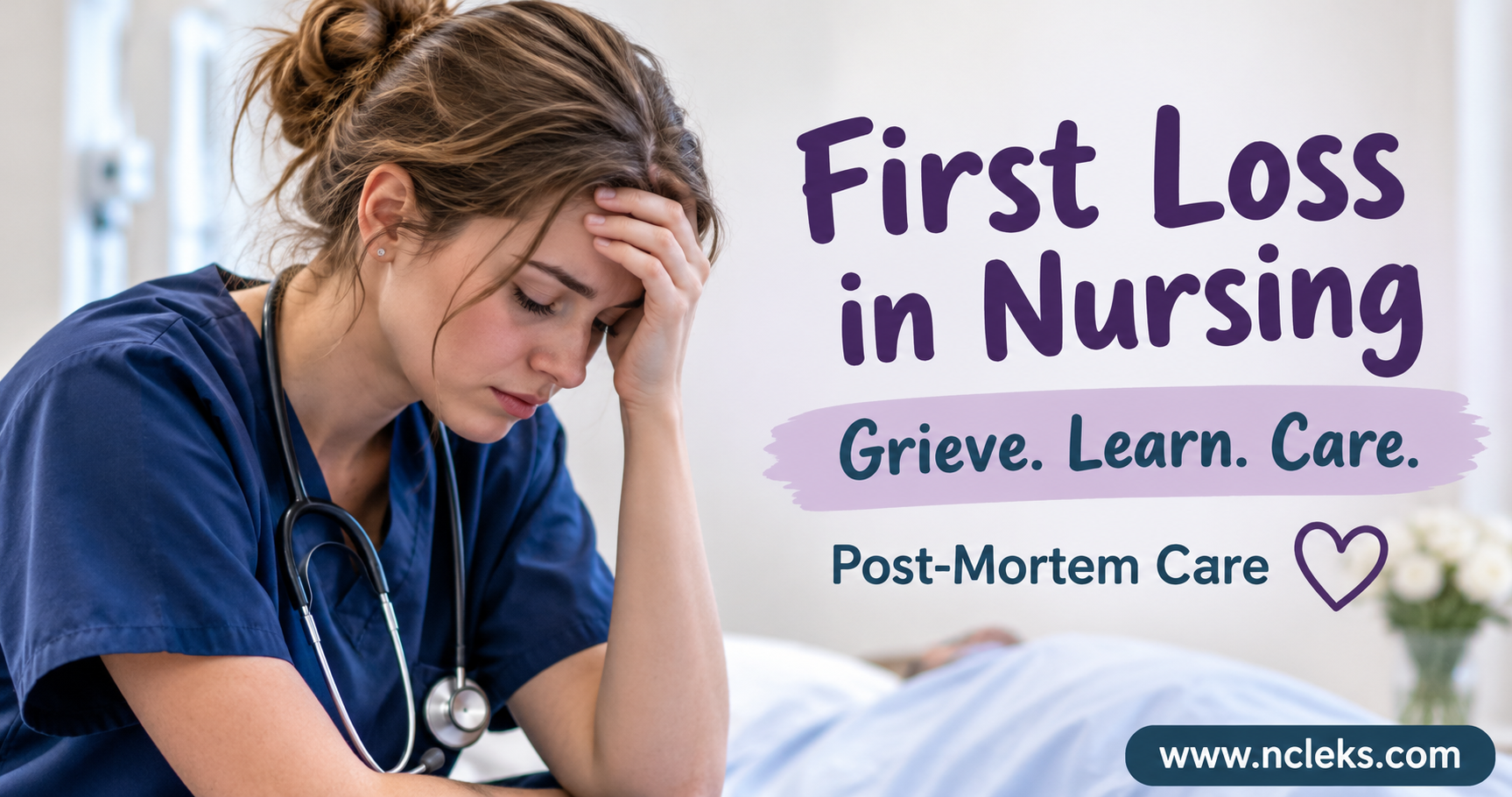
Many students feel guilty for crying. Others feel confused because they did not cry at all. Both reactions are normal. Nursing students' grief does not follow a script, and there is no correct amount of emotion to feel.
Experienced nurses still feel these losses. The difference is that they have built routines for processing grief and for giving dignified care at the end of life.
This guide covers both sides of the experience. The first is the practical skill of post-mortem care, which you may be asked to help with. The second is the emotional work of coping afterward. If you do not yet have someone in your clinical life to talk through moments like this, consider learning how to find a nurse mentor. A mentor can normalize what you are feeling and share how they handled their own first loss.

The Moment of Death: What Your Role Looks Like as a Student
When a patient dies during your clinical shift, your first responsibility is to stay calm and follow your instructor and the primary nurse. Students do not pronounce death. Depending on state law and facility policy, a physician, an advanced practice provider, or, in some settings, a registered nurse confirms and documents the time of death. Your job in those first minutes may simply be to step back, observe, and support the team.
If a code was called, you might have been doing compressions, documenting, or running supplies. The abrupt end of that activity can leave you shaking with adrenaline. That jittery, numb feeling is an early form of nursing student grief, and it is completely normal.
Once death is confirmed, the nursing team has several time-sensitive notifications to process. Federal regulations require hospitals to notify their organ procurement organization of every death or imminent death.

The primary nurse will usually make that call before significant post-mortem care begins. The provider and nursing staff will also decide whether the death must be reported to the medical examiner or coroner. This usually applies to unexpected deaths, deaths after trauma or surgery, and deaths under unclear circumstances. Watch how your nurse communicates these updates, often in a structured format similar to an SBAR report to the provider. That alone is a valuable learning experience.
In a high-acuity setting, such as your first ICU clinical rotation, deaths may happen more often and faster than you expect. Ask your instructor before the shift what students are permitted to do if a patient dies. Some programs allow students to assist with post-mortem care under supervision, while others want students to observe only. If you are worried about losing your first patient during a busy rotation, knowing your boundaries ahead of time removes one layer of uncertainty from an already emotional moment.

Post-Mortem Care Step by Step: A Practical Guide for Student Nurses
Post-mortem care is the physical care of the body after death. Its goals are to preserve dignity, prevent tissue damage and discoloration, and prepare the body for family viewing and transport to the morgue or funeral home.
Before you begin, confirm whether the case involves the medical examiner or a pending autopsy. Also check for cultural or religious preferences. Some faiths have specific rules about who may touch the body, whether it should be washed, or how quickly burial must occur. Always ask the family or check the chart before proceeding.
Standard precautions still apply because body fluids remain potentially infectious after death. If the patient was on isolation, continue the same precautions. Review the correct PPE order for contact, droplet, and airborne precautions if you need a refresher.

Place the body supine with the arms at the sides. Then elevate the head of the bed slightly or place a pillow under the head. This prevents blood from pooling in the face, which causes discoloration from livor mortis. Gently close the eyes, insert dentures if the patient wore them, and close the mouth, using a rolled towel under the chin if needed. Rigor mortis usually begins within two to four hours, so position the body promptly.
If the death is not a medical examiner case, remove tubes, drains, and lines according to policy and apply small dressings. If it is a coroner's case, leave all tubes and lines in place. Next, bathe soiled areas, place an absorbent pad under the perineum, apply a clean gown, and straighten the linens before the family arrives. Identification tags are typically placed on the body and on the shroud.
Inventory and document valuables and personal belongings carefully. The time of death, the notifications made, and what happened to the belongings all belong in the record. The same principles you use to write a nursing progress note apply here: be objective, timely, and specific.

Supporting the Family Through Final Goodbyes
Families often arrive at the bedside in shock, and the way the nursing team greets them shapes their memory of the loss for years. Before they enter, make the room calm and tidy. Remove unnecessary equipment, dim harsh lights, and provide chairs and tissues. Offer the family as much uninterrupted time as they need, and let them know they can touch, hold, or talk to their loved one. If they want to help bathe the body or take part in religious rituals, support that wish whenever policy allows.
Many students freeze because they are afraid of saying the wrong thing. Presence matters more than perfect words. Simple statements such as 'I am so sorry for your loss' or 'Take all the time you need' are appropriate. Avoid clichés like 'Everything happens for a reason' or 'At least he is not suffering anymore,' which can feel dismissive even when well-intended. When a family member expresses guilt or anger, reflect the feeling instead of arguing or offering false reassurance. Reviewing these therapeutic communication examples and phrases before clinical gives you language to rely on when emotions are high.

It is also acceptable to show emotion in front of the family. A few quiet tears during a goodbye are a normal expression of nursing student grief, and they often communicate genuine care. Families frequently remember the student who cried with them. What you want to avoid is becoming so overwhelmed that the family ends up comforting you. If you feel that happening, step out briefly, collect yourself, and let the primary nurse take the lead. Losing your first patient teaches you that compassion and professionalism are not opposites; they work together.

Coping With Nursing Student Grief After Your Shift Ends
The hardest part of nursing student grief often shows up later. It may come when you are driving home, trying to study, or lying awake replaying the shift. You might wonder whether you missed a sign, whether you should have spoken up, or whether you are cut out for this profession. These thoughts are common, and they deserve to be talked through rather than buried.
Start by debriefing with your clinical instructor or the nurse you worked with. Many units hold informal or formal debriefs after a death. Asking questions about what happened clinically can turn confusion into understanding.

Give yourself permission to feel the loss without judging it. Writing in a journal can help. So can talking with classmates who have been through something similar or naming the patient's death out loud to a trusted friend while protecting confidentiality? Physical recovery matters too, so eat, hydrate, sleep, and move your body. A transition ritual, such as a short walk or a specific playlist, is one of several ways to decompress on the way home after a hard shift. Most schools also offer free counseling services. Using them is a sign of professional self-awareness, not weakness.
Watch for signs that grief is becoming something heavier. Reach out for professional support if you cannot sleep for days, feel numb or hopeless, or start avoiding clinical altogether. If the loss is stacking on top of exams, care plans, and work, this step-by-step survival guide for feeling overwhelmed in nursing school can help you regain control. Healthily coping with nursing student grief now builds resilience for your entire career. Losing your first patient will not be your last loss, even if it remains the one you remember most.

Post-Mortem Care and End-of-Life Priorities on the NCLEX
End-of-life content appears on the NCLEX-RN and NCLEX-PN under psychosocial integrity and basic care and comfort. Post-mortem care questions tend to test a few predictable principles. Expect items about positioning the body, handling tubes in a medical examiner case, honoring cultural practices, and communicating with grieving families. Questions may also ask you to tell the difference between normal grief and complicated grief or to identify the most therapeutic response to a family member's statement.
On these questions, look for answers that preserve dignity, follow policy, and center the family's needs. Answers that rush the family, impose the nurse's beliefs, offer false reassurance, or skip notification steps are usually wrong.
Cultural and religious preferences generally take priority over routine procedure, as long as they do not conflict with legal requirements. Many of these items use priority wording. Understanding the difference between first and best on NCLEX questions will help you choose correctly when several options seem reasonable.
The experience of losing your first patient can actually make this content easier to remember, because you have lived it. Reflect on what you saw, from the positioning of the body to the words the nurse used with the family. That reflection turns a painful memory into clinical knowledge. Processing nursing student grief and learning post-mortem care are both part of becoming a nurse who can support patients and families at the end of life. Try the practice questions below to test your understanding.




No comments yet. Be the first to comment!