Accidentally Disclosed Confidential Patient Information? What Nursing Students Should Do Next
What It Means to Accidentally Disclose Patient Information
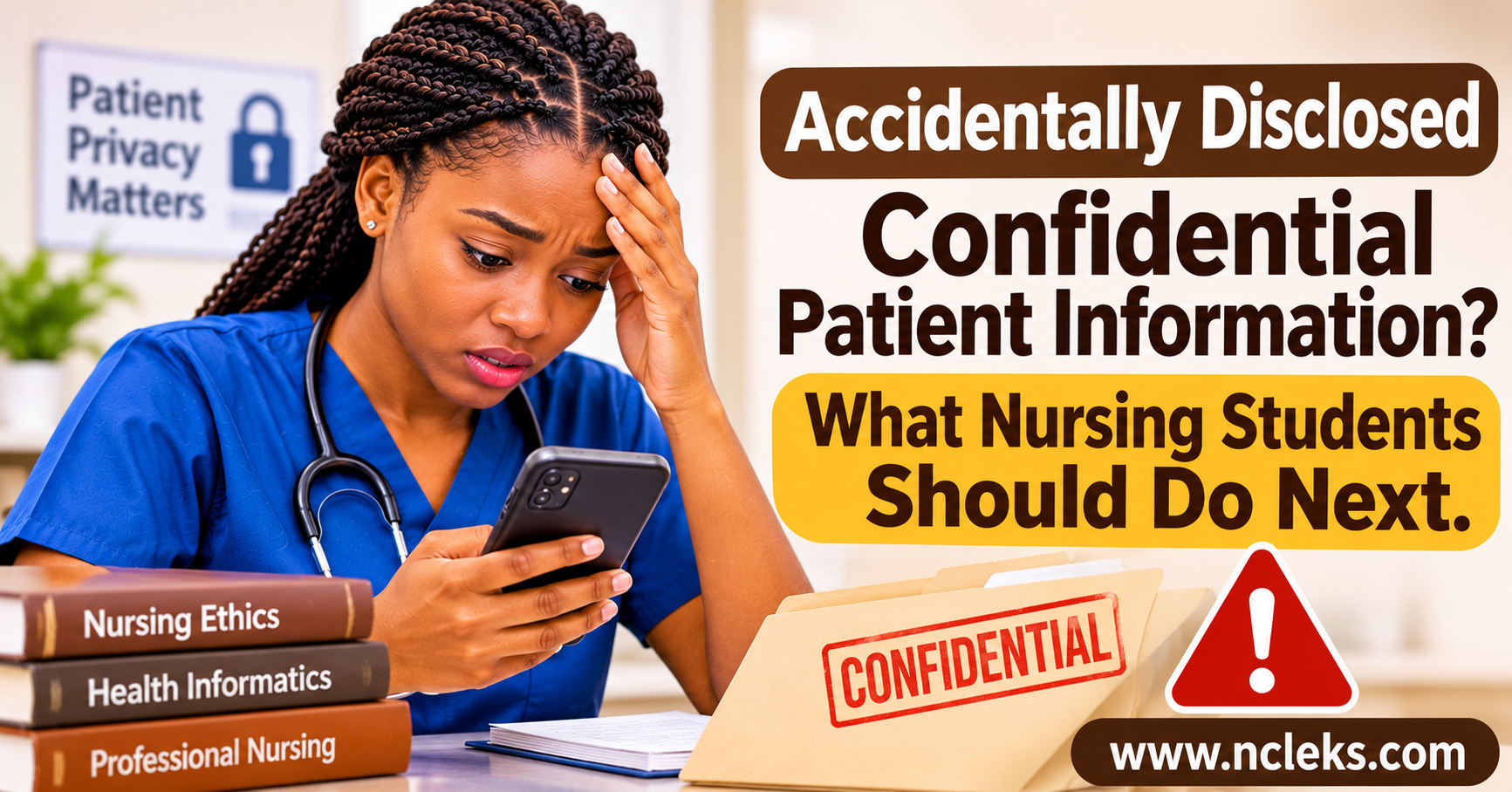
It happens faster than most people expect. You mention a patient's name while venting to a friend after clinicals, leave your care plan worksheet in the cafeteria, or send a photo of your clinical notes to the wrong group chat. In the moment, it feels small. However, any time protected health information reaches someone who does not need it for treatment, payment, or health care operations, you have breached patient confidentiality; for a nursing student, knowing what to do in the first hour after that mistake matters as much as knowing how to prevent it.
Protected health information (PHI) includes far more than a diagnosis. Names, dates of birth, room numbers, medical record numbers, photos, addresses, and even a description specific enough to identify someone all count. Under the HIPAA Privacy Rule, sharing any of these outside the circle of care without authorization can be a HIPAA violation, whether it was intentional or not. Intent affects the consequences, but it does not change the fact that a breach occurred.
It also helps to understand what is not a violation. HIPAA recognizes incidental disclosures, such as a visitor overhearing a quiet bedside conversation. These are acceptable as long as reasonable safeguards were in place and you shared only the minimum necessary information. The problem arises when safeguards were skipped.
If you are still learning these boundaries, review the early mistakes that can get you dropped from nursing school. Confidentiality breaches are on that list at nearly every program.
Your First Steps After a Patient Confidentiality Breach
The most important rule is simple: do not hide it. A nursing student who panics often hopes nobody notices. Concealment, however, turns an honest error, even a minor HIPAA violation, into an integrity issue, and programs and boards of nursing treat integrity issues far more seriously. Your first goal is to contain the disclosure. Your second is to report it immediately.
Containment means taking reasonable, immediate steps to stop the information from spreading further:
If you left paperwork somewhere, go back and retrieve it. If you sent a message or email to the wrong person, ask the recipient not to open, forward, or share it. Keep a record of what was sent and to whom, because the facility will need those details. If you posted something on social media, take the post down right away, but do not assume deleting it solves the problem; screenshots and shares may already exist. Never contact the patient yourself to apologize or explain, because that decision belongs to the facility.
Next, report the incident to your clinical instructor as soon as possible, ideally during the same shift. Write down the facts while they are fresh: what information was disclosed, to whom, when, how, and what you did to contain it. Stick to objective facts the way you would in a well-written nursing progress note, without excuses or speculation.
Do not document the breach in the patient's medical record. The facility will tell you exactly which incident or event report to complete. Acting quickly protects patient confidentiality and shows accountability, which instructors and privacy officers look for when deciding how to handle a mistake.

Who to Tell and How the Reporting Process Works
As a nursing student, your chain of command starts with your clinical instructor. Your instructor will typically notify your preceptor or the charge nurse, and the facility will involve its privacy officer or compliance department. Most hospitals require you to report any suspected breach internally right away, even if you are unsure whether it truly qualifies as a HIPAA violation. Let the experts make that determination. Your job is to report, not to judge your own case.
When you speak with your instructor, use a clear, structured approach. Many students borrow the format they already use for giving an SBAR report. Describe the situation, the background, your assessment of how far the information spread, and what you have already done. This keeps the conversation calm and factual rather than emotional.
After you report, the privacy officer conducts a risk assessment. They look at what type of information was involved, who received it, whether it was actually viewed, and how well it was contained. Under the HIPAA Breach Notification Rule, if the organization determines a reportable breach occurred, it must notify the affected patient without unreasonable delay. That notice must go out no later than 60 days after the breach is discovered. Larger breaches may also require notification to the federal government.
You may be asked to give a written statement or attend a meeting. Answer honestly and completely. If your instructor responds harshly rather than professionally, our guide on handling a difficult clinical instructor can help you stay composed and respectful through the process.

Consequences of a HIPAA Violation for Students and Nurses
The consequences depend heavily on intent, scope, and how you respond afterward. After an accidental disclosure that was reported quickly, a nursing student commonly receives remediation rather than dismissal. That might be a written warning, a learning contract, a reflective paper, or required privacy retraining. Programs view honest reporting as evidence of professional integrity.
Some behaviors are treated far more seriously: deliberately snooping in charts, posting identifiable patient photos, or covering up a breach. These can lead to clinical failure or dismissal, because clinical sites can refuse to accept a student who violated their policies.
For licensed nurses, the stakes rise. Employers may terminate a nurse for a serious HIPAA violation, and boards of nursing can take disciplinary action for unprofessional conduct, especially when social media is involved. Under federal law, civil monetary penalties are tiered based on culpability. They range from cases where the person did not know a violation occurred to cases of willful neglect. Knowingly obtaining or disclosing protected health information can bring criminal penalties, including fines and possible imprisonment. Those penalties are harsher when the information is used for personal gain or to cause harm.
None of this is meant to frighten you into silence. The biggest factor separating a learning experience from a career-ending event is whether you reported promptly and told the truth. One accidental lapse in patient confidentiality does not define you. If a breach leaves you shaken and doubting whether you belong in nursing, the strategies in overcoming imposter syndrome in nursing school can help you separate one mistake from your identity as a future nurse.

Common Ways Students Breach Patient Confidentiality and How to Prevent Them
Most breaches by students are not malicious; they come from habits.
Clinical paperwork is a frequent culprit. Use only initials or a non-identifying label on care plans and worksheets. Never take printouts home if facility policy forbids it, and shred anything with identifiers in the designated bins before you leave the unit.
Conversations are another risk. Elevators, hallways, cafeterias, and break rooms are public spaces. Save case discussions for post-conference rooms with the door closed.
Technology creates newer risks. Never photograph anything in a patient room, even if you think nothing identifiable is visible; wristbands, monitors, and whiteboards often appear in the background. Avoid typing patient details into personal phones, group chats, or AI tools. Our article on using ChatGPT in nursing school ethically explains why even case details that seem anonymous can create a problem.
Chart access is the other half of the equation. Open only the charts of patients you are assigned to, and log out of every workstation when you step away. Every click in the electronic health record is tracked through audit trails, which we explain in nursing informatics for students.
Finally, remember that patient confidentiality extends to people you know. If a neighbor or a classmate's relative is admitted to your unit, you cannot look up their chart, mention that you saw them, or confirm they are there. Protecting patient confidentiality consistently is the best way to make sure a HIPAA violation never becomes part of your story.
How Patient Confidentiality Appears on the NCLEX
Confidentiality questions appear on the NCLEX under the Management of Care category, and they reward the same instincts you use on the unit. Expect scenarios where a nurse:
overhears a colleague discussing a patient in a public area, sees a coworker's social media post about a patient, or gets a phone call asking for information about a patient.
The correct answer almost always protects patient confidentiality while following the chain of command, such as notifying the charge nurse, nurse manager, or privacy officer.
Watch for distractors that sound helpful but bypass policy. Examples include confronting the coworker publicly, telling the patient directly, or ignoring the situation because no harm seemed to occur. Also remember that information can be shared with care team members who need it, so giving report to the oncoming nurse is not a HIPAA violation.
When a question asks what to do first after a breach, think the way you would on risk-based NCLEX safety questions: stop further harm, then report. The principles in therapeutic communication rules for the NCLEX will also help when callers and family members ask for details they are not authorized to receive. Practicing these scenarios now builds the reflexes you will rely on as a new graduate.
Moving Forward With Integrity After a Mistake
Once the report is made and the facility has handled the breach, shift your focus to learning. Reflect honestly on how the disclosure happened and what habit or system gap allowed it. Many instructors will ask for a written reflection. Treating it as genuine growth rather than punishment makes a lasting difference in how you practice. Consider sharing the lesson with classmates, without any identifying details, so the same mistake is less likely to happen again in your cohort.
It also helps to talk with someone experienced. A trusted nurse can share how they have handled similar lapses and what they do differently now. Our guide on finding a nurse mentor walks you through building that kind of supportive professional relationship.
Every nurse makes mistakes. What defines you is whether you protect the patient first and tell the truth. A nursing student who self-reports an accidental HIPAA violation shows the accountability that boards of nursing want to see in future licensees. Keep patient confidentiality at the center of every shift, and keep sharpening your judgment with practice questions on NCLEKS so these decisions become second nature by exam day.



No comments yet. Be the first to comment!