Contact, Droplet, and Airborne Precautions: PPE Order & Mnemonics Made Easy
Why Isolation Precautions and PPE Order Matter on Exams and in Clinicals
Few topics show up as reliably on nursing exams and clinical check-offs as isolation precautions. You might be walking into a room with a sign on the door, or you might be answering a question about a client with tuberculosis. Either way, you need to know which protective equipment to grab and in what sequence. Getting the PPE order wrong in real life can contaminate your scrubs, your hands, and the next patient you touch. Getting it wrong on the NCLEX costs you points on a topic that should be free.
Transmission-based precautions are layered on top of standard precautions, which apply to every patient regardless of diagnosis. Standard precautions mean hand hygiene plus gloves, gowns, masks, or eye protection whenever you expect contact with blood, body fluids, nonintact skin, or mucous membranes. Contact, droplet, and airborne precautions are added when a specific organism spreads by a specific route. The trick is to match the organism to its route, then match the route to the right barrier. If you have already worked through our guide to isolation precautions NCLEX questions, this article goes one level deeper with memory tools and step-by-step donning and doffing.
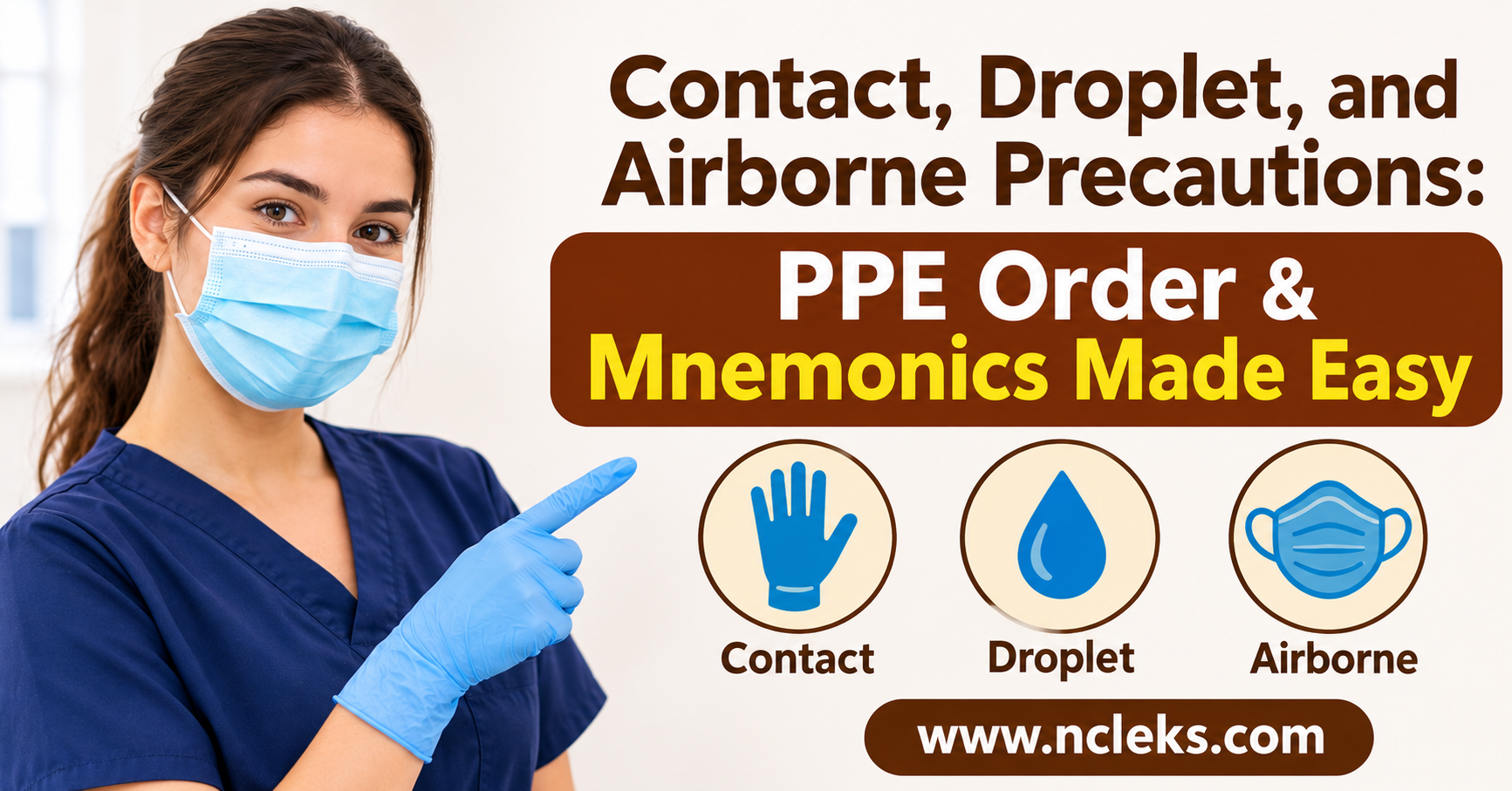
Each route has a simple core idea:
- Contact means touch.
- Droplet means large particles that fall within a few feet.
- Airborne precautions are for tiny particles that float and travel on air currents.
Once that idea clicks, the mnemonics below will feel logical rather than random. Exam writers love this topic because it reflects safety-first, risk-based thinking, which runs through the entire test plan.
Contact Precautions: Gown, Gloves, and the MRS. WEE Mnemonic
Contact precautions are used for organisms that spread by direct touch with the patient or by indirect touch with contaminated surfaces like bed rails, bedside tables, and blood pressure cuffs. This is the most common type of isolation precautions you will see on a hospital unit. The required PPE is a gown and gloves, put on before entering the room and removed before leaving. The client should be in a private room when possible or cohorted with another client who has the same organism. Dedicated equipment such as a stethoscope, thermometer, and blood pressure cuff should stay in the room so it does not carry organisms to other patients.

The classic mnemonic for contact conditions is MRS. WEE:
- M is for multidrug-resistant organisms such as MRSA and VRE.
- R is for respiratory infections spread by touch, most notably RSV in infants.
- S is for skin infections. You can expand this with VCHIPS: varicella zoster, cutaneous diphtheria, herpes simplex, impetigo, pediculosis (lice), and scabies.
- W is for wound infections.
- E is for enteric infections like Clostridioides difficile and E. coli.
- E is for eye infections such as conjunctivitis.
If abbreviations like MRSA, VRE, and RSV still slow you down, keep our list of common medical abbreviations every nursing student must know handy.
One detail is tested again and again. For C. difficile, you must wash your hands with soap and water, because alcohol-based hand rub does not kill the spores. Bleach-based cleaners are typically used on surfaces. Also note the difference between two kinds of shingles. Disseminated herpes zoster, or shingles in an immunocompromised client, requires both airborne and contact precautions. Localized shingles in an immunocompetent client generally needs only standard precautions with the lesions covered.

Droplet Precautions: The SPIDERMAN Mnemonic and the Surgical Mask Rule
Droplet precautions protect against large respiratory particles, greater than 5 microns, produced when a client coughs, sneezes, or talks. These droplets travel a short distance, generally about 3 to 6 feet, before falling. The key PPE is a surgical mask worn when entering the room. Add eye protection if splashes are possible, and use standard precautions as needed. A private room is preferred, but no special air handling is required, and the door may remain open. If the client must leave the room for a test, the client wears a surgical mask during transport.
The favorite memory tool here is SPIDERMAN:
- S covers sepsis, scarlet fever, and streptococcal pharyngitis.
- P covers parvovirus B19, pneumonia, and pertussis.
- I is for influenza.
- D is for diphtheria of the pharynx.
- E is for epiglottitis caused by Haemophilus influenzae type b.
- R is for rubella.
- M covers mumps, meningitis caused by Neisseria meningitidis, and Mycoplasma pneumonia.
- A is for adenovirus.
- N is for Neisseria meningitidis, which reinforces that bacterial meningococcal meningitis belongs in this group.
The most common trap is confusing droplet with airborne precautions. A surgical mask is not the same as an N95 respirator, and a droplet room does not need negative pressure. Suppose an answer choice offers an N95 for a client with influenza or pertussis. That is usually overkill and incorrect, unless the question mentions an aerosol-generating procedure such as intubation or open suctioning. Exam questions often hinge on a single word like this, much like the distinction covered in our article on first versus best on NCLEX questions.
Airborne Precautions: My Chicken Hez TB and the Negative Pressure Room
Airborne precautions are reserved for organisms carried on tiny particles, 5 microns or smaller. These particles stay suspended in the air and drift on air currents well beyond the bedside. Because they can pass through a standard surgical mask, staff must wear a fit-tested N95 respirator or a powered air-purifying respirator (PAPR) under airborne precautions.
The client is placed in an airborne infection isolation room (AIIR). This is a private room with negative pressure, so air flows into the room rather than out into the hallway. These rooms have frequent air exchanges, commonly 6 to 12 or more per hour, and the air is exhausted outdoors or filtered through HEPA filters. The door must stay closed.
The mnemonic is My Chicken Hez TB:
- My stands for measles (rubeola).
- Chicken stands for chickenpox (varicella).
- Hez stands for herpes zoster when disseminated or in an immunocompromised client.
- TB stands for tuberculosis, both pulmonary and laryngeal.
Varicella and disseminated zoster also require contact precautions because the lesions are infectious, so you will wear a gown and gloves along with your N95. Staff who are not immune to measles or varicella should not care for these clients when immune staff are available. That makes this a frequent assignment question.
If the client must leave the room, the client wears a surgical mask, not an N95, during transport. That detail surprises many students. The N95 protects the wearer from inhaling particles, while the surgical mask on the client contains the particles at the source. For more practice on how staffing decisions interact with isolation precautions, review our guide to delegation rules for LPNs and UAPs.

PPE Order Made Easy: Donning and Doffing Mnemonics
Knowing which PPE to use is only half the battle. The other half is the PPE order, because putting equipment on or taking it off in the wrong sequence is one of the fastest ways to contaminate yourself.
Donning (putting on). Perform hand hygiene first, then follow the CDC sequence:
- Gown
- Mask or respirator
- Goggles or face shield
- Gloves
An easy way to remember it is that you dress from your body outward and work toward your hands. Gloves go on last so their cuffs can pull over the gown sleeves and seal your wrists. If you are using an N95, perform a user seal check every time you put it on.

Doffing (taking off). The sequence most programs teach is shown below, followed by hand hygiene:
- Gloves
- Goggles or face shield
- Gown
- Mask or respirator
Here is the trick students love: doffing is alphabetical. Gloves, Goggles, Gown, Mask. The gloves come off first because they are the most contaminated item. The mask or respirator comes off last because it protects your airway. Remove it by the ties or straps without touching the front. Under airborne precautions, take off the N95 only after you have left the room and closed the door. Perform hand hygiene right after removing all PPE, and also any time your hands become contaminated during removal.
Some facilities teach an alternate method in which the gown and gloves are peeled off together, rolling the gloves inside the gown. Either method is acceptable in practice, but on exams the alphabetical PPE order is the safest answer to choose. Ordered-response and drag-and-drop items on the Next Generation NCLEX often test this exact sequence, so treat it as both a hands-on skill and an exam fact. Practice it physically before your skills lab. Our guide on passing practical check-offs in simulation lab explains how instructors grade these steps.

Common NCLEX Traps With Isolation Precautions and PPE Order
Most missed questions on isolation precautions come from a handful of predictable traps. Watch for these three:
- Choosing the most protective option just to be safe. The NCLEX rewards the correct precaution, not the maximum one. An N95 for influenza or a negative pressure room for MRSA is wrong.
- Forgetting who wears the mask during transport. For both droplet and airborne precautions, the client wears a surgical mask, not the nurse.
- Using an alcohol hand rub after caring for a client with C. difficile. Soap and water is required.
Room assignment questions are another favorite. Cohorting is acceptable only when clients have the same organism. Two clients with MRSA can share a room, but a client with MRSA should not room with a client who has VRE. A client with suspected tuberculosis goes into airborne isolation immediately, even before the diagnosis is confirmed. Immunocompromised clients, such as those receiving chemotherapy, should never be placed with an infectious roommate. These questions overlap heavily with stable versus unstable prioritization, because you may need to decide which client gets the last private room.
Finally, watch for questions about the PPE order that ask what the nurse should remove first, or which action shows a need for further teaching. If a student removes the mask before the gloves, or touches the front of the respirator, that is the error the question wants you to catch. Many of these appear as select-all-that-apply items, so sharpen your approach with our guide on how to answer SATA questions on nursing exams.

How to Lock In Isolation Precautions Before Exam Day
Memorizing three mnemonics and two sequences is very doable if you review them in short, repeated sessions rather than cramming. Write MRS. WEE, SPIDERMAN, and My Chicken Hez TB on one index card, with the matching PPE next to each:
- Contact: gown and gloves
- Droplet: surgical mask
- Airborne precautions: N95 plus a negative pressure room
On the back, write the donning and doffing PPE order. Quiz yourself until you can recite both sides without looking.
Next, apply the knowledge. Every time you see an isolation sign during clinicals, predict the organism and required PPE before reading the details. Then mentally rehearse the sequence as you gown up. Pair that habit with practice questions, because recognizing a diagnosis inside a long case scenario is harder than recognizing it on a flashcard. Spaced retrieval is one of the most effective techniques in our article on smart NCLEX study methods, and it works especially well for infection control. If you are heading into your first rotation, also check what to bring to nursing clinicals so you are ready for N95 fit testing and unit orientation.
Once you can match any organism to its route, name the right PPE, and recite the PPE order from memory, isolation precautions become some of the easiest points on your nursing exams and the NCLEX.



No comments yet. Be the first to comment!