How to Get Into Nursing School Without Prerequisites
The dream of becoming a nurse often hits a wall when you see a long list of science and math prerequisites required before you can even apply. While traditional nursing pathways require classes such as anatomy, physiology and microbiology before admission, you can find nursing programs without prerequisites.
In 2026, many institutions have removed these barriers by offering nursing programs without prerequisites. Whether you are starting fresh or pursuing direct entry nursing programs for non-nursing degree holders, there is a streamlined path waiting for you. This guide explores how you can bypass the traditional pre-nursing phase and fast-track your jour nursing journey.

What Are Nursing School Prerequisites?
Most traditional nursing schools require students to complete several foundational courses before admission into the nursing. These classes are designed to prepare students for advanced nursing coursework and clinical training. Students must pass the courses with a specific grade before they’re admitted into a nursing clinical program.
Common prerequisite courses for nursing programs
While every university has its own unique curriculum, most traditional programs require a set of behavioural and science courses.
Also Read: Can You Sit for LPN NCLEX While in RN School?
Some of the common prerequisites include:
- Anatomy and Physiology: This helps you understand the structure and function of the human body.
- Microbiology: It involves studying microscopic organisms that cause infection and disease. You use this knowledge later in pharmacology and medical-surgical nursing classes.
- Chemistry: You’ll study organic chemistry or biochemistry for healthcare.
- Psychology: This covers human development or lifespan psychology to understand patient behaviour.
Students searching for nursing programs without prerequisites are often concerned because they have not yet completed these science-heavy courses. However, many schools now provide alternative structures that allow students to complete some foundational coursework during the nursing pathway itself.
Why nursing schools require prerequisites
Nursing school is rigorous and nursing students are expected to learn complex disease processes, medication safety and patient assessment within a short time. Therefore, schools use prerequisites to ensure applicants have the academic foundation to deal with the challenging nursing subjects.
Prerequisite courses also help students develop study habits and scientific reasoning before starting advanced nursing classes. A student who already understands basic biology and chemistry concepts may adapt more easily to pharmacology and pathophysiology later.
Why do some students not have prerequisites completed?
There are various reasons for looking for nursing programs without prerequisites. For instance, you could be a career changer with a previous degree in business, education or technology before discovering an interest in nursing later in life. If you’re a foreign nurse, you may also need to pursue nursing programs if your previous credits aren’t recognized in the new country.
Can You Really Get Into Nursing School Without Prerequisites?
While the traditional route to nursing is still the most common, many institutions are flexible, and you can find nursing programs without prerequisites.
Understanding schools with alternative admission pathways
Schools that offer entry without pre-existing credits use alternative admission pathways. Instead of making prerequisites a gatekeeper to applications, these schools use an integrated curriculum. In many nursing programs without prerequisites, you are admitted to nursing school on day one, but your first two semesters are the foundational phase, where you’ll take courses such as microbiology, chemistry and anatomy alongside introductory nursing theory. This approach is common in private nursing colleges that cater to adult learners and career changers who need to move quickly.
Some universities offer accelerated programs, especially if you’re transitioning from other careers into healthcare. You’ll also find institutions that prioritize your professional background, volunteer background and exam scores in TEAS or HESI over a list of completed courses.
Difference between traditional and direct-entry pathways
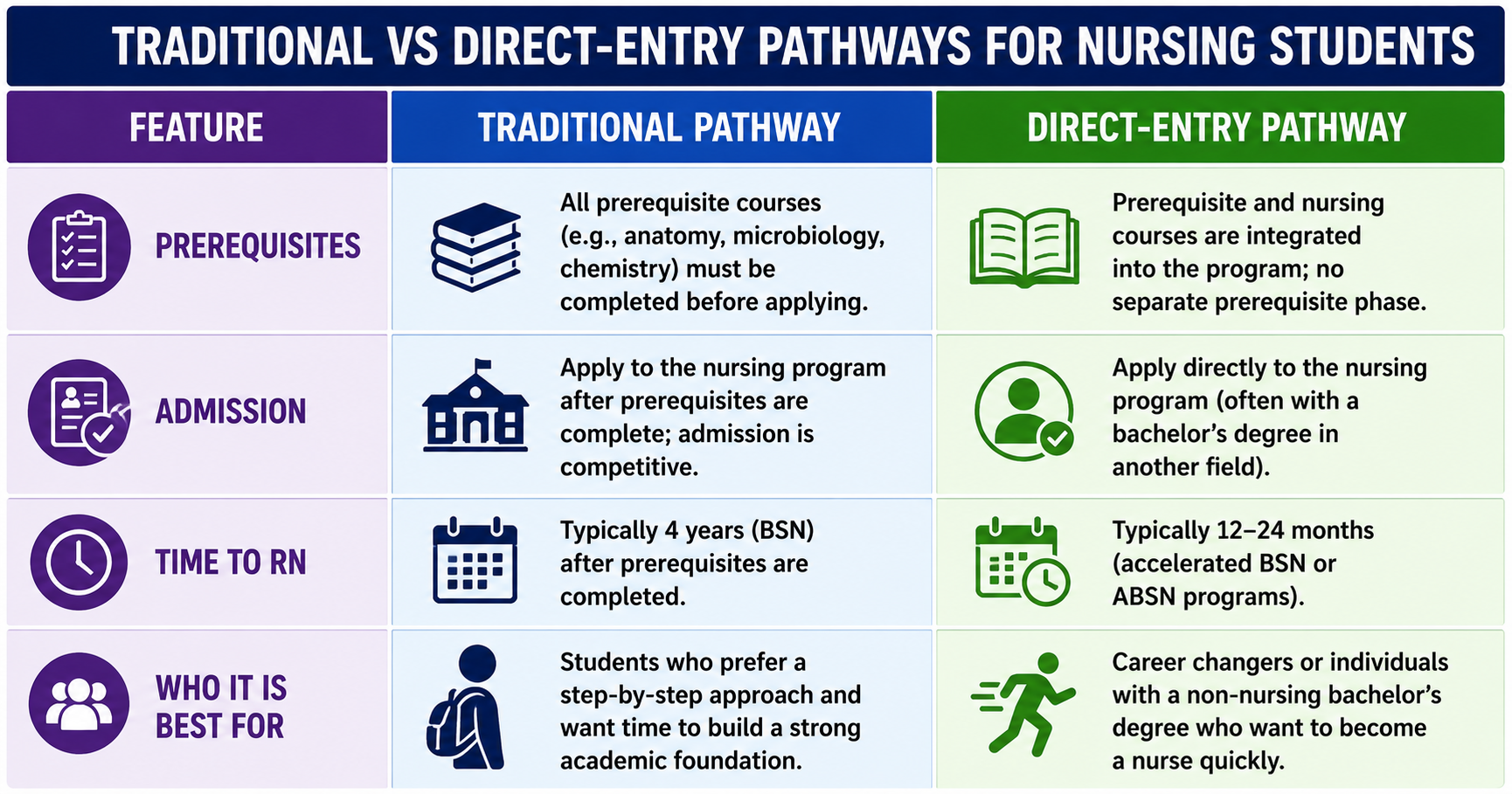
Traditional nursing programs separate prerequisites from nursing coursework entirely. Students spend months or years completing anatomy, microbiology and chemistry before they are eligible to apply to the nursing portion of the program.
In contrast, direct entry nursing programs combine foundational coursework and nursing education into one structured curriculum. These programs are common for students with bachelor’s degrees in unrelated fields.
Realistic expectations that you should have
While nursing programs without prerequisites give you a chance to pursue your dream career, these programs are intense. Unlike the traditional nursing programs that spread out your science classes over several years, the learning curve is steep.
Suggested: Nursing Scholarships That Pay Full Tuition: 2026–2027 Complete List
Even with the flexibility in prerequisites, admission to nursing is competitive. Schools may still require entrance exams, interviews, recommendation letters and minimum GPA standards.
Types of Nursing Programs Without Prerequisites
If you are joining the nursing field without a prior science background, these programs are structured to move you from zero to nurse.
- Direct entry nursing programs: When you already hold a bachelor’s degree in a non-nursing field, you can get a Direct Entry Master of Science in Nursing (DEMSN). Instead of making you repeat a four-year undergraduate degree, these programs bridge your existing education into the nursing profession. You’ll begin with foundational sciences before progressing into advanced nursing courses and clinical training. This allows you to earn your RN license and a Master’s degree simultaneously.
- Community college nursing programs: The most accessible nursing programs without prerequisites are found in community colleges. For instance, you can take the Associate Degree in Nursing(ADN) at a community college to get into healthcare and later pursue a Bachelor of Science in Nursing (BSN). However, these programs have a waitlist and a competitive admission system.
- Accelerated nursing pathways: Accelerated pathways are designed for highly motivated students capable of handling intense workloads. These programs compress nursing education into shorter timelines. For instance, you’ll complete your nursing degree in 12 to 18 months instead of the four years.
- LPN/LVN pathway: Starting as a Licensed Practical Nurse or Licensed Vocational Nurse can provide an entry into nursing because they have fewer science requirements, and you’ll gain healthcare experience. Take note that an LPN can transition into RN education
Admission Requirements You May Still Need
Even when applying to nursing programs without prerequisites, you need to demonstrate readiness for healthcare education. Here are some of the requirements you’ll need:
- Nursing entrance exams: Most schools that waive traditional prerequisites lean on standardized entrance exams. These tests assess your general reading and ensure you can survive a fast-paced nursing curriculum. TEAS is the most common exams that requires a high school level understanding of chemistry and biology. While HESI A2 is similar to TEAS, it has more topics related to healthcare. When taking the entrance exams, aim for 80% score.
- Minimum GPA benchmarks: While you may not need specific classes, you will need a good cumulative GPA. Most BSN and Direct Entry programs look for a minimum of 3.0 or 3.25. For integrated programs, admissions officers look at your performance in your previous field.
- Other requirements: Holistic admissions are becoming the industry standard, with schools determined to look at the whole person rather than just a transcript. You’ll need a personal statement, volunteer and work experience. Some schools also conduct background checks and proof of immunizations.

Challenges Of Joining Nursing School Without Prerequisites
Joining nursing school without a traditional science background can be exciting, but students should prepare for the challenges involved. Many students joining nursing programs without prerequisites have a steep learning curve, especially during the first semester. Subjects such as pharmacology and anatomy may feel overwhelming. Doing your first nursing school exam after many years may also feel intimidating.
Balancing foundational science education alongside clinical nursing courses also increases stress and time pressure. It will feel as though you are learning two courses at the same time. Students in direct entry nursing programs often report intense schedules with limited free time.
Despite these difficulties, many students succeed through nontraditional pathways every year. Success depends less on following a perfect academic timeline and more on consistency and willingness to seek support when needed. Students entering nursing programs without prerequisites can thrive academically and eventually do their NCLEX exams and build successful careers as RNs.


No comments yet. Be the first to comment!