What Should You Know for Your First Nursing School Exam? - Beginner’s Study Guide
Is your first nursing school exam approaching, and you aspire to ace it? You are not alone. Research reveals that most students feel significant pressure, anxiety, and stress regarding their first semester nursing school exam. This prevalent phenomenon is attributed to the high-stakes nature of nursing school, the sheer volume of nursing content the exam covers, and the big shift from simple memorization toward critical thinking. Despite these challenges, you can adequately prepare for your first nursing school exam and perform excellently.
Passing your first nursing school exam is a monumental milestone that validates the grueling hours of study and clinical preparation you’ve invested. This initial victory does more than just boost your GPA; it builds the foundational confidence necessary to tackle the increasingly complex medical concepts ahead. By successfully navigating the unique logic of nursing boards, you will prove that you have the requisite resilience and critical thinking skills for this demanding academic journey.
This comprehensive guide will teach you how to properly study and prepare for your first nursing school exam and ace it without breaking a sweat. Without much ado, let’s dive in.
Why the First Nursing School Exam Feels Different (The Breakdown)
Your first nursing school exam will differ greatly from general education exams. As observed, most aspiring nurses enter nursing school as experts at memorizing facts, but the first nursing school exam quickly shatters that comfort zone. This shift lies in Bloom’s Taxonomy: while previous courses tested your ability to "remember" or "understand" (Level 1 and 2), nursing exams live in the world of "application" and "analysis." A world where it isn’t enough to know what a drug does; you must determine which patient needs it most urgently.
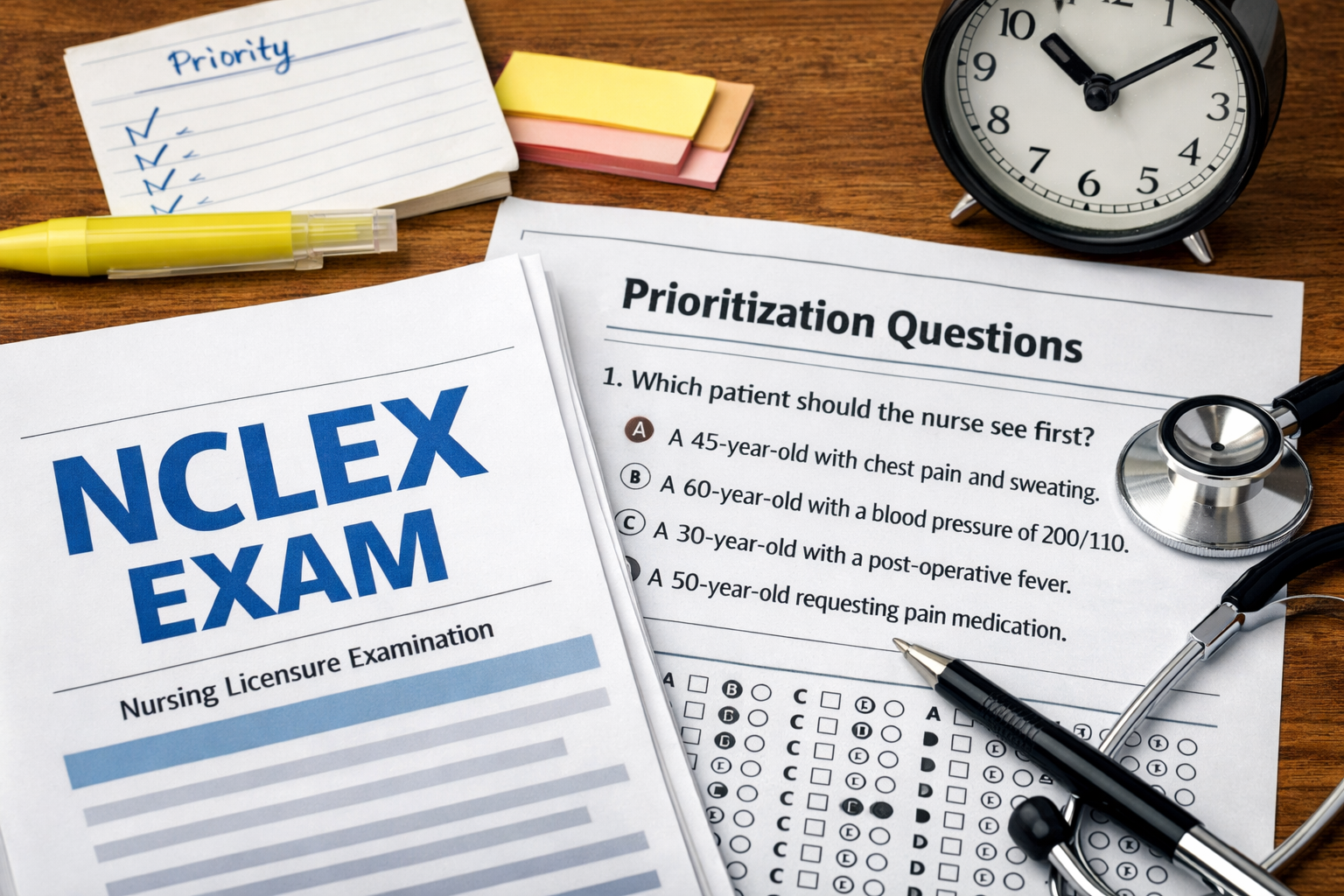
This requirement exemplifies the infamous "Most Correct" answer scenario. In your first nursing school exam, you will often face four options that are all technically accurate interventions. However, the exam will not be testing your ability to spot a lie; it will be testing your clinical priority. So, always identify which action addresses the most immediate threat to life—often following the ABC (Airway, Breathing, Circulation) rule.
To pass your first nursing school exam, you must stop thinking like a student trying to pass a test and start thinking like a nurse in a hospital room, forced to make a split-second decision to ensure patient safety.
Key Concepts of Nursing Exams: Understanding NCLEX-Style Questions (The Core)
The Anatomy of NCLEX-Style Questions
Mastering your first nursing school exam begins with deconstructing the NCLEX-style format, which comprises a stem, correct option, and multiple distractors. The stem provides the vital clinical data and the specific. The distractors, though designed to be realistic, are less suitable than the single best answer.
You must carefully identify these components to avoid being misled by “fluff” information that does not impact a patient’s immediate needs. By successfully separating the patient’s actual problem from the surrounding noise, you can systematically eliminate the distractors to pinpoint the most clinically significant priority.
Safety First: The Golden Rule
The "Safety and Infection Control" category is the cornerstone of nursing examinations – it represents the fundamental responsibility of the nurse to protect the patient from harm. During your first nursing school exam, always remember that any answer choice that addresses a risk of injury, medication error, or the spread of pathogens generally outweighs interventions addressing comfort or psychosocial needs. Thus, prioritizing safety-focused responses will demonstrate that you possess the vigilant mindset required to maintain a secure clinical environment.
The ABCs: Your First Nursing School Exam’s Best Friends
When faced with multiple patients or competing physiological needs, use the ABCs (Airway, Breathing, and Circulation) as the infallible hierarchy for determining your first move. This framework requires you to ensure that a patient has a clear Airway and is Breathing effectively before you ever address Circulation issues like blood pressure or heart rate.
For you, a new nursing student, this means that a patient struggling to inhale will always be your top priority over a patient who simply needs a scheduled dressing change. Relying on this vital sequence allows you to stay grounded during high-pressure exams and consistently choose the intervention that prevents life-threatening outcomes.
How to Study for Your First Nursing School Exam: Essential Strategies to Success
There is no one-size-fits-all approach to studying effectively during your first semester in nursing school. But do the following to make the best of your efforts:
Tap Into the Power of Practice Questions
Integrating NCLEX-style practice questions into your daily routine is the most effective way to bridge the gap between reading a textbook and passing a clinical exam. Even if you are a foreign nursing student, expose yourself consistently to NCLEX-style scenarios until you are truly ready for the NCLEX. Consistent exposure will train your brain to recognize patterns and identify what the "stem" of the question is actually asking.
Embrace Active Learning
Move beyond passive highlighting and instead engage deeply with the material through methods like concept mapping and active recall. This approach will shift your role from a consumer of information to an educator, solidifying your own understanding. Ultimately, you will build the long-term retention necessary for both your upcoming nursing exams and future career as a licensed nurse.
Focus On the "Why"
To master your first nursing school exam, prioritize understanding the underlying pathophysiology of a condition rather than simply memorizing a list of associated signs and symptoms. Once you grasp the "why" behind a clinical manifestation, you will logically deduce the correct nursing intervention even if you forget a specific bullet point from your notes.
Curate Your Resources
In this era of information overload, limit your study materials to a few high-quality, trusted resources to avoid resource fatigue and confusion. Focusing on reliable resources will protect you from the anxiety of being overwhelmed, allowing you to master a few essential tools rather than skimming through dozens of mediocre ones. Remember, you can always earn extra income from your skills to purchase your study material. Better yet, you can apply for nursing school scholarships to secure financial assistance.
Common Pitfalls to Avoid When Studying for Your First Nursing Exam
Cramming
Nursing school requires long-term retention of information because the material builds upon itself throughout the entire program. Attempting to memorize vast amounts of information the night before an exam will often make you anxious, hurting your performance on complex application questions. So, ditch the all-nighter and stick to consistent, daily review sessions that allow your brain to process and store critical clinical concepts permanently.
Skipping Rationales
When working through practice questions, the most valuable information resides in the explanation of why an answer is right or wrong. Simply identifying the correct letter choice is a missed opportunity to understand the underlying clinical logic required for future scenarios. So, start carefully reviewing every rationale – it will train your brain to think like a nurse and develop the critical thinking skills necessary for all NCLEX-style tests.
Passive Reading
Simply reading the textbook or highlighting pages is one of the most ineffective ways to prepare for a nursing exam. Passive reading fails to stimulate the deep cognitive processing needed to apply medical knowledge to real-world patient care. Instead, focus on active engagement strategies, such as creating concept maps or teaching the material to a peer, to ensure you truly master the content.
Misinterpreting Questions
Many students lose points not because they lack knowledge, but because they fail to read the exam questions carefully. When taking your first nursing school exam, vigilantly scan for "priority" keywords like first, best, or except, which fundamentally change the question. Take your time to identify these qualifiers to provide the specific answer the scenario requires rather than giving a response that is technically true but irrelevant.
Test-Day Strategies for Your First Nursing School Exam
Tame Your Testing Nerves
Anxiety management is a critical skill in nursing because nursing exams are designed to challenge your confidence as much as your knowledge. If you feel your heart racing or notice the computer screen continuing past a certain point, pause for a deliberate, deep breath to reset your focus. Maintaining physical and mental composure ensures that stress does not cloud your clinical judgment during high-stakes moments.
Embrace the Art of Elimination
When faced with a complex scenario, use the elimination process to reject the least plausible responses systematically. By identifying and removing "distractor" options that are clearly incorrect or unsafe, you significantly increase the statistical odds of selecting the best clinical action. This methodical narrowing of choices allows you to navigate even the most difficult questions with a clearer, more logical perspective.
Overall, your first nursing exam might make you feel anxious, but there is no reason to worry. Once you understand that you are not alone, adopt a good studying approach, choose your study materials wisely, and grasp the key concepts of nursing, be sure to master pass without hassle. To increase your odds of success, avoid all the common pitfalls and embrace the test-day strategies outlined above.

No comments yet. Be the first to comment!