Must-Have Items for a New Nursing Student: The Complete Nursing School Supplies Guide
Why the Right Nursing School Supplies Matter for a New Nursing Student
Starting nursing school can feel like stepping into a completely different world. You get a syllabus, a clinical schedule, a uniform order form, and a long list of items that upperclassmen, social media, and online stores all insist you need. As a new nursing student, it is easy to overspend on gadgets you will never touch while overlooking the simple tools that actually keep you safe and organized.
The most useful nursing school supplies are the ones that support three things: safe patient care in clinicals, efficient learning in lecture and lab, and steady performance on exams. Everything else is optional. A quality stethoscope matters far more than a matching set of color-coded binders, and supportive shoes will do more for your first semester than a trendy scrub brand.
Your program will also have its own requirements, so read your student handbook before you buy anything. Some schools require a specific uniform color, a particular watch style, or a photo badge from campus security. Many also require proof of immunizations, a current TB screening, a background check, and an American Heart Association BLS card before your first clinical day. These documents are part of your nursing student essentials just as much as anything you carry in your bag, and missing one can keep you off the unit.
The early weeks set the tone for the whole program, which is why it helps to understand what could get you dropped from class in the first four weeks of nursing school. Showing up prepared, with the right tools and paperwork, removes one major source of stress so you can focus on learning.
Clinical Gear: Stethoscope, Penlight, and Watch
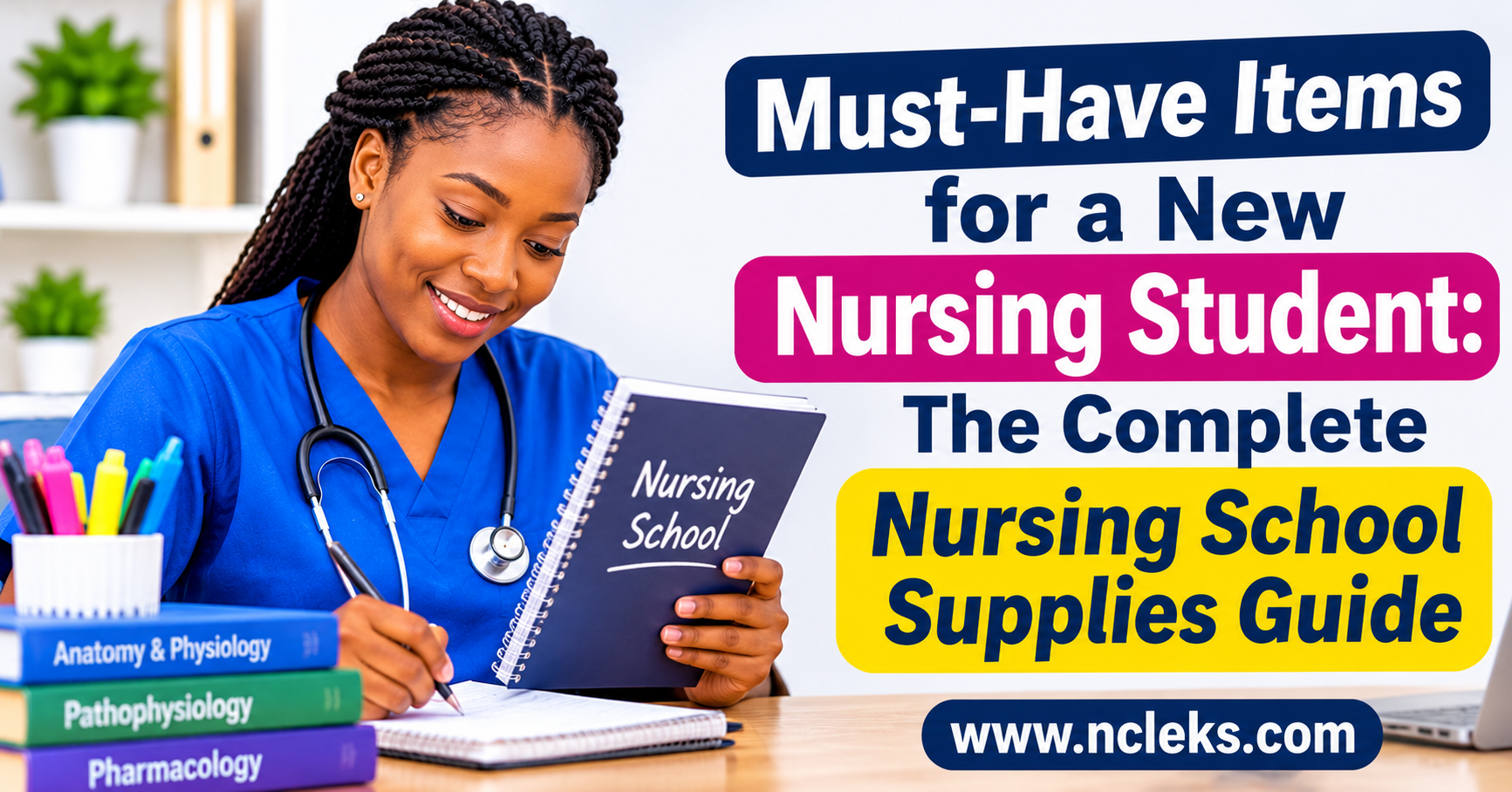
The core of your clinical kit is small, but each item gets used every single shift. Your stethoscope is the most important purchase on the list. Look for a dual-head model with both a diaphragm and a bell, since you will use the diaphragm for high-pitched sounds like normal breath sounds and bowel sounds, and the bell for low-pitched sounds like S3, S4, and some murmurs. A mid-range cardiology-grade or classic model is more than enough for school, and acoustic quality matters more than color or engraving.
Owning a good stethoscope is only half the skill, so practice early and often. Our guide on how to hear lung and heart sounds clearly covers placement, positioning, and the common mistakes that make students miss crackles or murmurs.
A penlight is next among your nursing student essentials. You will use it to check pupils for size, equality, and reaction to light, and to inspect the mouth and throat. Buy a few inexpensive ones, because they disappear quickly on busy units. A watch with a second hand is equally important because you will count respirations and pulses by the clock. Many facilities discourage wrist jewelry for infection control, so a clip-on fob watch is a smart choice for a new nursing student who wants to stay within policy.
Round out your clinical gear with bandage scissors, black ink pens (many facilities require black ink on paper documents), a small notepad or report sheet, and a pocket-sized hand sanitizer for moments when a dispenser is out of reach.

Uniforms and Footwear Built for 12-Hour Shifts
Your uniform is usually dictated by your program, so follow the required color and style exactly. Buy at least two or three sets so you always have a clean one ready, and choose fabric with some stretch, because you will be bending, lifting, and repositioning patients all day. A long-sleeve undershirt in an approved color can help in cold units, and a fleece or warm-up jacket is often allowed if it matches your school dress code.
Footwear deserves serious attention. Clinical shifts often run eight to twelve hours on hard floors, and poor shoes can lead to foot, knee, and back pain that drags down your energy and focus. Look for closed-toe, fluid-resistant shoes with good arch support and slip-resistant soles. Our breakdown of the best shoes for nursing students working 12-hour clinical shifts compares popular options by comfort and support.
Compression socks are among the most underrated nursing school supplies. They reduce leg swelling and fatigue, and many students say they feel noticeably less sore after a long day. Keep your nails short and natural, since artificial nails and extenders are prohibited in most clinical settings because they harbor bacteria. Pack plain hair ties as well, because hair must stay off the collar and away from sterile fields and patients.
If your rotations include overnight hours, planning your meals and sleep becomes part of your gear list too. These tips on surviving 12-hour night shift clinicals show how to pack food and protect your rest.

Technology and Study Tools That Actually Help
Technology is where many students overspend. A reliable device for reading e-books, completing online assignments, and taking proctored exams is one of the true nursing student essentials, but you do not need every accessory on the market. Before buying, check your program's testing requirements, because platforms used for ATI and HESI exams often have specific operating system and browser requirements that some tablets cannot meet.
If you are deciding between devices, our comparison of a laptop vs. iPad for nursing school explains which tasks each one handles well. Many students find that a laptop is mandatory for testing, while a tablet with a stylus is a helpful extra for annotating slides.
Lectures in nursing school move fast and cover dense content, so a new nursing student often benefits from recording class, if the instructor permits it. Reviewing a difficult lecture on fluid balance or cardiac drugs a second time can make the material click. Our list of the best apps to record nursing lectures highlights tools with transcription and timestamp features.
Beyond devices, a few low-cost nursing school supplies make studying more effective. Noise-canceling earbuds help in crowded libraries, a portable charger keeps your phone alive during long clinical days, and a whiteboard or blank paper lets you practice drawing out concepts like the renin-angiotensin system from memory. Active recall and practice questions beat passive rereading every time, so pair your tools with regular question practice on the NCLEKS flashcards page.

Reference Guides and Pocket Cards for Quick Answers
In clinicals, you will constantly run into unfamiliar abbreviations, lab results, and medications. Pocket references help you answer those questions in seconds, which builds confidence and keeps you from interrupting your nurse for every small detail. A compact drug guide is one of the most valuable nursing school supplies you can own, whether it is a print handbook or an approved app. Use it to look up classification, nursing considerations, and parameters for holding a dose before you administer anything.
Laminated pocket cards or a small binder of cheat sheets are another clinical favorite. Keep one card for normal lab ranges and one for common abbreviations. Our nursing lab values cheat sheet with mnemonic tricks is a great starting point for building your own card, and reviewing it before each shift helps you spot a critical potassium or low platelet count quickly.
Medical shorthand can be confusing at first, especially when you are reading provider notes or receiving reports. A new nursing student who learns the most common abbreviations early will chart faster and follow handoffs more easily. Start with these 50 common medical abbreviations every nursing student must know, and remember that the Joint Commission's "Do Not Use" list bans abbreviations like "U" for units and trailing zeros because they cause medication errors.
Whatever format you choose, keep your references updated and confirm that apps are permitted on your clinical unit. Some facilities restrict phone use in patient areas, so a printed backup is among the safest nursing student essentials to carry.

Organization and Self-Care Items Every Student Needs
Nursing school rewards organization. A paper planner or digital calendar that holds lecture dates, clinical times, care plan deadlines, and exam weeks is one of the simplest nursing student essentials, yet it prevents some of the most painful mistakes, like forgetting a skills check-off. Color coding by course or by task type makes it easy to see a heavy week coming before it arrives.
A sturdy, washable clinical bag is also worth the investment. Choose one with separate compartments so your stethoscope, penlight, and pens are easy to grab, and keep a clean pouch for food and personal items away from anything that touches the clinical environment. Wipe down your stethoscope and bag regularly, and never set your belongings on a patient's bed or bedside table.
Self-care items belong on this list too. A refillable water bottle, healthy snacks with protein, lip balm, and a spare set of socks can make a long day far more manageable. A new nursing student often underestimates how physically and emotionally demanding the first semester will be, and small comforts help you stay alert and steady.
If the workload starts to feel like too much, you are not alone. This step-by-step survival guide for feeling overwhelmed in nursing school offers practical ways to reset your schedule and protect your mental health. Treat rest, sleep, and support systems as part of your nursing school supplies, because a burned-out student cannot use even the best equipment well.
Building Your Kit on a Student Budget
You do not have to buy everything at once. Start with the items you need for the first two weeks—usually your uniform, shoes, stethoscope, penlight, watch, and required documents—then add the rest as you learn what your program and clinical sites actually expect. Ask second-year students what they used most and what sat untouched in their bags, because their advice is often more accurate than any shopping list.
Look for student discounts on stethoscopes, scrubs, and software, and check whether your school bookstore offers bundled clinical kits. Many programs also accept gently used reference books, and older editions of drug guides can work for basic concepts, though you should always confirm current dosing and safety information with an up-to-date source. If cost is a barrier, explore scholarships and grants early; our guide on how to fund nursing school with grants, scholarships, and aid walks through your options.
Finally, remember that the most powerful nursing student essentials are not physical objects. Consistent study habits, regular practice questions, and a willingness to ask for help will carry you further than any gadget. As a new nursing student, focus on building a kit that keeps you safe, organized, and confident, and spend the rest of your energy on learning. When you are ready to test what you know, explore the NCLEKS practice exams and keep your nursing school supplies simple, functional, and ready for every shift.


No comments yet. Be the first to comment!