How to Pass an LPN Program: A Practical Study and Clinical Survival Guide for Nursing Students
Why an LPN Program Feels So Different From Prerequisites
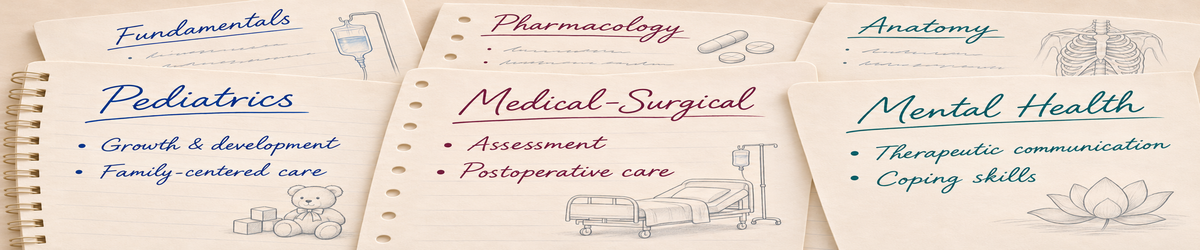
Getting accepted into an LPN program is a big accomplishment. Most students soon find that passing it takes a different kind of effort than prerequisites did. Practical nursing programs usually fit fundamentals, pharmacology, med-surg, maternity, pediatrics, and mental health into about 12 to 18 months. New content arrives almost every week, and clinical hours run alongside lectures, so there is very little room to fall behind and catch up later.
The other change is the style of testing. LPN school exams rarely ask you to recall a definition. They ask what you would do first, which finding needs follow-up, or which statement shows the patient understood your teaching. These are the same application-level questions you will see on the NCLEX-PN, so the habits you build now carry straight into licensure.
Understanding your role also matters, because many questions depend on what falls inside the practical nurse's scope. Reviewing what LPNs can and can't do early will help you rule out answer choices that belong to the RN.
This guide covers the strategies that consistently help students pass an LPN program. You will learn how to build a weekly study system, master the high-stakes courses, perform well in clinicals, think the way the NCLEX-PN expects you to think, and protect your energy so you can finish strong.

Build a Study System in Your First Weeks of LPN School
The first month of your LPN program sets the tone for everything that follows. Most dismissals do not happen because a student lacks ability. They happen because the student underestimated attendance policies, quiz grades, or the minimum passing score, which is often 75 to 80 percent in practical nursing courses. Read your syllabus and student handbook during the first week. It also helps to review what could get you dropped from class in the first four weeks of nursing school so nothing catches you off guard.
Next, build a weekly rhythm you can repeat. A simple system works for many students. Preview the chapter for 20 to 30 minutes before lecture. During class, focus on what the instructor emphasizes. Review the same day by turning your notes into practice questions. Instructors in LPN school often write exam items from their own slides, so anything they repeat, pause on, or call important deserves a flag in your notes.
Finally, schedule study blocks the way you would schedule a shift. Short daily sessions of 60 to 90 minutes work better than one exhausting cram session the night before an exam. Spaced repetition helps you keep content for the cumulative final and later for the NCLEX-PN. Use active recall instead of rereading. Cover your notes and explain a concept out loud, or quiz yourself with flashcards until you can answer without looking.

Master the Courses That Make or Break an LPN Program
Three areas cause the most trouble for practical nursing students: fundamentals, pharmacology, and dosage calculations. Fundamentals is the foundation for every course that follows. It covers safety, infection control, vital signs, positioning, and basic data collection. Rather than memorizing isolated facts, ask yourself why each nursing action matters and what could go wrong if you skipped it.
Pharmacology is where many students feel overwhelmed because of the sheer number of drugs. Learn by drug class and suffix instead of memorizing every medication. For example, the suffix '-olol' signals a beta blocker. That one clue tells you to check the apical pulse and blood pressure, watch for bradycardia, and teach the patient not to stop the drug abruptly. The approach in how to studying pharmacology without memorizing everything applies directly to an LPN program, where you may give oral, intramuscular, and subcutaneous medications early in clinicals.
Dosage calculation exams need special attention. Many programs require a score of 90 to 100 percent, often with limited retakes. Choose one method, such as dimensional analysis, and use it for every problem until the process becomes automatic. Label every unit, double-check conversions such as 1 kg equals 2.2 lb and 1 teaspoon equals 5 mL, and ask whether your final answer makes clinical sense. Following a method-first strategy for dosage calculation exams will sharply reduce careless errors.

Clinicals and Skills Check-Offs: Where Practical Nursing Students Prove Safety
Most LPN programs grade clinical rotations as pass or fail. One unsafe behavior can end your enrollment even if your test scores are excellent. Arrive early and research your patient's diagnoses and medications beforehand. Never perform a skill you have not been checked off on unless your instructor is present. If you are unsure about anything, stop and ask. Instructors respect a student who pauses for safety far more than one who guesses.
Skills check-offs follow strict checklists. Practice each skill in the lab until you can perform it while saying every step out loud. That includes hand hygiene, two patient identifiers, privacy, and documentation. Students who fail check-offs usually skip a critical safety step under pressure; it is rarely because they don't know the procedure. Reading about what to expect in the nursing simulation lab and how to pass practical check-offs can help you rehearse the flow before test day.
Clinicals are also where you learn the difference between your role and the RN's role. In LPN school, you will collect data, reinforce teaching, give medications, and report changes. The RN handles initial assessments, care plan development, and unstable patients. Paying attention to this division during clinicals makes exam questions about delegation and LPN versus UAP rules much easier to answer.

Think Like the NCLEX-PN From Your First Unit Exam
The fastest way to raise your exam scores in an LPN program is to study for application instead of recall. Every unit exam is a rehearsal for the NCLEX-PN, which uses clinical judgment items, select-all-that-apply questions, and case studies. After you finish a chapter, complete 20 to 30 practice questions on that topic. Read every rationale, including the ones for questions you got right, because a lucky guess teaches you nothing.
When a question asks for a priority, use the same framework every time. Start with airway, breathing, and circulation, then safety. After that, address Maslow's physiological needs before psychosocial ones. Ask whether the patient is stable or unstable and whether a finding is expected for the condition. A postoperative patient with mild incisional pain is expected. A postoperative patient with a new respiratory rate of 30 and restlessness is not. These study tips for mastering nursing-style questions in fundamentals break this thinking down further.
Keep an error log as well. For every missed question, write down the topic, why you chose the wrong answer, and the rule you will remember next time. Patterns show up quickly. Maybe you keep choosing more data collection when the patient needs an action, or you miss key words like "first" and “except.” Fixing those patterns is what turns a borderline grade into a comfortable pass in LPN school.
Protect Your Energy, Time, and Support System
Many practical nursing students work, parent, or both while in school. Burnout is one of the most common reasons capable students fall behind. Watch for warning signs such as dreading every class, losing sleep before clinicals, or rereading the same page without retaining it. The signs of nursing school burnout and how to recover are worth learning before finals arrive, not after.
Protect your sleep the same way you protect study time, because fatigue slows the clinical reasoning that LPN school exams demand. A few habits make the week easier. Meal prep on your day off, and lay out your uniform the night before clinicals. Use small pockets of time, such as a 15-minute lunch break, for flashcards or a handful of practice questions. If you need income, look for work that bends around your schedule. Roles such as CNA, patient sitter, or unit secretary also reinforce what you are learning in class.
Finally, lean on your support system. Form a small study group of two to four committed classmates. Tell family members your exam dates in advance so they can plan around them. If you are struggling, talk to your instructor early. Most instructors want you to succeed and can point you to tutoring or remediation, but they can only help if they know about the problem before the final grade is posted.

Finish Your LPN Program Strong and Get Ready for the NCLEX-PN
The final term of an LPN program usually includes a comprehensive predictor, such as the ATI PN Comprehensive Predictor. Some schools require a minimum score to graduate or to receive approval to test. Treat this exam as a diagnostic tool rather than a verdict. Review your individual performance profile, find the two or three content areas where you scored lowest, and remediate those first. This complete study guide for the ATI PN Comprehensive Predictor explains how to structure that final stretch.
In the last few weeks, shift from content review to timed question practice. Complete mixed-topic sets of 75 to 85 questions to build stamina. The NCLEX-PN is computer adaptive, so you need to stay focused from the first question to the last. Review rationales the same day and add any new rules to your error log.
The habits that help you pass LPN school are the same ones that help you pass the NCLEX-PN on your first attempt. Those habits are consistent daily study, question-based learning, and safe clinical practice. Once you graduate, apply for your authorization to test promptly. The step-by-step guide to getting your NCLEX ATT explains the licensing timeline, so you can schedule your exam while the content is still fresh.



No comments yet. Be the first to comment!