Preparing for the ATI PN Comprehensive Predictor Exam: A Complete Study Guide for Practical Nursing Students
What the ATI PN Comprehensive Predictor Actually Measures
The ATI PN Comprehensive Predictor is the exit exam many practical nursing programs use to decide whether a student is ready to sit for the NCLEX-PN. Unlike a unit exam that covers one body system or one course, this test pulls from everything you learned in your program, including fundamentals, pharmacology, medical-surgical nursing, maternal and newborn care, pediatrics, and mental health. Its purpose is not simply to grade you. It is designed to estimate how likely you are to pass the licensing exam on your first attempt.
The exam is built around the same client needs categories found on the NCLEX-PN test plan. You will see questions on coordinated care, safety and infection control, health promotion and maintenance, psychosocial integrity, basic care and comfort, pharmacological therapies, reduction of risk potential, and physiological adaptation. Most versions contain around 150 questions with an allotted time of roughly three hours, but your school may administer a specific form, so confirm the details with your faculty before test day.
Understanding this structure changes how you study. Because the predictor mirrors the NCLEX-PN blueprint, the same habits that help on the licensing exam help here. If you are curious how practical nursing and registered nursing licensure relate, the article on whether you can sit for the LPN NCLEX while in RN school offers useful context. The key takeaway is that this exam tests clinical judgment within the PN scope of practice, not your ability to memorize isolated facts.

How Scoring and Benchmarks Work
Your results report shows an individual adjusted score and, most importantly, a predicted probability of passing the NCLEX-PN. This percentage is calculated from how past test takers with similar scores performed on the actual licensing exam. Many programs set a benchmark, often a predicted probability of 90 percent or higher, though some schools use different cutoffs. Ask your program early which number you need, how many attempts you are allowed, and whether remediation is required between attempts.
The score report also breaks your performance down by client needs category and by topic. This breakdown is far more valuable than the overall number. A student who scores well overall but performs poorly in pharmacological therapies has a very different study task than a student who struggles with psychosocial integrity. Treat the report as a map of exactly where your knowledge gaps are hiding.
ATI also generates a Focused Review based on the questions you missed. Students who skim this material tend to repeat the same mistakes, while students who work through every linked topic and write out why they missed each item usually improve significantly. If your school requires a passing score before you can graduate, it helps to understand your options ahead of time, and the guide on what happens if you fail the nursing school exit exam explains how to respond calmly and strategically.
Building a Realistic Study Plan in the Final Weeks
Most students have four to eight weeks between their final practice assessment and the proctored predictor. Start by taking a full-length practice assessment under timed conditions, then use the results to divide your study time. Give your weakest two or three client needs categories about half of your weekly hours, and rotate the remaining categories through the rest of the week so nothing gets neglected.
A sustainable rhythm works better than marathon cram sessions. Two to four focused hours per day, broken into blocks of content review followed by question practice, builds retention without burnout. The breakdown in how many hours a day you should study for a nursing exam can help you set a schedule that fits around work, clinicals, or family responsibilities.
Plan to complete at least 50 to 75 practice questions on most study days, and spend as much time reading rationales as you spend answering. When you miss a question, ask yourself whether it was a content gap, a misread stem, or a strategy error. Each type of mistake needs a different fix. Content gaps require review, misreads require slowing down, and strategy errors require practicing prioritization frameworks. Active recall and spaced repetition will help facts stay with you, a method explained well in smart study methods to retain information. Schedule a second full practice test about two weeks before the real exam to measure progress.

High-Yield Content Areas for Practical Nursing Students
Pharmacology consistently trips up PN students, so make it a daily habit. Focus on drug classes rather than individual medications, and learn the major adverse effects, key lab values to monitor, and when to hold a dose. Anticoagulants, insulin, cardiac glycosides, antihypertensives, opioids, and antibiotics appear frequently. A quick reference like the NCLEX pharmacology cheat sheet makes daily review faster, and pairing it with lab value practice strengthens both areas at once.
Coordinated care is another heavily tested category, and for PN students it centers on scope of practice. You need to know what the practical nurse can do independently, what must be reported to the RN or provider, and which tasks can be assigned to assistive personnel. Expect questions asking which client the PN can care for, which task belongs to the UAP, and when a finding requires escalation. Reviewing LPN versus UAP delegation rules will sharpen your judgment here.
Do not overlook safety and infection control, including fall prevention, restraint use, isolation precautions, and medication safety. Basic care and comfort topics like positioning, nutrition, elimination, and mobility are often considered easy, yet students lose points by rushing through them. Maternal and newborn care and pediatrics deserve attention as well, particularly normal versus abnormal findings and developmental milestones.

Mastering Question Styles and Prioritization
Knowing content is only half the challenge. The predictor uses the same question formats as the NCLEX-PN, including multiple choice, select all that apply, ordered response, and items that ask you to identify the priority action or the client to see first. Many students lose points not because they lack knowledge but because they apply it inconsistently under pressure.
Priority questions reward a structured approach. Start with airway, breathing, and circulation, then consider safety and Maslow's hierarchy, and finally ask whether a finding is expected for the condition or a sign of a complication. An expected finding, such as mild incisional pain after surgery, is usually less urgent than an unexpected one, such as new confusion or sudden shortness of breath. The guide to prioritizing NCLEX questions using ABCs, Maslow, and safety walks through this process with clear examples.
Select all that apply items require a different mindset. Treat each option as its own true or false statement rather than comparing choices against one another. Avoid the habit of selecting only two or three options because it feels safe, since some items have one correct answer and others have all of them. The tips in how to tackle SATA questions on the NCLEX can make these items far less intimidating. Finally, read every stem for key words like first, priority, further teaching needed, and report, since a single word changes the correct answer.
Test Day Strategy and What Comes Next
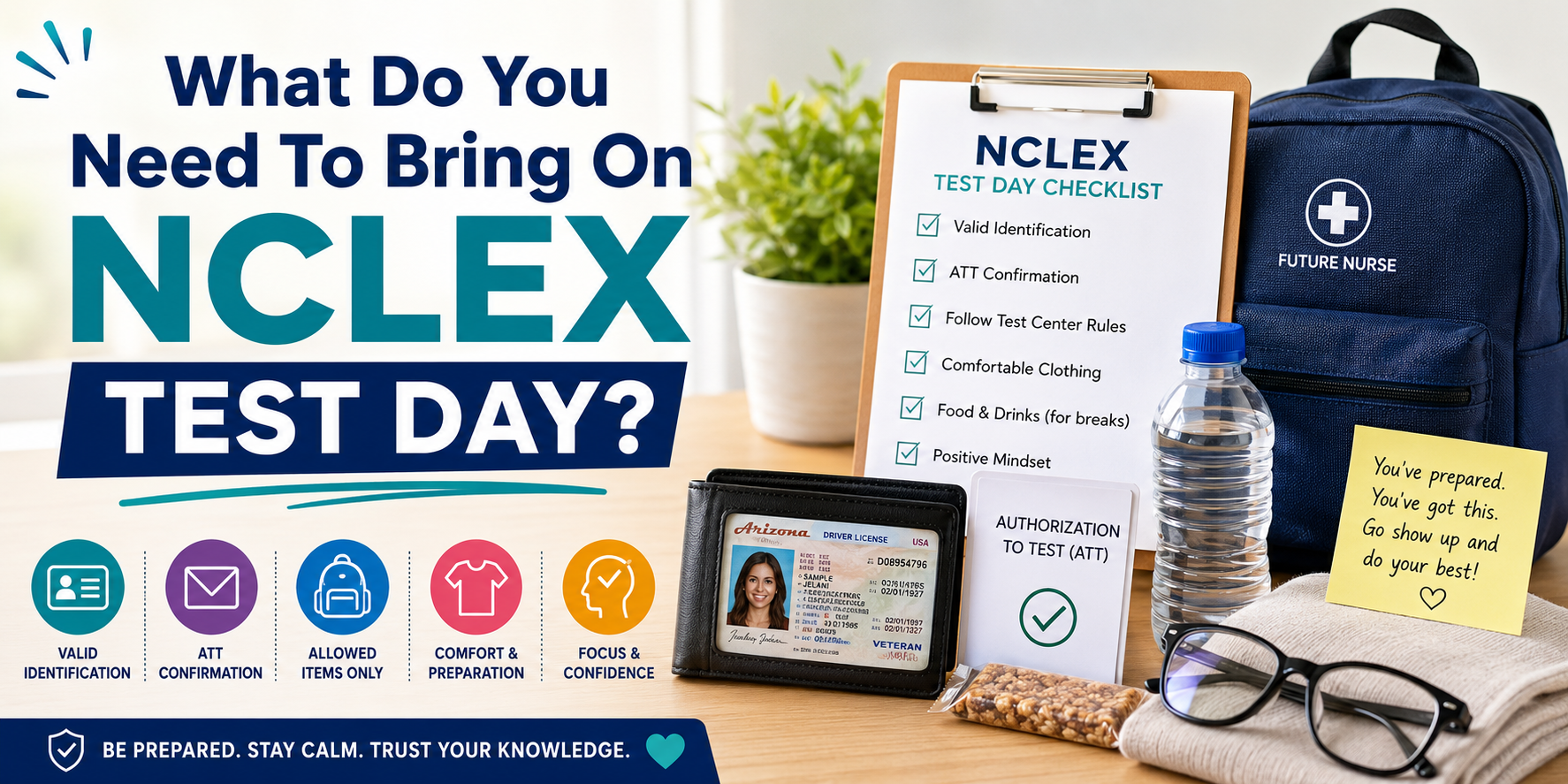
The night before the exam, stop studying new material. Light review of formulas, lab values, and your own error notes is fine, but sleep matters more than one more chapter. Eat a balanced breakfast, arrive early, and bring whatever identification and login information your school requires. Once the exam begins, pace yourself at roughly one question per minute, which leaves a cushion for harder items without letting any single question drain your time.
If you hit a stretch of difficult questions, do not panic. Difficult items appear for every test taker, and one hard question does not mean you are failing. Reset by rereading the stem, identifying what the question is truly asking, and eliminating options that fall outside the PN scope or delay necessary care. Choose the answer that keeps the client safest and move on.

After the exam, review your report regardless of your score. A strong result confirms you are on track, and that same momentum should carry directly into NCLEX-PN preparation while the material is fresh. If you want a structured approach for the weeks after graduation, the plan in how to pass the NCLEX in 30 days builds naturally on predictor results. You can also gauge your readiness using the signs described in how to know when you are truly ready for the NCLEX. A predictor score below your benchmark is not the end of your path; it is precise feedback telling you exactly where to focus next.


No comments yet. Be the first to comment!