How Many Times Can You Take the NCLEX? State-by-State Breakdown
Failing the NCLEX can feel discouraging, especially after months or years of preparing for your nursing career. One of the first questions many graduates ask after seeing an unsuccessful result is, how many times can you take the NCLEX? The good news is that you have multiple opportunities to retake the exam. However, the exact number of attempts depends on both national guidelines and your state board of nursing. Let’s go through the general retake rules, the policies on NCLEX attempts by state and what to do if you need to take the NCLEX more than once.

General NCLEX Retake Rules (National Guidelines)
Before looking at NCLEX attempts by state, it’s important to understand the national rules that affect how many times you can take the NCLEX. These guidelines are set by the National Council of State Boards of Nursing (NCSBN), which administers NCLEX exams.
How many times can you take the NCLEX nationwide?
Generally, you can take the NCLEX up to eight times per year. This rule exists because there must be a waiting period between attempts. The national standard requires aspiring nurses to wait at least 45 days before retaking the exam.
There is no universal lifetime limit on how many times you can take the NCLEX exam. However, this doesn’t mean you can attempt it indefinitely without meeting other requirements. State boards may set additional limits on the total number of attempts or how long you have to pass the nursing exam after graduation.
What happens after you fail the NCLEX?
When you fail the NCLEX, you will receive a Candidate Performance Report (CPR) from your nursing regulatory body. This document provides detailed feedback about your strengths and weaknesses in various nursing content areas. If you want to be successful in your second attempt, you can use the CPR to guide your NCLEX study plan.
If you found out about your NCLEX performance before the official results, wait until you receive your official results. With your results, you need to do the following to retake the exam:
- Reapply to your state board of nursing by contacting the board and submitting a new application online. Some states require resubmitting a background check and the fees vary by state.
- Register again with Pearson VUE and pay the exam fee on the NCLEX official site. You can do both applications at the same time, and once the state board and Pearson VUE process your application, your Authorization to Test (ATT) will arrive by mail. Check the validity of the ATT, which is usually 90 days, and book your NCLEX exam.
Time limits after graduation to pass the NCLEX
Many states require candidates to pass the NCLEX within a certain number of years after graduating from nursing school. The most common time frame ranges from two to three years, although some states allow longer periods. If this time expires, you may be required to complete refresher courses or repeat certain nursing coursework before becoming eligible again.
NCLEX attempts by State
You may notice that how many times you can take NCLEX differ depending on where you apply for licensure. This variation exists because each state regulates nursing independently.

Role of state boards of nursing
Every state has a board of nursing or a Nursing Regulatory Body (NRB). These boards determine the eligibility requirements for becoming an RN or PN, enforce the licensing standards and establish retake policies. While the NCLEX exam is standardized nationwide, the number of attempts differs by state. Some limit the total number of attempts or impose mandatory remediation after repeated failures. Because of these differences, checking your specific state’s guidelines is essential before scheduling another exam.
States with Unlimited NCLEX Attempts
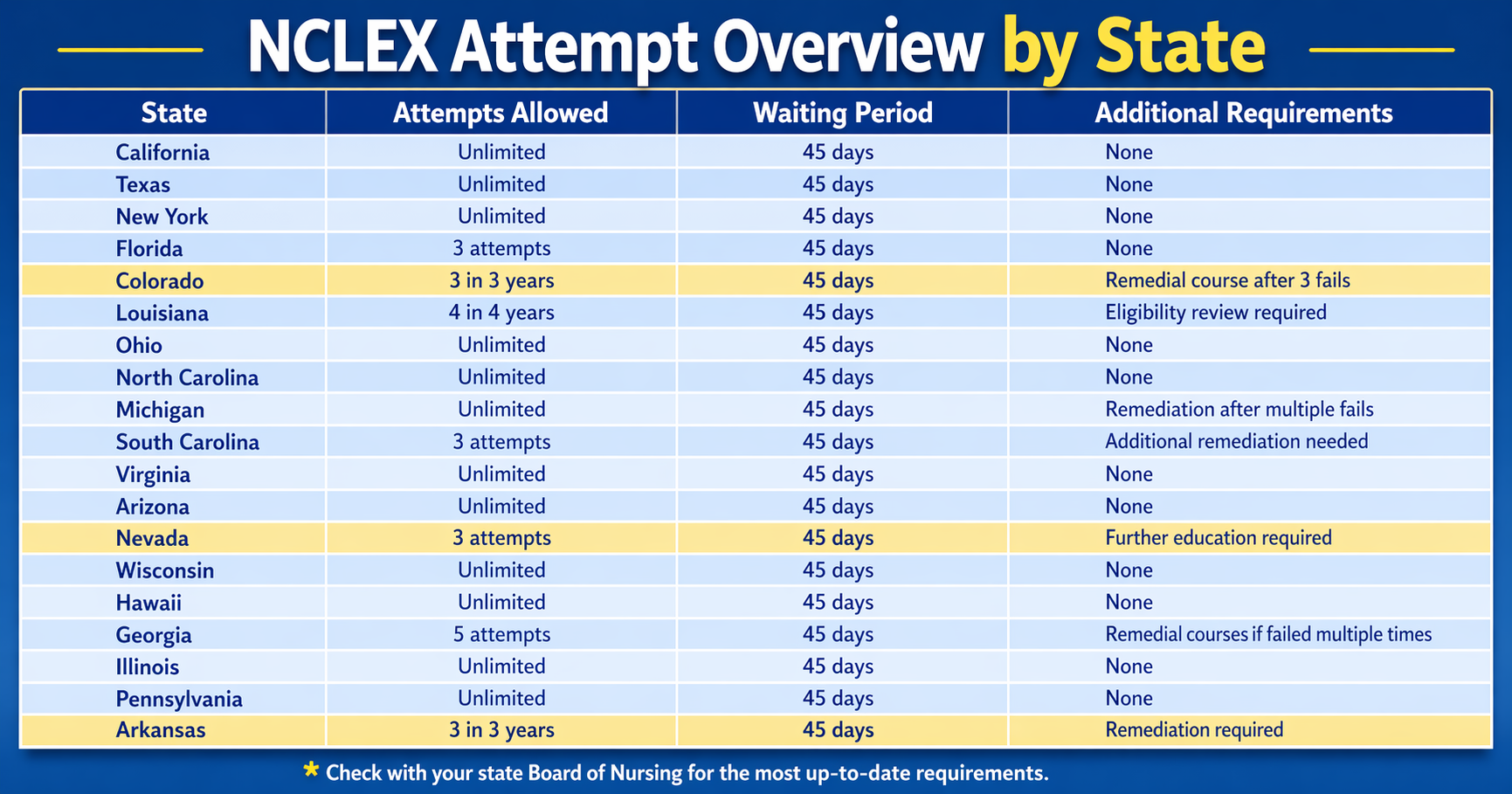
Many states allow candidates to retake the NCLEX multiple times without setting a strict lifetime limit. In these locations, the primary restriction is the 45-day waiting period between attempts. Some of the states that allow unlimited attempts include California, New York, Texas, Ohio, Pennsylvania, Arizona, North Carolina, Virginia, Wisconsin and Washington.
Also Read: Can You Sit for LPN NCLEX While in RN School?
In these states, candidates can continue retaking the exam as long as they remain eligible and follow all registration requirements. However, unlimited attempts don’t mean unlimited time. Most states still enforce deadlines associated with graduation dates. For instance, a state may allow unlimited attempts within a specific time frame, such as three years after graduation.
States with Limited NCLEX Attempts
Some states impose stricter limits on the number of times you can take the NCLEX within a defined period. These restrictions are intended to encourage candidates to improve their knowledge before repeatedly retesting.
Some of the states with defined limits include:
- Colorado: Here, nurses have up to three attempts within three years. If you’re unsuccessful after this period, you may need additional education before you continue.
- Louisiana: You are allowed four attempts within four years.
- South Carolina: If you fail multiple times, you need to complete remediation before receiving approval to test again.
- Nevada: You’ll need to show proof of continued education after a certain number of failed attempts.
States with limited attempts often emphasize preparedness and professional competency. If you live in one of the states above, you need to prepare adequately before each retake and take a practice test to improve your chances of passing.
States that require remedial courses after multiple failures
Several states allow retakes but require formal remediation after repeated failures. These courses help candidates strengthen weak areas and improve their chances of passing. States with remediation requirements include:
- Florida: If you fail the NCLEX three times, you must complete an approved remedial course before scheduling another attempt.
- Hawaii: After repeated unsuccessful attempts, remediation coursework may be required to restore eligibility.
- Michigan: You must complete remedial education before continuing with additional attempts.
Remedial programs often include structured instruction in areas such as pharmacology, patient safety, clinical reasoning and prioritization. These programs can be instructor-led courses, online modules or supervised clinical practice. While you’ll have to spend extra cash on remediation and create extra hours for study, it increases your chances of passing future attempts.
How long must you wait between NCLEX Attempts?
One of the most important national rules that affects how many times you can take the NCLEX involves waiting periods between tests. The standard waiting period is a minimum of 45 days between NCLEX attempts. This rule allows time to review performance reports and strengthen weak areas before retesting. During this waiting period, you should study your weak areas, check out the NCLEX-RN test plan and practice how to tackle SATA questions or Vaccine questions.
What happens if you fail the NCLEX Multiple times?
Failing the NCLEX more than once can be frustrating, but it does not mean your nursing career is over. Many licensed nurses pass after several attempts. If you fail repeatedly, some of the consequences include:
- Mandatory remediation requirements
- Expiration of eligibility after a certain time
- Additional documentation requirements
- Higher financial costs due to retake fees
Some states may also require candidates to repeat portions of their nursing education if too much time passes without a successful exam result.
Suggested: What Happens If You Fail the Nursing School Exit Exam? What to Do Next
If your eligibility expires, you may need to enroll in refresher courses or repeat certain clinical hours. These programs help ensure that your nursing knowledge remains current and safe for patient care.
Tips if you need to retake the NCLEX
Wondering how to reduce the number of times you take the NCLEX? You have to prepare strategically. Many candidates improve their performance between attempts when they change their study plans. If you want to excel in your NCLEX exam, start by reviewing your CPR to identify your weak areas and create a study plan that will help you improve.
Practice questions are one of the most effective tools for NCLEX preparation. Completing daily practice tests helps improve clinical reasoning and familiarity with exam-style questions. When you practice, you’ll know if you’re truly ready for the NCLEX. Consider enrolling in a structured NCLEX review course if you struggled during your first attempt. These programs often provide guided lessons, mock exams, and test-taking strategies. Maintaining a consistent study schedule also improves retention. Short, daily study sessions are often more effective than long, infrequent sessions.
Failing the NCLEX is frustrating, but you can take the NCLEX multiple times. You'll have multiple opportunities to retake the exam, and many licensed nurses today passed after more than one attempt. Understanding how many times you can take the NCLEX in your state helps you plan your next steps. Always verify your state board’s requirements, follow recommended waiting periods, and use performance feedback to guide your preparation. With persistence, focused studying, and the right support from NCLEKS, passing the NCLEX is an achievable goal.


No comments yet. Be the first to comment!