Insulin Peak Times Chart: Easy Mnemonics to Prevent Hypoglycemia on Exams
Few medication topics show up on nursing exams as reliably as insulin, and few cause as many missed questions. Test writers rarely ask you to define insulin. Instead, they give you a clock time, an insulin type, and a client who suddenly feels shaky. Then they ask what you expect or what you do first. If you know your insulin peak times, those questions become almost automatic. If you don't, you end up guessing.
The peak is the window when an insulin is working its hardest to move glucose into cells. That also makes it the window when hypoglycemia is most likely. This single idea, peak equals danger, connects nearly every insulin question on the NCLEX-RN, NCLEX-PN, HESI, and ATI exams. Onset tells you when to give the dose relative to a meal. Duration tells you how long to keep watching. The peak tells you when to be at the bedside with juice and a glucometer.
This guide turns the numbers into a simple chart you can picture, then adds insulin mnemonics that make the timing stick under pressure. You will also see how these facts connect to assessment, safe administration, and priority actions. If you want the broader drug picture first, our NCLEX pharmacology cheat sheet of high-yield drug classes is a good companion. The strategies for studying pharmacology without memorizing everything also pair well with the approach used here.
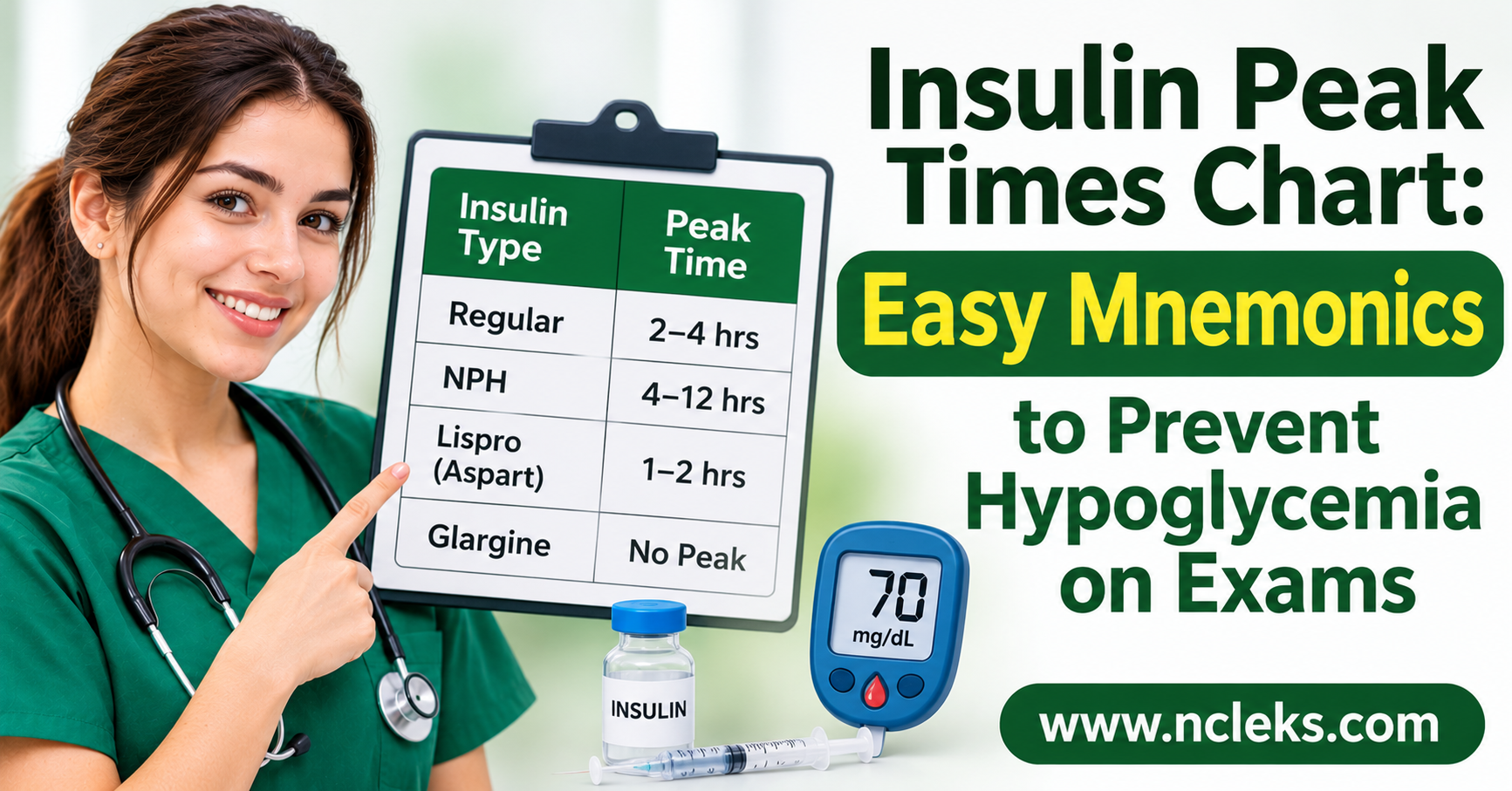
The Insulin Peak Times Chart in Plain Language
Think of the chart as four rows, moving from fastest to slowest. One warning first: textbooks and drug references list slightly different ranges. Learn the pattern and the approximate numbers rather than worrying about a single half hour. Exam questions are written so that ranges like these lead you to the right answer.
Rapid-acting insulins include lispro (Humalog), aspart (NovoLog), and glulisine (Apidra). They begin working in about 15 minutes, peak in roughly 1 to 2 hours, and last about 3 to 5 hours. Because they start so quickly, the meal must be ready before you give them.
Short-acting regular insulin (Humulin R, Novolin R) starts in 30 to 60 minutes, peaks in about 2 to 4 hours, and lasts 6 to 8 hours. It is clear, and it is the insulin given intravenously. That is why it appears in DKA and hyperkalemia questions.

Intermediate-acting NPH (Humulin N, Novolin N) starts in 1 to 2 hours, peaks in 4 to 12 hours, and lasts 12 to 18 hours or longer. It is the cloudy insulin in this group. Its long, wide peak makes it the classic cause of afternoon lows.
Long-acting glargine (Lantus, Basaglar) and detemir (Levemir) start in about 1 to 2 hours and have essentially no peak. They produce a flat background effect for about 24 hours, and ultra-long degludec (Tresiba) can last up to 42 hours. When you study insulin peak times, the key takeaway for this row is that no peak means a lower risk of hypoglycemia. The risk is lower, but it is not zero. The insulin mnemonics in the next section will help you hold all four rows in your head at once.

Insulin Mnemonics That Make the Numbers Stick
Raw numbers fade fast during an exam, so attach them to images. The first of our insulin mnemonics covers the order of speed: Run, Hop, Nap, Lounge. Rapid-acting insulin runs. Regular hops along at a steady pace. NPH takes a long afternoon nap. Long-acting insulin lounges flat all day. If you can say those four words, you can rank any set of insulins from fastest to slowest.
The second mnemonic covers insulin peak times directly: 1, 2, 8, zero. Rapid-acting peaks around hour 1 and regular ones around hours 2 to 3. NPH peaks somewhere in its 4- to 12-hour window, so picture 8 as the center. Glargine has zero peak. Saying "1, 2, 8, zero" takes two seconds and gives you a workable estimate for almost any timing question.
For rapid-acting insulin specifically, many students remember 15, 1, and 3. That means onset at 15 minutes, peak at 1 hour, and duration of about 3 hours or slightly more. Pair it with "Lispro means Lunch is on the tray," a reminder that food must be present before you inject.
For long-acting glargine, picture a flat glass of water. “Glargine is a glass, flat with no peak,” reminds you that it has a steady effect and should never be mixed in a syringe with another insulin. For NPH, "N is for Noon to Night" captures the danger window after a morning dose. Lows tend to appear from late morning through the afternoon and early evening.
These insulin mnemonics work best when you say them out loud and then use them right away on a practice question. This is the retrieval approach described in smart NCLEX study methods to retain information.

Doing the Clock Math: Predicting When Hypoglycemia Strikes
Exam writers love clock questions. A typical one reads, "A client received NPH insulin at 0730. At what time is the nurse most alert for hypoglycemia?" To answer, add the peak window to the administration time. NPH at 0730 plus 4 to 12 hours puts the risk between roughly 1130 and 1930. An afternoon answer such as 1500 fits best.
Apply the same logic to every row. Lispro given at 0800 peaks around 0900 to 1000, so a midmorning low is the concern, especially if breakfast was skipped. Regular insulin given at 0700 peaks around 0900 to 1100. Glargine has no true peak, so these questions usually test something else, such as not mixing it or giving it at the same time each day.
This is why knowing insulin peak times beats memorizing isolated facts. Once you can do the clock math, you can anticipate risk, plan your assessments, and see when a client's symptoms match the insulin's action. Several situations should trigger the same thought: a meal tray that arrives late, a client who is NPO for a procedure, or a client vomiting after a rapid-acting dose. In each case, the insulin will peak whether or not food is on board.
That reasoning also guides whether to give a dose at all. Our guide on when to hold a medication on NCLEX questions explains how to weigh a low glucose reading or NPO status against the order. The ultimate nursing lab values cheat sheet will help you remember the fasting glucose target of about 70 to 100 mg/dL.

Mixing Insulins and Other Administration Rules Tested on Exams
Mixing questions are a favorite because they combine timing with technique. Regular insulin and NPH are the pair commonly mixed in one syringe, and the rule is clear before cloudy. Remember it with "RN": Regular first, then NPH, just like the initials after your name. Drawing regular first keeps cloudy NPH from contaminating the clear vial. Before drawing up, roll the NPH vial gently between your palms. Do not shake it, because shaking creates bubbles that can throw off the dose.
The full sequence goes like this. Inject air into the NPH vial first, then into the regular vial. Withdraw the regular dose, then return to the NPH vial. Glargine and detemir should never be mixed with anything. Insulin is a high-alert medication, so many facilities require a second nurse to verify the dose. Always use an insulin syringe measured in units. To tighten your accuracy, review how to avoid common dosage calculation mistakes.
Site and storage details also show up on exams. Rotate sites within the same general area; the abdomen absorbs fastest. Store unopened vials in the refrigerator. An opened vial can usually stay at room temperature for about 28 days. Exercise and heat at the injection site speed absorption, which can shift insulin peak times earlier and raise the risk of a low.
One more exam favorite links insulin to electrolytes. IV regular insulin drives potassium into cells, so monitor closely for hypokalemia during DKA treatment. The hypokalemia vs hyperkalemia NCLEX review explains why that shift matters so much.

Recognizing and Treating Hypoglycemia on the NCLEX
Knowing insulin peak times only helps if you can also recognize a low when you see one. The usual threshold is a blood glucose below 70 mg/dL. Early adrenergic signs include shakiness, sweating, tachycardia, anxiety, and hunger. Later neuroglycopenic signs include confusion, slurred speech, and behavior changes, which can progress to seizures or loss of consciousness.
One of the most useful insulin mnemonics for symptoms is "cold and clammy, need some candy; hot and dry, sugar high." It helps you separate hypoglycemia from hyperglycemia in a single read. Keep in mind that beta blockers can mask tachycardia and tremor. In those clients, diaphoresis and confusion may be the only clues.
Treatment follows the rule of 15. If the client is awake and can swallow, give 15 grams of fast-acting carbohydrate, such as 4 ounces of juice or regular soda, or 3 to 4 glucose tablets. Recheck in 15 minutes and repeat if the glucose is still low. Once it recovers, give a snack with protein and complex carbohydrates if the next meal is more than an hour away.
If the client is unconscious or cannot swallow safely, never give anything by mouth. Give glucagon IM or subcutaneously, or dextrose 50% IV if access is available. Turn the client to the side, because glucagon can cause vomiting.
On the exam, the priority is usually to check the glucose if the client is stable enough. Treat immediately if symptoms are severe or a meter is not at hand. For more depth, read what is the priority nursing action for hypoglycemia. Our breakdown of the difference between first and best on NCLEX questions explains why the "first" answer is often assessment while the "best" answer may be treatment.

Turning Insulin Mnemonics Into Exam-Day Confidence
The fastest way to make this chart permanent is to practice it in the format you will be tested on. Start each study session by writing the four rows from memory using Run, Hop, Nap, Lounge, and 1, 2, 8, zero. Then pick five insulin questions and do the clock math out loud before looking at the options. If you miss one, note whether the error came from the numbers, the mixing rule, or the treatment step. Then review only that piece.
Spaced practice beats cramming here. Revisit your insulin mnemonics two days later, then again a week later. Add one twist each time, such as a client who is NPO for surgery, a client on a beta blocker, or a late meal tray. Those twists are exactly how NCLEX-style case studies build complexity. Our guide to breaking down NextGen NCLEX case study questions shows how insulin details often hide inside larger scenarios.
Aim for a point where you can look at any insulin and do four things: name its peak, predict when hypoglycemia is most likely, recall how to draw it up safely, and choose the right first action. At that point, you have mastered one of the highest-yield safety topics on the exam. Keep these insulin peak times and memory tricks close as you head into practice tests and your first clinical shifts as a licensed nurse.



No comments yet. Be the first to comment!