How to Pass the AANP FNP Exam: Study Plan, Practice Questions, and Test-Taking Tips
What the AANP FNP Exam Actually Tests
The AANP Family Nurse Practitioner exam is offered by the American Academy of Nurse Practitioners Certification Board (AANPCB). It is the credential many new FNPs choose because it focuses almost entirely on clinical practice. You will see 150 multiple-choice questions, of which 135 are scored, and 15 are unscored pretest items mixed in randomly. You have three hours to finish. Scores are reported on a scaled range of 200 to 800, and a scaled score of 500 is required to pass. Always confirm these details against the current AANPCB candidate handbook, because formats and policies are updated periodically.
The blueprint is organized around the clinical reasoning cycle: assessment, diagnosis, planning, and evaluation. If you remember working through the nursing process (ADPIE) as an undergraduate, the structure will feel familiar, but the depth is very different. You are now expected to choose the correct diagnosis, order the most appropriate diagnostic test, and select first-line pharmacologic therapy.
Content spans the entire lifespan, including prenatal care, pediatrics, adolescents, adults, and older adults. Students often underestimate how much pediatric and women's health content appears. Compared with the ANCC FNP exam, the AANP exam includes fewer questions on theory, policy, and professional roles. That is why it is often described as more straightforward but more clinically dense. Knowing this changes how you study, because nearly every hour should focus on clinical decision-making rather than memorizing frameworks.
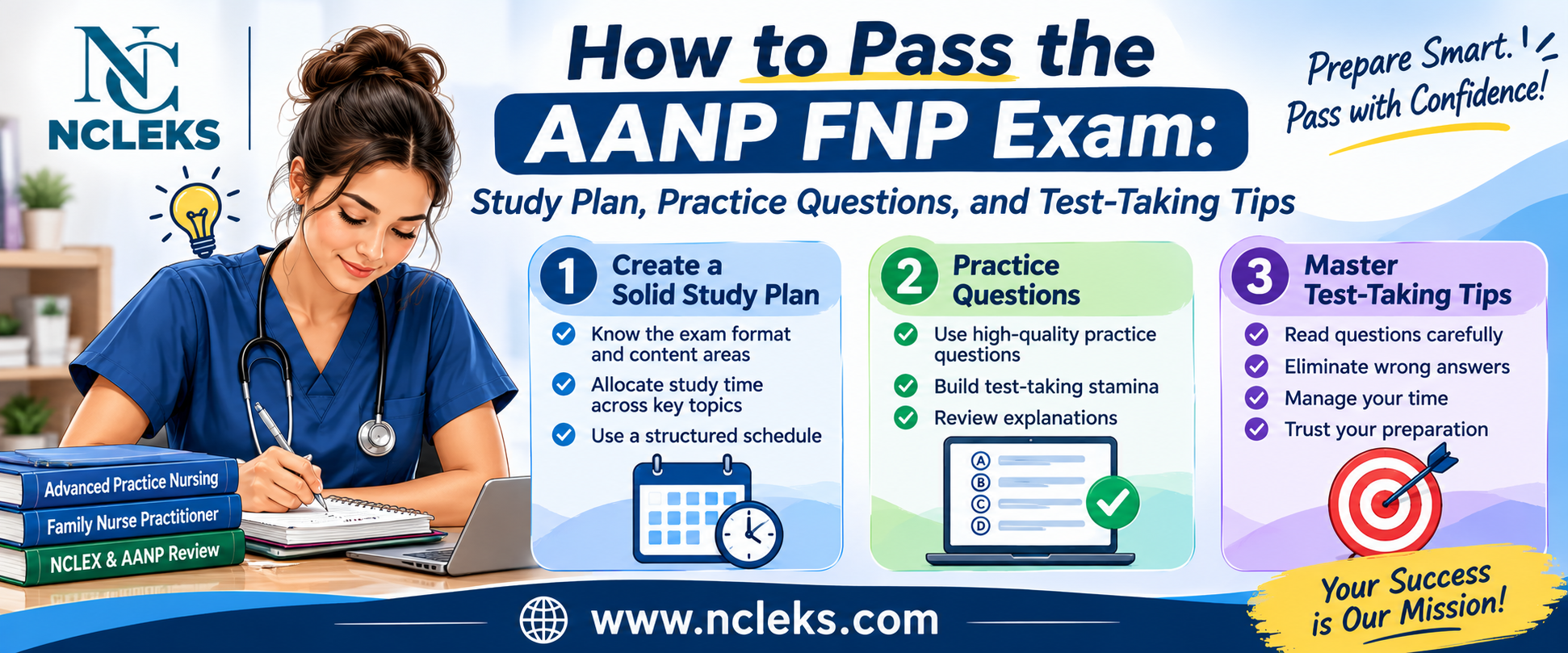
Building a Realistic 8- to 12-Week Study Plan
Most successful candidates study for eight to twelve weeks after graduation, while their coursework is still fresh. Begin with a diagnostic practice exam of 75 to 150 questions. Your goal is not a high score; it is a map of your weak systems. Many students discover that dermatology, musculoskeletal exams, or pediatric milestones pull their scores down far more than cardiology.
Divide your weeks by body system and population. A common approach is to spend the first six weeks on systems such as cardiovascular, respiratory, endocrine, gastrointestinal, renal, neurologic, musculoskeletal, dermatology, and mental health, then dedicate two weeks to pediatrics, women's health, and geriatrics. Reserve the final two to three weeks for mixed practice exams and focused review of missed questions. This mirrors the structure of a structured 30-day NCLEX study plan, just stretched to cover a much wider scope.
Daily time matters less than consistency. Two to four focused hours on weekdays, with a longer practice session on weekends, works well for most people who are also working as RNs. If you need help setting realistic daily targets, the approach in this guide to daily study hours transfers well to board preparation. Pair content review with at least 50 practice questions per day, and keep a written log of every missed concept. That log becomes your most valuable review tool in the final week.

High-Yield Content You Cannot Skip
The AANP exam rewards knowing first-line management according to current national guidelines. Hypertension management based on ACC/AHA recommendations, diabetes care based on ADA Standards of Care, asthma and COPD stepwise therapy based on GINA and GOLD, and lipid management are tested repeatedly. Know which drug class is first-line, what to monitor, and when to escalate therapy. Your undergraduate foundation in insulin types and their onset and peak times is a useful starting point, but now you must also know when to start basal insulin and how to titrate it.
Preventive care is another heavily tested area. Memorize USPSTF screening recommendations for colorectal, breast, cervical, lung, and abdominal aortic aneurysm screening, along with CDC immunization schedules for children and adults. Questions often present a healthy patient at a routine visit and ask what screening is due.
Do not neglect pediatric developmental milestones, normal physical exam variants, and red-flag findings that require referral. Examples include a painless testicular mass, sudden vision loss, or signs of child abuse. Common antibiotic choices for otitis media, strep pharyngitis, urinary tract infections, and community-acquired pneumonia also appear frequently. Reviewing the most common medications tested on the NCLEX can refresh drug classes quickly before you layer on prescribing decisions.
How to Use Practice Questions Effectively
Practice questions are the single best predictor of readiness, but only if you use them correctly. Doing thousands of questions without reviewing rationales builds false confidence. For every question, right or wrong, read the explanation and ask yourself why each distractor was incorrect. If you guessed correctly, treat it as a miss.
AANP questions are usually short clinical vignettes. You will read a patient's age, chief complaint, and a few findings, then choose a diagnosis, test, or treatment. The skill being tested is pattern recognition. Train yourself to identify key details such as age, sex, timing of symptoms, and one or two classic findings. For example, a young woman with fatigue, cold intolerance, and weight gain should immediately trigger hypothyroidism and a TSH order.
Many questions ask for the initial or most appropriate action, which echoes the skill you built when learning the difference between first and best on NCLEX questions. On the FNP exam, the first step is often the least invasive diagnostic test, such as an X-ray before an MRI, unless red flags are present. Lab interpretation also appears regularly, so brush up on how to approach lab value questions and extend that knowledge to CBC patterns, thyroid panels, liver enzymes, and lipid results. Aim for consistent scores of 75 to 80 percent or higher on timed, mixed practice exams before your test date.

Test-Taking Tips for Exam Day
Three hours for 150 questions gives you a little over one minute per item, which is generous if you pace yourself. Check your progress at the 50- and 100-question marks. If you find yourself stuck, choose your best answer, flag the item, and move on. Changing answers without a clear reason, such as a detail you missed, usually lowers scores.
Read the final sentence of each question first, so you know whether you are being asked for a diagnosis, a test, or a treatment. Then read the vignette with that goal in mind. Watch for age-specific clues, because the same symptom can point to very different diagnoses in a toddler versus an older adult. Answer according to textbook guidelines, not your workplace habits. The exam reflects evidence-based standards, and local practice patterns can lead you astray.
When two answers both seem reasonable, choose the one that addresses a potentially life-threatening condition or follows guideline-recommended first-line therapy. Prioritization frameworks still apply here, and the principles in prioritizing with ABCs, Maslow, and safety can help you spot emergent presentations such as chest pain with diaphoresis or a headache with neck stiffness. Get a full night of sleep, eat a real breakfast, and arrive early with the required identification. Testing centers are strict, and a calm start sets the tone for the next three hours.

Knowing When You Are Ready and What Happens If You Do Not Pass
Readiness is not about feeling confident; it is about consistent data. If your timed practice scores have stabilized in the passing range across several full-length exams, and you can explain why wrong answers are wrong, you are likely ready. The signs outlined in how to know when you are truly ready for the NCLEX apply here as well, including steady scores, fewer repeated mistakes, and improved speed.
After you finish, you will typically see a preliminary pass or fail result at the testing center. Official results and your certification follow after AANPCB verification. If you pass, you can move on to state licensure applications, DEA registration, and credentialing with employers and insurers.
If you do not pass, it is not the end of your career. AANPCB generally requires candidates who fail to complete additional continuing education in their weakest domains before retesting and limits how many attempts can be made within a calendar year. Review your score report carefully, since it breaks down performance by domain and shows exactly where to focus. Many nurses who failed the NCLEX once went on to excel, and the same is true for FNP boards. The process of regrouping is similar to what is described in this breakdown of NCLEX retake rules: understand the policy, build a targeted plan, and return stronger. For extra warm-up, the practice exams on NCLEKS can help you sharpen the question-analysis skills that boards demand.



No comments yet. Be the first to comment!