ATI Comprehensive Predictor Exam Explained: What to Expect and How to Prepare to Pass
What Is the ATI Comprehensive Predictor Exam?
If you are in your final semester of nursing school, your program has probably scheduled the ATI Comprehensive Predictor as a capstone exam. This proctored assessment measures how well you have mastered the content tested on the NCLEX. It also estimates your predicted probability of passing the licensure exam on your first attempt. Many programs use it as a progression or graduation requirement, which is why students often feel more pressure about this test than any other ATI exam they have taken.
ATI offers separate versions for registered nursing and practical nursing students. The RN version aligns with the NCLEX-RN test plan, and the PN version aligns with the NCLEX-PN. If you are a practical nursing student, our guide to preparing for the ATI PN Comprehensive Predictor covers the PN-specific details. Both versions share the same purpose. They give you and your faculty an objective snapshot of your NCLEX readiness before you graduate.
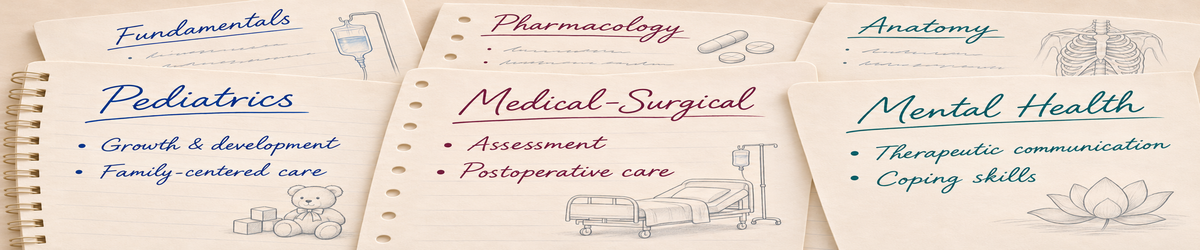
It helps to think of this exam as a diagnostic tool rather than a final judgment. A unit exam tests one course, but this exam pulls from everything you have studied: fundamentals, med-surg, pharmacology, maternity, pediatrics, mental health, leadership, and community health. If your school uses HESI instead, the purpose is similar, and you can compare approaches in our article on passing the HESI Exit Exam on your first attempt. In both cases, the goal is to find your knowledge gaps early enough to close them before the NCLEX.

ATI Comprehensive Predictor Format: Questions, Timing, and Content
The RN version of the ATI Comprehensive Predictor contains 180 questions. Of those, 150 are scored and 30 are unscored pretest items. You typically have 3 hours to finish. You cannot tell which items are pretest questions, so treat every question as if it counts. The PN version follows a similar structure, but your school may set slightly different testing conditions. Confirm the details with your faculty before test day.
Questions are organized around the same client needs categories used on the NCLEX: management of care, safety and infection control, health promotion and maintenance, psychosocial integrity, basic care and comfort, pharmacological and parenteral therapies, reduction of risk potential, and physiological adaptation. Management of care and pharmacology carry significant weight, so they deserve a large share of your study time. Reviewing the 2026 NCLEX-RN test plan is a smart way to see how these categories are weighted.
Expect a mix of item types. Alongside traditional multiple-choice questions, you will see select-all-that-apply, ordered response, hot spot, and dosage calculation items. Recent versions also include Next Generation NCLEX style items, such as matrix, bow-tie, and case study questions that test clinical judgment. If those formats still feel unfamiliar, practice breaking down NextGen NCLEX case study questions step by step. Getting comfortable with these formats builds your NCLEX readiness directly, because the same item types appear on the real licensure exam.

Understanding Your Score and Predicted Probability of Passing
After you submit the ATI Comprehensive Predictor, ATI generates a score report with two numbers that matter most. The first is your adjusted individual total score, which is the percentage of scored items you answered correctly. The second is your predicted probability of passing the NCLEX on your first attempt. ATI calculates this percentage by comparing previous test takers' scores with their actual NCLEX outcomes.
This is where many students get confused. A raw score of around 70 percent may sound low, yet it can translate into a high predicted probability of passing because the exam is intentionally difficult. The score needed for a given probability varies by exam form, so do not compare your percentage with a classmate who took a different version. Focus on the probability figure and on the breakdown by content area.
Most programs set a benchmark, commonly a predicted probability of passing of 90 percent or higher. Some programs accept 85 percent, and others require 95 percent. Check your syllabus carefully. Missing the benchmark may trigger mandatory remediation, a retake, or in some programs a delay in graduation. If that happens to you, our guide on what to do if you fail the nursing school exit exam explains your options calmly and realistically.
The report also breaks down your performance by client needs category and lists specific topics to review. This section is the most useful part of the report. It shows exactly where your knowledge is thin, which makes the rest of your NCLEX readiness work far more efficient.

How to Prepare for the ATI Comprehensive Predictor
Start preparing about four to six weeks before test day. Begin with the online practice assessments your school provides. Take one early to establish a baseline and another closer to the real exam to measure progress. After each practice test, complete the focused review, which ATI builds from the topics you missed. Students who skip this remediation often see little improvement between attempts.
Next, build a realistic daily routine. Two to four focused hours a day is more productive than marathon sessions that leave you exhausted. Our breakdown of how many hours a day to study for a nursing exam can help you set a sustainable schedule. Split your time between content review in your weak areas and timed practice questions. In the final weeks, aim for 75 to 100 questions a day. Read every rationale, including the ones for questions you answered correctly.
Variety in your question bank matters too. Seeing the same questions repeatedly can inflate your confidence without improving your understanding. The NCLEX exams section of NCLEKS offers original NCLEX-style questions and full-length Final Readiness Assessments rather than recalled ATI items. Our explanation of why NCLEKS does not offer word-for-word ATI questions describes why this approach builds real understanding. Prioritize high-yield content such as medication safety, lab values, infection control, delegation, and prioritization. These themes appear repeatedly across the exam, and mastering them raises your predicted probability of passing on test day.

Test-Taking Strategies That Raise Your Score
Content knowledge gets you most of the way, but strategy often separates a borderline result from a comfortable pass. Many questions on the ATI Comprehensive Predictor ask you to identify the priority action or the client to see first. Use the same framework every time. Address airway, breathing, and circulation first, then safety, then Maslow's hierarchy, and finally the nursing process. To sharpen this skill, review how to prioritize NCLEX questions using ABCs, Maslow, and safety, and practice applying it until it becomes automatic.
Select-all-that-apply items cost many students points because they overthink or second-guess themselves. Treat each option as a separate true or false statement about the client in the stem, and judge it on its own. Our article on tackling SATA questions on the NCLEX offers practical techniques that apply directly to this exam.
Pacing is another overlooked factor. With 180 questions in 3 hours, you have about one minute per item. If a question stumps you, make your best choice and move on rather than spending several minutes on it. Good pacing habits also build NCLEX readiness, because time management matters on the licensure exam as well. Read each stem carefully for words like first, priority, best, and further teaching needed, since these words change what the question is asking. Answer based on textbook practice rather than what you saw during clinicals, because the exam rewards ideal standards of care.
After the Exam: Using Your Results to Build NCLEX Readiness
Whether you met the benchmark or fell short, your results give you a roadmap. If your predicted probability of passing is high, celebrate, then keep studying. A strong result reflects your knowledge on one day, and that knowledge fades without review. Use your topic breakdown to keep sharpening weaker areas in the weeks between graduation and your NCLEX appointment.
If you scored below the benchmark, try not to panic. Complete your school's required remediation thoroughly and focus on the content categories where you scored lowest. Pharmacology is a common weak spot, and this NCLEX pharmacology cheat sheet of high-yield drug classes can help you review efficiently. Then retest with fresh practice questions. This confirms that your understanding has improved, not just your memory of specific items.
Remember that the ATI Comprehensive Predictor estimates probability. It does not determine your future. Many students with modest scores pass the NCLEX after focused preparation, and some with high scores struggle because they stopped studying. Track your progress through consistent practice exam performance and honest self-assessment. If you are unsure whether you are prepared, our guide on how to know when you are truly ready for the NCLEX lists clear signs of genuine NCLEX readiness. Treat this exam as one checkpoint on the path, and use what it shows you to walk into the NCLEX confident and prepared.
No comments yet. Be the first to comment!